
Life on Vulcan
It is good to learn stuff about volcanoes.

Hawaii IS volcanoes, being a volcanic archipelago. And I can’t tell you how many times since arriving here on 14 December I have said to myself, Why, Self, are you not a Vulcanologist, instead of an English professor? What a different and exciting life that would have been! Probably quite warm, somewhat unpredictable, and I am gonna guess, full of very nice boots with horribly melted soles.
At any rate, as someone has no doubt already written somewhere, it is never too late to learn about volcanoes, or even to become — wait for it — an Amateur Vulcanologist!
Welcome to “Where No Mangoes: To Live on Vulcan!”
Vulcanologist and Volcanologist are two alternate spellings of the same word, which derives from Vulcanus, the Roman god of fire. Or possibly from Star Trek: The Original Series, the noted home planet of the noted Officer Spock, because as the Romans always say, Tutte le strade portano a Star Trek / All roads lead to Star Trek.
You can see volcanoes from a lot of places all over Hawaii The Big Island, but to be in volcanoes, you want to rent a car and drive to the village of Volcano, which sits at the entrance to Hawai’i Volcanoes National Park.
At the same time, you might also want to sign up for daily email updates about the current volcanic activity from the US Geological Survey, because these are not dead old craters. These are smoking, steaming, earthshaking craters currently full of activity.
Then you can read exciting daily missives like this one:
HAWAIIAN VOLCANO OBSERVATORY DAILY UPDATE
U.S. Geological Survey
Thursday, January 4, 2024, 9:00 AM HST
KILAUEA (VNUM #332010)
19°25’16” N 155°17’13” W, Summit Elev 4091 ft (1247 m)
Current Volcano Alert Level: ADVISORY
Current Aviation Color Code: YELLOW
Activity Summary: Kīlauea volcano is not erupting. [I am adding here a dramatic “However:” ] Unrest may continue to wax and wane with fluctuating input of magma to the area, and eruptive activity could occur in the near future with little or no warning.
The volcano Kilauea, which last erupted here on 18 September 2023, and which in 2018 melted much of the island’s south-eastern district of Puna, and about which every Park Ranger I encountered noted solemnly, could erupt at any time now. There have been hundreds of micro-earthquakes this week, also known as “swarms of increased seismic activity,” and according to the Rangers, the magma is piled high right underneath the current caldera base. It will either subside goo-ily somewhere inside our planet, or it will erupt.
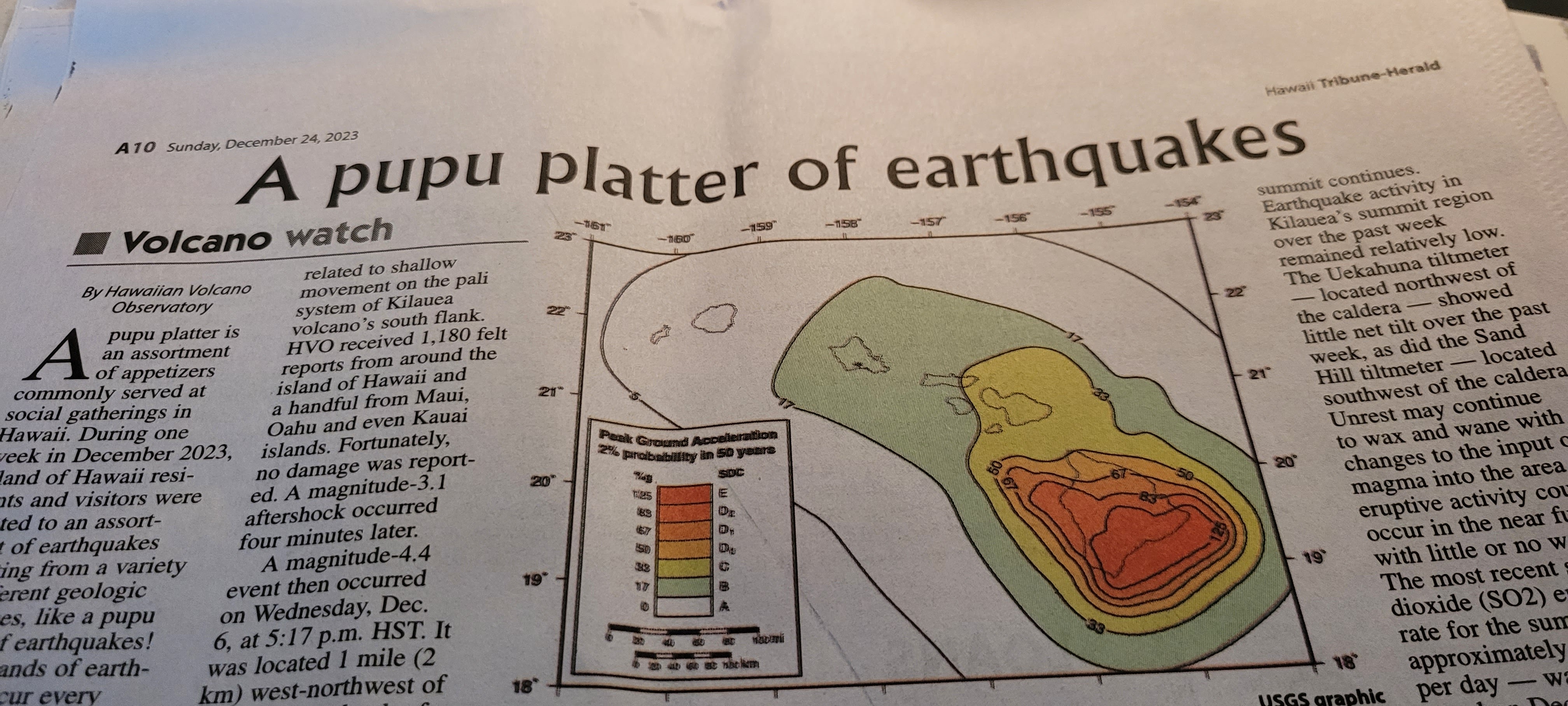
Didja notice my vocabulary there? I looked at, drove up, drove down, and walked around volcanoes for 4 days in Volcano, and now I can speak some actual Vulcan. Sulphur Gas. Lava. Downwind Hazardous Rockfall.
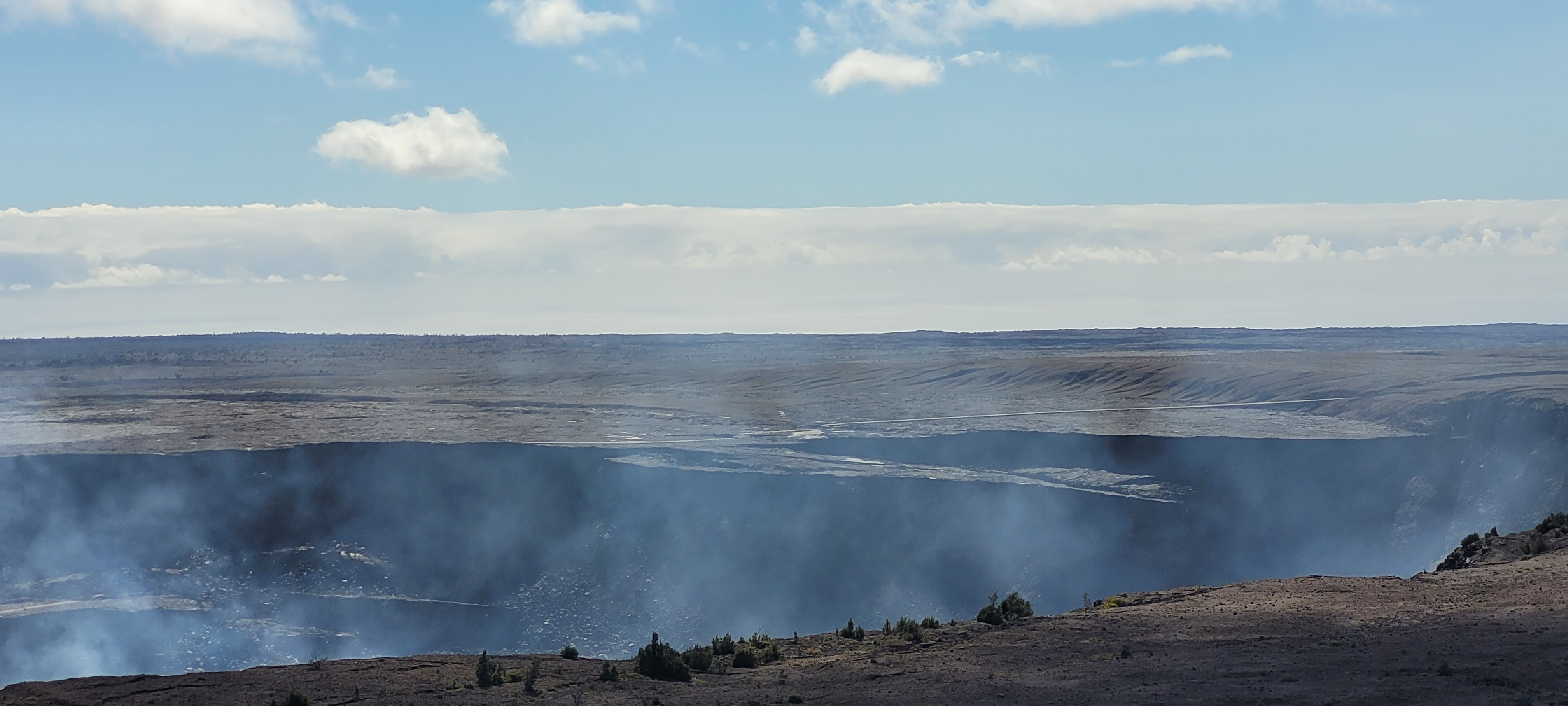
You pay your $30 entrance fee to Volcanoes National Park, and you can visit for a week. You will need a few days to see everything. (Unless some of it happens to be exploding, in which case the cool-headed expert advice from the experienced Park Rangers was uniformly: “Run in the opposite direction.”)
You can take a cruise up some 6600 feet towards the peak of Mauna Loa volcano. It is a winding, narrowing drive through forest and then along desert and dried-black lava flows.
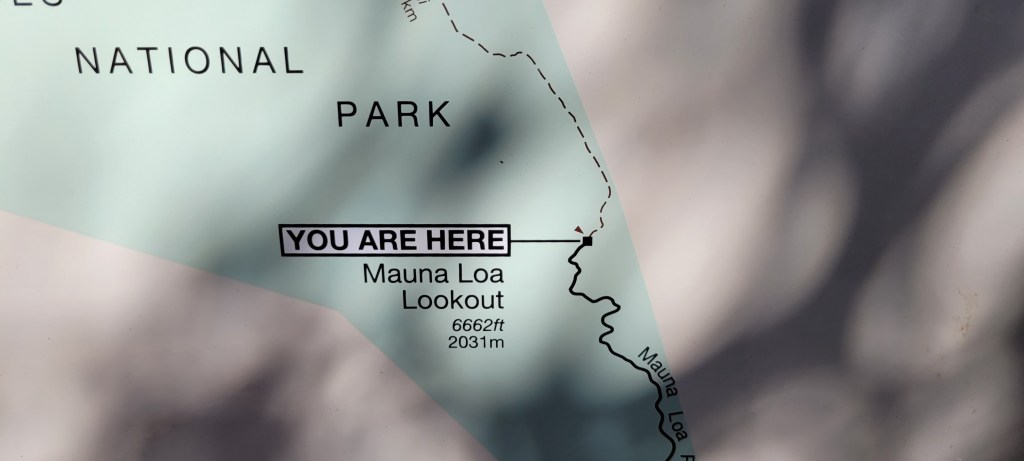

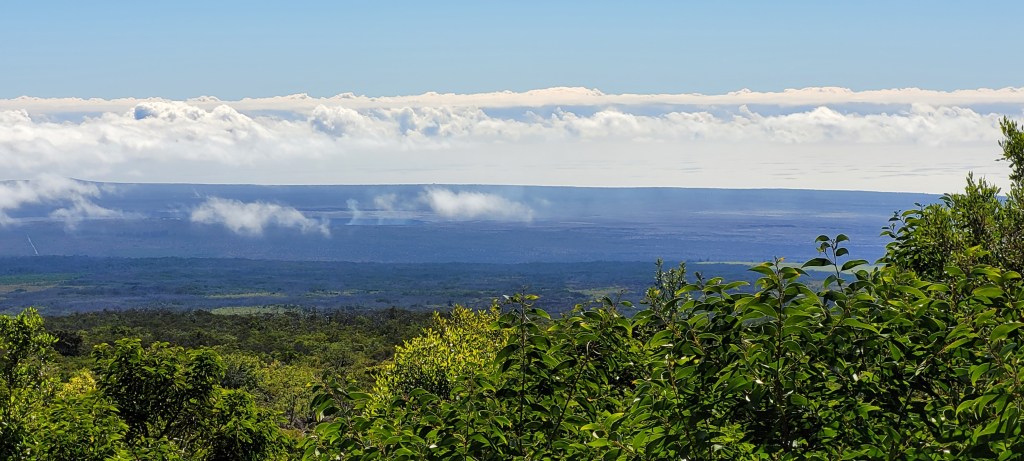
At the end of the road up Mauna Loa, you are looking out to the steam rising from the nearby caldera of Kilauea. From one volcano to another.

I was not so inclined.
In Volcanoes National Park you can drive the two segments of the Craters Road, going West to stand and peer into the earthquakey, steaming pit of Kilauea:
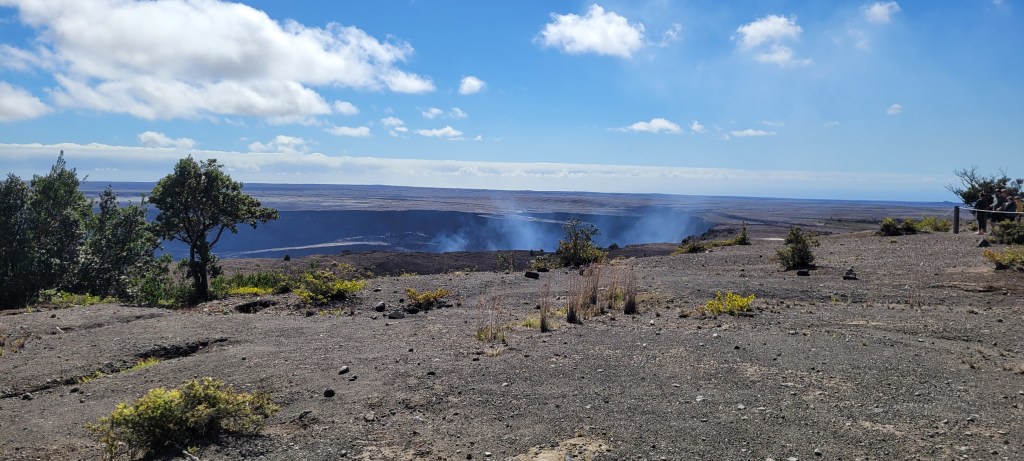
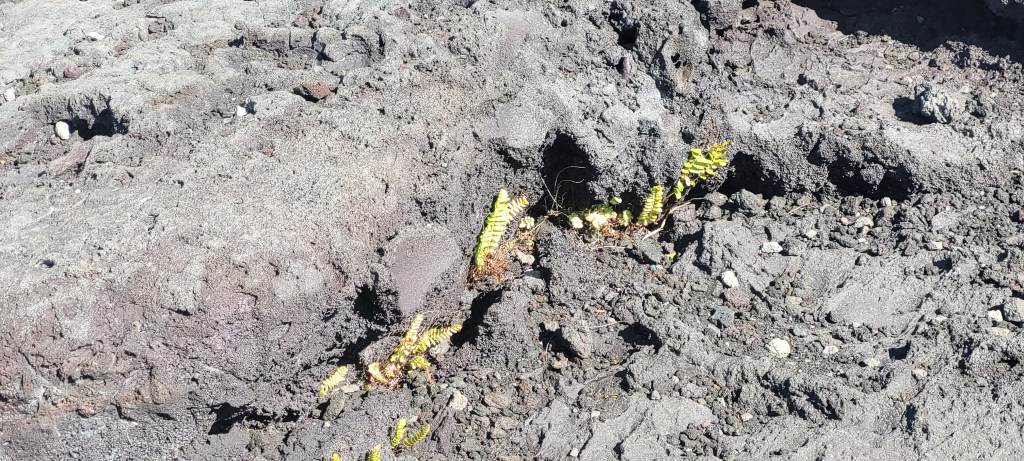
and then East to stand by craters, on vast recently-created lava fields, and on a landscape dramatically scarred by dark swathes of volcanic rock:
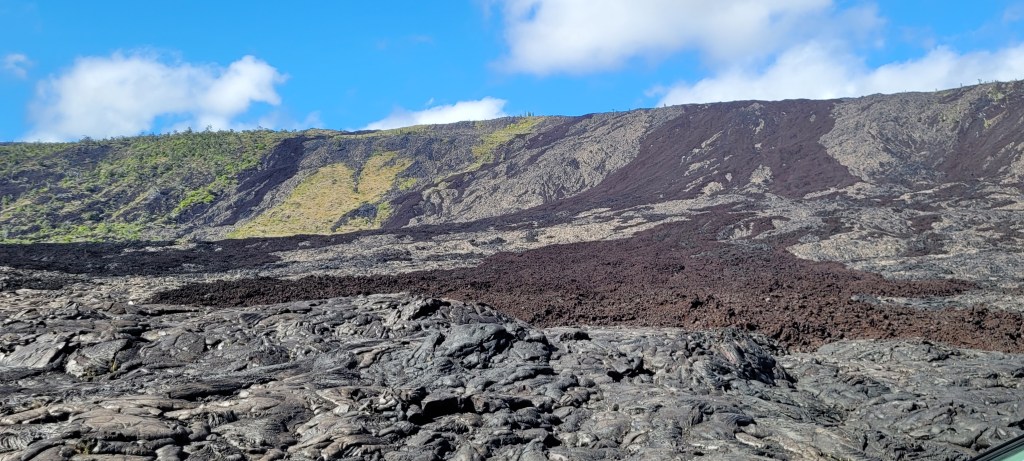


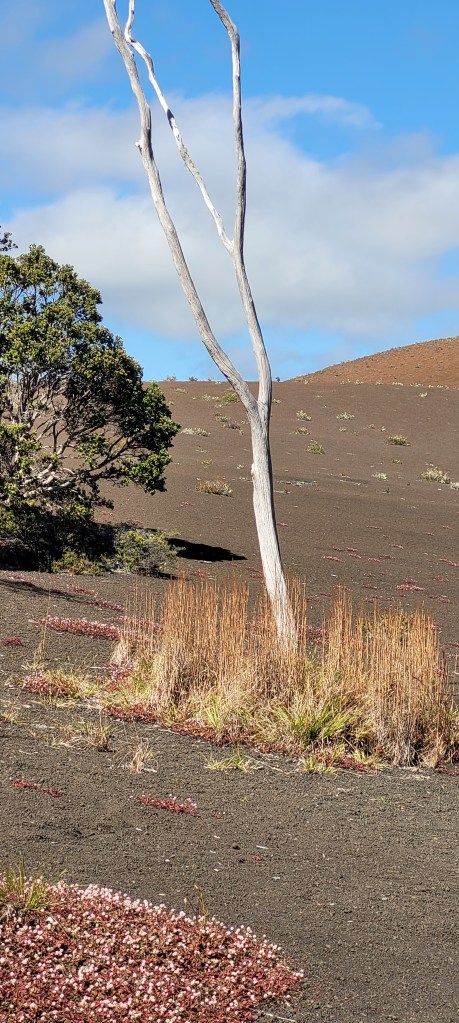
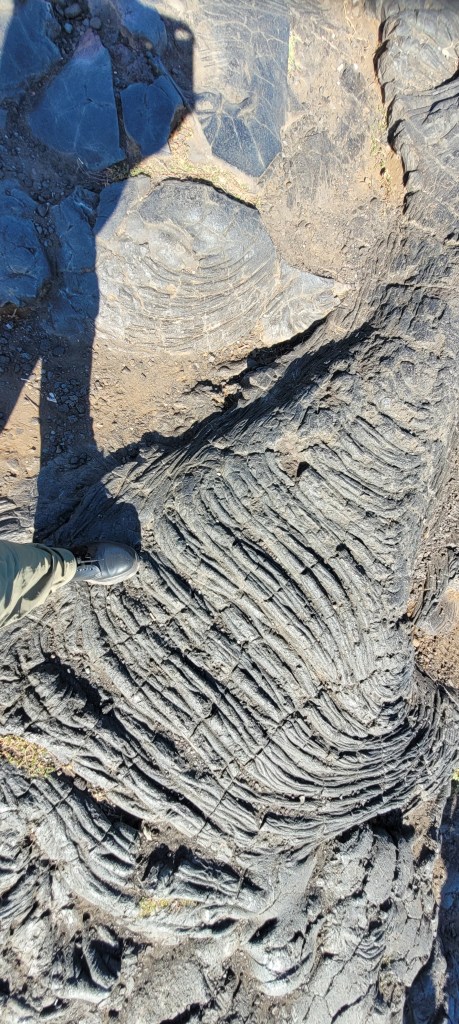

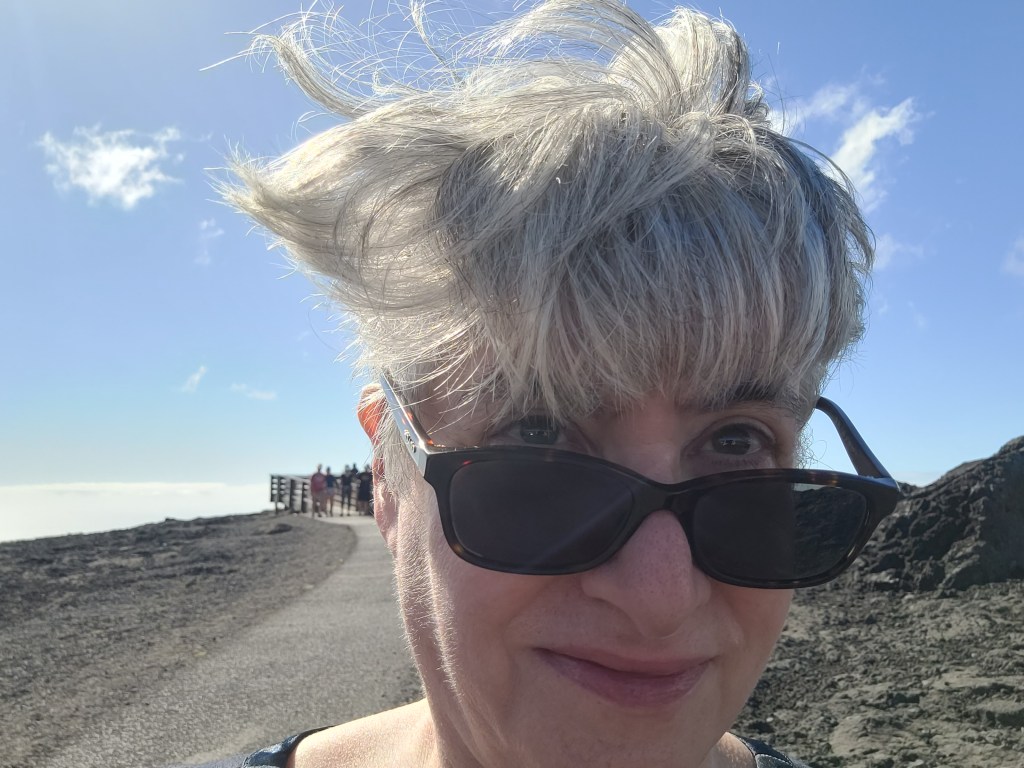
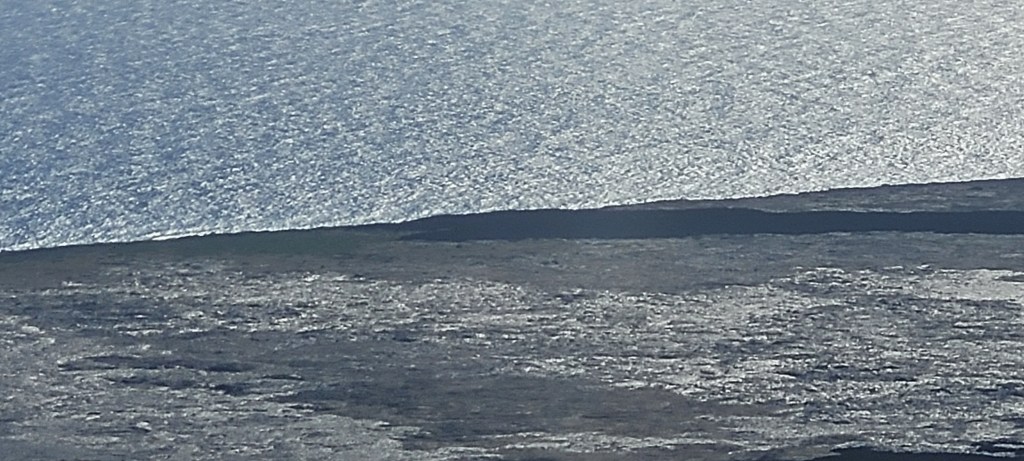
One can spend hours on the East Crater Drive. There are dozens of pull-offs for views, and for side-hikes one can stop to do, like the one through Desolation, an empty lava-blasted landscape. Or one can just stand in the silence and wind and experience true awe at the power of nature to destroy land, and then create more by spilling fire into the sea and extending the island by hundreds of acres.
The Hawaiians of course have a word for this:
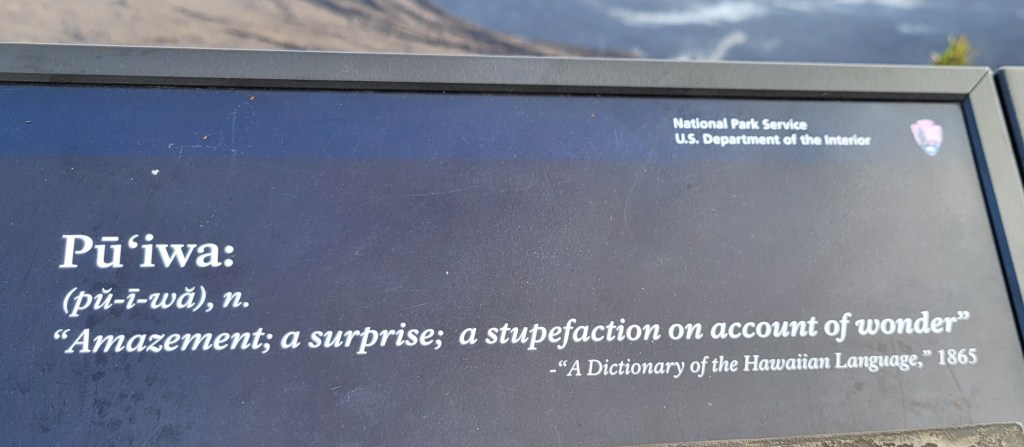
Pu’iwa! “A stupefaction on account of wonder!” Now that is a really good word. (And it happens to be the same word in Vulcan.)
It can be hard to recover from an intense state of wonderous stupefaction. One might need to take the rest of the day off from Amateur Vulcanology and go knock back a few nice cold seltzer waters. But the next day, which perhaps is New Year’s Eve, you can drive to the Saddle Road, which is not in the park but begins near Hilo, to drive up the Mauna Kea volcano, which is taller than Mauna Loa when measured above sea level, but somehow a slightly shorter volcano than Mauna Loa when measured from the sea bottom. So Mauna Kea is taller if you do not measure from the bottom? Let’s just agree with the earnest Park Ranger, and move on.
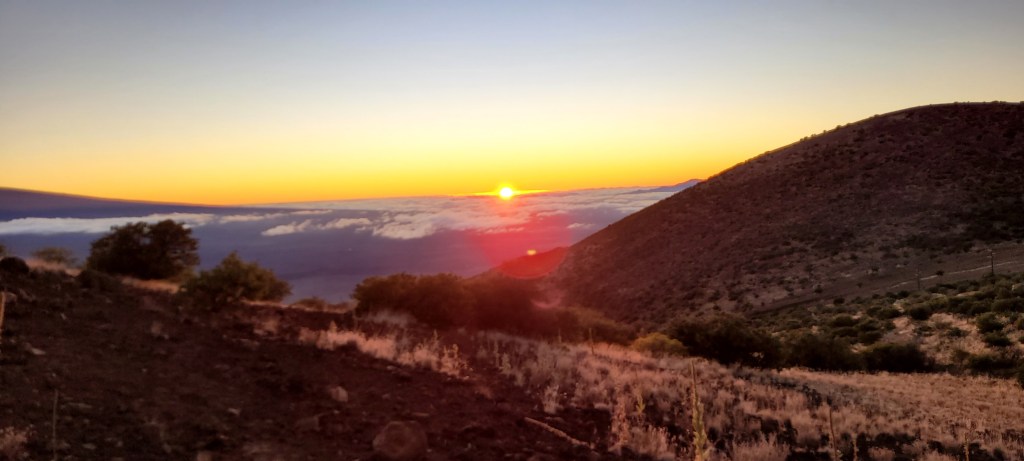
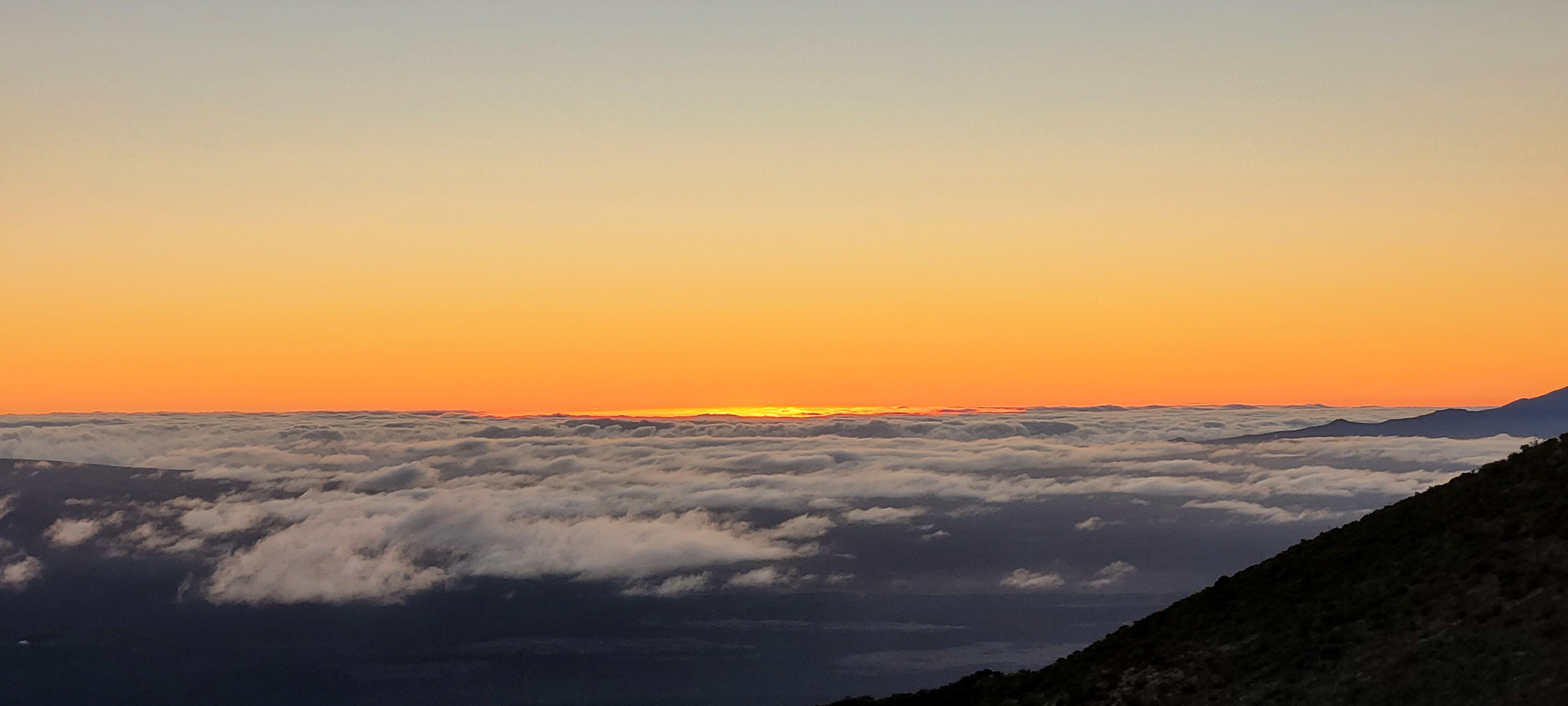

You can park your car at 9200 feet on the Mauna Kea volcano at the Visitors’ Center, acclimate to the altitude a bit, say hello to the high-altitude Park Rangers up there, put on a warm jacket, and go watch the sun set into the clouds below.


You can also watch people at the base of the next segment of road going further up assure the Park Rangers that the car they rented two days ago definitely does have all-wheel-drive, at least half a tank of gas, and functional if not stellar brakes, and that they should be cleared to start the nutso, perilous ascent to the Mauna Kea summit to see the telescopes at the Mauna Kea Observatory, and all the snow up there.
Yes, I wrote “nutso!” Who comes to Hawaii to see snow?
It is apparently a white-knuckle ascent (and then descent) on gravel, with switchbacks, steep climbs, and at some points, no guard rail. And once atop, one can’t look inside any of the telescope buildings up there, because those are not for Amateur Vulcanologists. They are the domain of Professional Astrophysicists only.
A high-altitude Park Ranger, slipping momentarily from the mandatory Park Ranger demeanor of solemnity into one which sounded suspiciously of borderline snark, told me at the base of that road that on occasion, people return from the 13,800-foot summit with their brakes on fire.
So instead of inviting the potential voiding of one’s rental car warranty to go look at the snowy exteriors of buildings housing telescopes, one can instead hang around for an hour after sunset to attend a talk about the night sky with a Park Ranger who is extremely well versed in astronomy, and who packs a very powerful laser for pointing out stars, planets, galaxies, and nebulas. We also got a tutorial in night-sky photography with a cell phone. Here are some of my 2023 New Year’s Eve Dark Sky pictures.


Apparently my Android phone is particularly good at recording images of space dust and gas. And space, I now know, is full of all colors of dust and gas.

We learned how to do time-lapse pictures. Lacking a tripod, I employed the “Lean on a Pole And Later One’s Car” technique for staying still while taking long-exposure pictures. Also, I did not breathe.
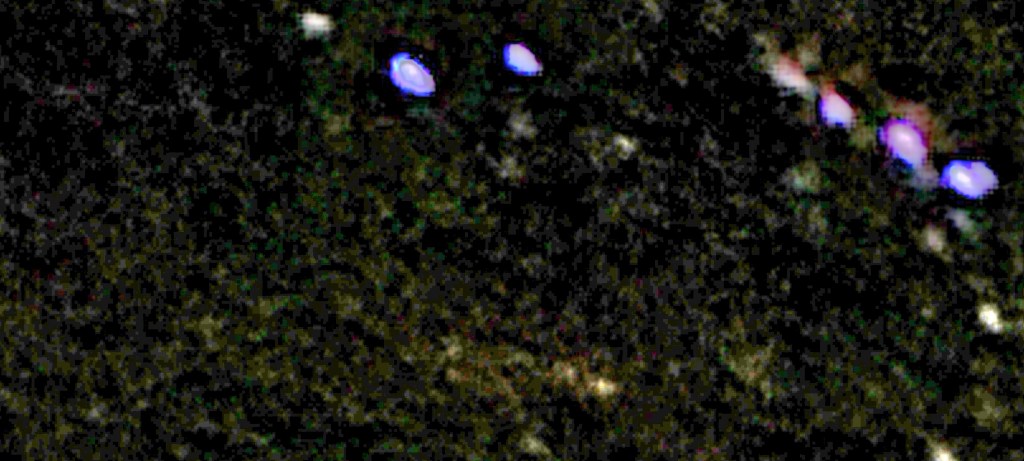


Not bad for an Amateur Vulcanologist.
Happy New Year, Everybody!


Leave a Reply