
Satire: Mimesis, Nemesis
OR
Some Writing About Writing About Satire
Have any of you ever come across Spalding Gray’s one-man performance piece, Monster in a Box, from around 1990? Spalding Gray was an American writer and performer, and sometime in the 1980s he started to work on his first novel, based on a promising and exciting idea. The manuscript for the book got longer and longer, and he took to carrying it around with him so he could continue to work on it whenever inspiration hit. And because he dealt with the frequent upsurge of his particular brand of writer’s block, the writing became a completely unpredictable process.
The novel, titled Impossible Vacation, expanded eventually to 400 pages, and still he carried it, now in a larger briefcase, all 600 pages, then 800 pages. At some point he put it in a box for more convenient transport.
Gray was of course concerned that he might not ever finish this grand work. But since he based his performance monologues on his own life experiences, he then started working on a performance monologue about the giant unfinished novel, which he now referred to as the Monster in a Box. At this point he was carrying around both the original weighty Monster in a Box, because inspiration still might arrive at any time, and the evolving notes for the future performance monologue, now also called Monster in a Box.
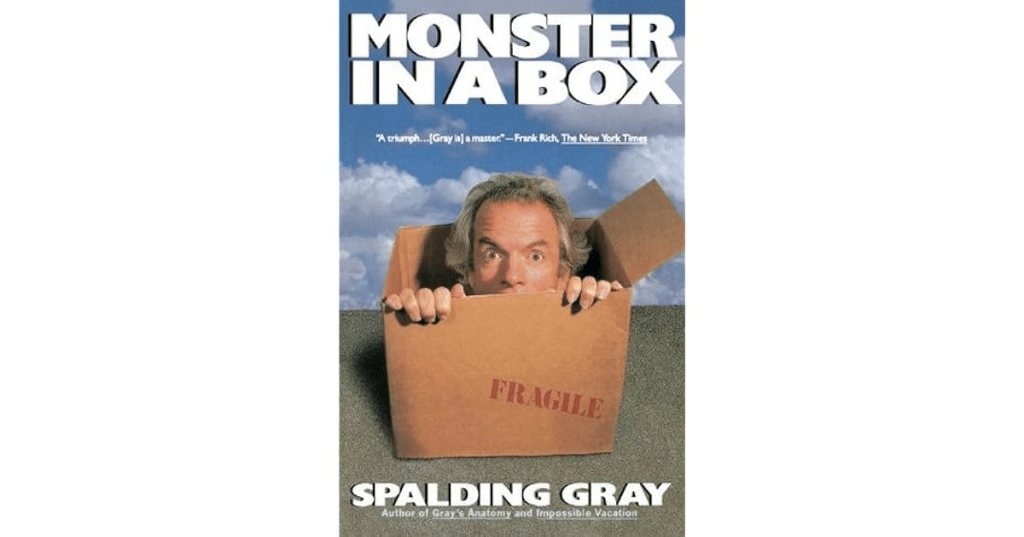

Publicity for Spalding Gray’s show, Monster In A Box.
I got to see this performance piece, back in London in around 1991 at a smallish theater in Hammersmith. I’d already been there to see Gray perform an earlier staged monologue, Swimming to Cambodia, in maybe 1989, about his experience of filming a role in The Killing Fields, a film about the Cambodian genocide. At this point I was an enthusiastic fan of his work.
That earlier piece, Swimming to Cambodia, had been quite a critical success, with a long run in New York City before a tour. For each of his performances, Spalding Gray sat at a table and talked to the audience, occasionally looking at notes set in front of him: a classic storyteller who kept his audience enthralled by his vocal dexterity, the relentless forward drive of the exciting narrative, and the many dramatic sidelines and anecdotes which each managed surprisingly to rejoin the main thread in clever ways. It was both very basic and very heightened performance.

And Spalding Gray’s work did have elements of satire. He seemed to have a natural tendency to see the ridiculous in situations and people he encountered, and he spared no vitriol whether it was the Hollywood film industry or his own parents. He delivered these attacks with a signature buoyant and exhilarated style.
The show, Monster in a Box, has stayed with me for decades. It was just Gray at his table, with his notes, a glass of water, and his main prop: the substantial Box sitting on the table, containing the actual Monster. In talking about dragging his manuscript practically around the world with him for years, I thought that he hit on a very universal theme.
Maybe we each have some version of The Monster which we drag around with us, or for which we maintain a totally unrealistic hope that someday a flash of shimmering insight will hit us, and we’ll see our way forward to the thing’s logical and meaningful end. It could be a distant career goal, or creating a majestic work of art, or some large-scale life plan.
Maybe we come across a pile of our saved papers occasionally, which we were hanging onto for when we got to work on that Thing.
Maybe it’s a notebook with a started symphony, a pad with half-finished poems, or sketches for a complete graphic novel. Or some notes for an essay about satire.
Welcome to “Satire: Mimesis, Nemesis” or “My Monster in a Box.”
This is my unfinished idea for a piece of writing about an aspect of satire which I have worked on for over 15 years. I think it is about the ways that satire has to establish both a clear and obvious connection with our actual world, the familiar and recognizable world we live in, and at the same time set itself up as the corrosive enemy of that world, spewing critique and undermining our assumptions. A dynamic model, in other words, of both mirroring and attacking. Since I have never completed this essay, I am not entirely sure where it ends or what conclusions it makes.
But isn’t that a great idea to explore? And: that title! The words almost rhyme, displaying both assonance, similar vowel sounds, and consonance, similar consonant sounds. This feature, to me, disarms them of their odd foreignness as fairly obscure terms of literary criticism with names in Greek: Mim-ee-sis, Nem-ih-sis.
Let’s begin with that title, because for a long time, that title was all I had.
But it is such a great title! Satire, the obvious focus of the piece. Clearly, this going to be a written piece about satire. And I am grounded in reality just enough to acknowledge that no one is going to willingly pay for a ticket to sit through a staged monologue on “Aspects of Satire, With Two Unfamiliar Greek Words in The Title,” so I never envisioned that “Satire: Mimesis, Nemesis” was going to end up as anything like a staged performance piece, read aloud to an audience in public. I thought that surely this will end up as an academic essay in an obscure academic journal, and in the course of several years after publication eventually seven or so people will come across it and give it a quick skim. (Same as everything else I have ever published.)
The next word in the title is Mimesis, and this comes partly from an impressive academic book written during WWII by a German literary scholar named Erich Auerbach. The book is called Mimesis: The Representation of Reality in Western Literature. Auerbach, a Jewish professor of literature, wrote it during his exile from Germany during World War II. He was forced by the Nazis to leave his teaching job at a German university in 1935, but managed to get to Turkey and teach at a university in Istanbul for the duration of the war. His book is about how significant works of literature manage to be both fictional narrative and to reflect really well our own experiences of the lived world.


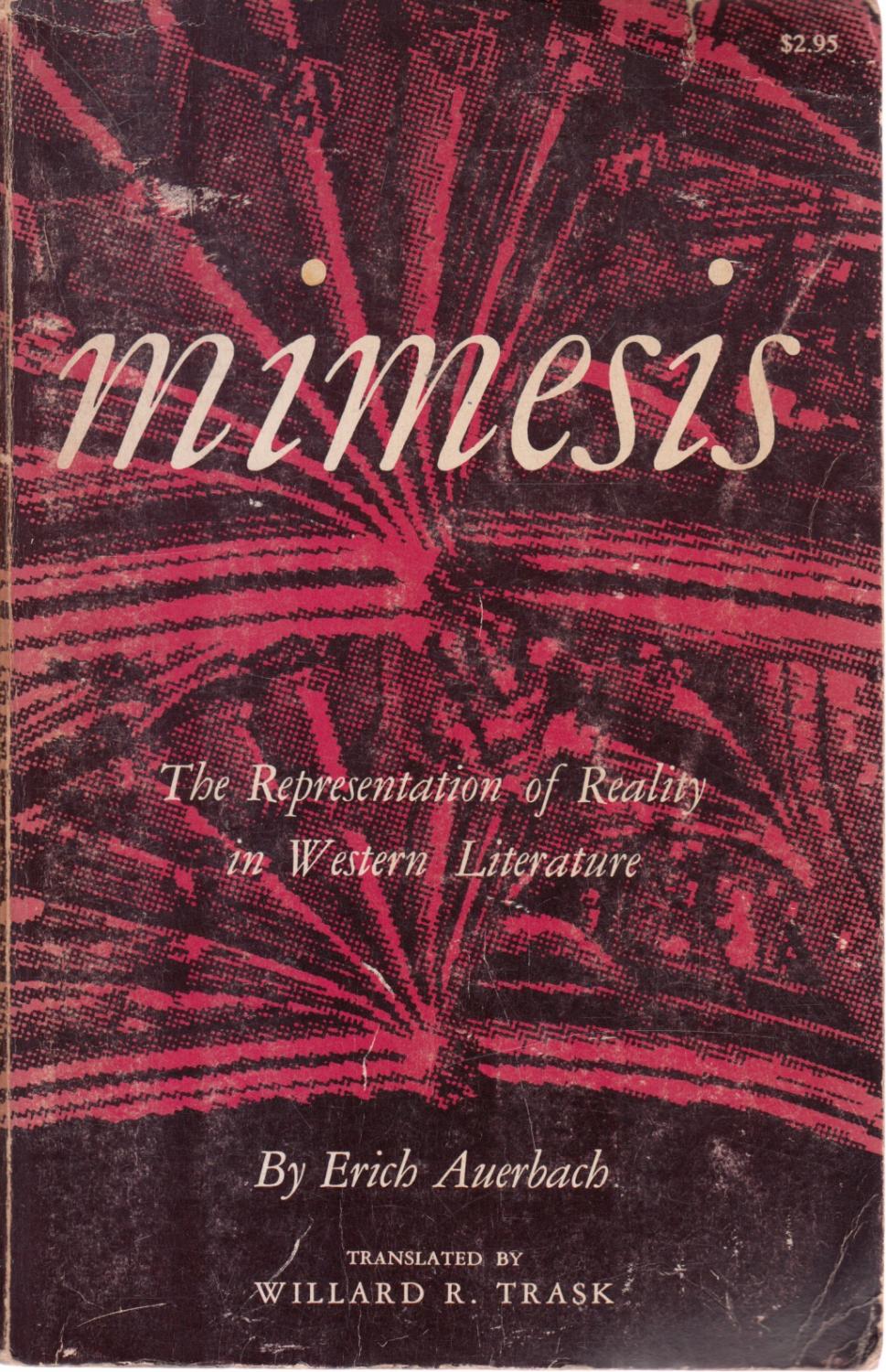

There are many editions of Professor Erich Auerbach’s book.
Literature in this way, explained Auerbach, works as a sort of mirror of our own world. Mimesis is, of course, a much older Greek word, and it appears in work by Plato, Aristotle, and others, but Auerbach was covering new ground in applying it to a wide range of literature. Mimesis means “imitation.” It has roots in the words for “mime” and “mimic.” One can talk about mimetic behavior, for example, when one group mimics the traits or ways of another. But I am leaning into Auerbach’s particular use of the word, because he was thinking of it specifically in literary terms: how mimesis is used in fictional stories, narratives, and novels. He was considering how writers employ imitation of the world around them in ways that make that “world” which appears in the story recognizable and familiar, even though it is the product of a writer’s own imagination.
A fascinating aspect of Auerbach’s Mimesis is that he wrote it with limited access to library resources, so even though it is a thoughtful and deeply scholarly work, it is almost entirely without references to any additional books about literature or history. Auerbach simply lined up the great books he wanted to write about, which he knew quite well, and launched each chapter, in which he examined in an individual book or story its conflict of a recognizable reality mirrored in an invented fiction. Or: its simultaneous degrees of realness and fakeness. He began with Homer’s Odyssey, and continued through 19 more books up to Virginia Woolf’s To The Lighthouse (1927), and he charts how writers working through the centuries present increasingly natural and even democratic versions of our world in literary works.
Nemesis means enemy, and is actually the name of the Greek goddess of retribution. Nemesis the Goddess doles out rewards for fair behavior, and punishment for treachery, always taking her time to decide when to strike. These days we tend to assign a meaning of vengeful retribution when we use the word. Although I first came across it in a piece of academic work, the word shows up in many places, to describe plagues like mosquitoes in the summer, and the arch-rivals of comic book superheroes. I suppose one can’t really be a superhero without a formidable nemesis.
And there we have it: a really promising title! Which for a very long time was all I had for this piece, but I was still 100% sure that it would be a really great essay, when it eventually got, you know, written.
Starting With A Title
Here I’d like to pause and point out something that I want absolutely no one to take away from this essay: that starting with a title is a good idea. I have chosen to work this way an embarrassing number of times, both for written work and for papers read aloud at conferences. And I do not recommend it. But I get fixated on clever phrases, like a kid in a candy store. Oooo, a crunchy Pun! Is that a sugary Rhyme? And there I remain, completely unwilling to let go.
So I can’t emphasize enough that starting with a clever, funny, interesting, out-there, or whatever title is a truly terrible idea. Don’t do it. I did it recently with “Joanne Kyger’s Desecheo Notebook and the Beat Veneration,” an essay I contributed to a book of many essays about poet Joanne Kyger, because I fell in love with that wonderful pun I came up with on the “Beat Generation.” Joanne Kyger was a poet affiliated with the Beat Generation writers of the mid-20th century. And the pun started as a typo in a text I sent, because the letters G and V are pretty close on the tiny phone keyboard. There it was, Beat Veneration, and there I was, in the candy store, thinking, “Oooo, that looks really good.”
And then I spent many months laboriously shaping my narrative to fit the title, gathering the information that would enable me to make my written case that Kyger incorporated into her writing a sense of conflict, because people so revered the writers of the Beat Generation: Jack Kerouac, Allen Ginsberg, Michael McClure, William S. Burroughs, and so on. I did get there eventually, and I completed the essay, but I really cannot recommend this as a smart way to work. It is not a logical way to approach anything. As the late blogger Heather Armstrong of Dooce memorably wrote: “Be ye not so stupid.”
I Am That Stupid
So not only did I fall for a title, “Satire: Mimesis, Nemesis,” and then decide to devote myself to crafting a piece of writing that would fit it, the endeavor proved so challenging that I kept amassing more material and notes until I had my very own Monster in a Box.
Since the era had shifted from typed manuscripts to digital files, my Monster was never a massive printed manuscript that I carried around. My Monster was instead an expanding collection of magazine-box files of printed articles and chapters I planned on referring to, kept on a shelf and occasionally dusted, and also a computer file called “Satire: Mimesis, Nemesis” which appeared on each subsequent computer I used for work and at home. My Monster wasn’t too heavy, but I carried it nonetheless. Occasionally I would print a copy of the pages I had written so far, and then I’d carry those around for a while. At some point I’d do some actual new writing of the thing, and then I could shred that copy of the older version, and print the latest one, and go dust my shelf full of file boxes of printed articles.


Magazine boxes are perfect for constructing one’s very own Monster.
I also had a stack of borrowed books from my university library, which I had read parts of and which I wanted to finish reading, and then refer to in my essay. In the early days, I would remember to renew this stack of books, and avoid accruing any late fines at the library. But then I reached a point where the stack of books had sat on the shelf next to my desk for so long that I sort of stopped noticing them. I definitely stopped renewing them. I ignored them completely until an email reached me one day, years into this project, stating that the books were so overdue they were assumed to be lost, and I now owed the library $1200 to replace them.
That certainly got my attention. There was the huge amount of money to replace books that were still sitting by my desk, but also the impending threat that my borrowing privileges would be cut off if I did not immediately pay the fine. That meant I could not continue to amass more articles and chapters for my on-going project, or anything else I was working on at the moment. (I did, during this extended period of time, complete and publish an entire book on satire, as well as a few other essays, so I had several on-going projects requiring the fairly constant acquisition of new research material.)



Public-domain images of a stack of books, meant to conjure the idea of “A Stack of Books.”
The only option seemed to be to confess and come clean. Surely the library officials couldn’t charge me $1200 to replace lost books if I showed them the physical evidence that the books were not in fact lost. So I packed my entire stack of books into a giant shopping bag, and drove to the library, where I asked immediately to see the Overdue Books Police Chief Librarian, and announced that I was turning myself in.
The resolution was satisfactory. After my explanation, and the presentation of the books in question, the Overdue Books Police Chief Librarian said that he could waive the late fees completely, since the books were now being returned.
“Returned?” I asked with bafflement.
“Why yes,” replied the Overdue Books Police Chief Librarian. “You are returning the books.”
“But I’m not done with them!” I exclaimed.
The Overdue Books Police Chief Librarian regarded me with a sort of calm version of the way we will all probably look at the aliens when they eventually arrive on our planet. It was a tame Librarian version of utter disbelief.
“Okay,” he said slowly. “I suppose we can renew them.”
Then he explained in detail how one should go about renewing books. This was actually quite educational, as the library had developed an entire online system for quickly renewing borrowed items since the last time I’d even had a vague thought about renewing anything. It seems there was now a site one could go to, click a few boxes (in this case, ten for the ten books I had) and Ta-dah! One had renewed one’s borrowed items for another academic year.
One reason I had all of these books for so long is that no one else requested them. I would have been prompted to return them if someone had, but for years on end, no one did. That sort of gave me a sense that I was alone in this particular obscure corner of contemplation. Alone, with my boxes of articles and my stack of books. One very good book was by Walter J. Ong, a Jesuit priest born in 1912, who was also a hugely productive scholar of literature, history, culture, theology, sociology, and psychology. He taught and wrote for decades, happy to connect the field of English literature to many other areas in the liberal arts, as that reflected the huge span of his intellectual interests across many fields. His students apparently appreciated this intriguing cross-disciplinary approach so much that they referred to all of Dr. Ong’s offerings as “Onglish Courses” to reflect this. I had a copy of his very interesting book, Orality and Literacy: The Technologizing of the Word (1982), which looks at how culture has been impacted over a long span of time as human communication methods developed.
Several of the books in the stack were written by scholars studying classical-era Greek and Roman writers, and their uses of mimesis. One was by D. M. Hooley and was called The Knotted Thong: Structures of Mimesis in Persius (1998). Hooley’s book is a very interesting consideration of mimetic aspects of the satires of the Roman writer, Persius, proposing that his imitation of earlier writers, particularly the satirist Horace, could be seen as deliberate and insightful rather than just immature, mimicking, fan-boy echoes.
On a side note, I don’t really understand why Dr. Hooley chose that title, but I hope it is not his version of being a kid in the candy store of possible titles. In other words, I sincerely hope The Knotted Thong was not Dr. Hooley’s Monster In A Box.
To wrap up the Library part of this saga, I will share with some degree of pride that I needed to avoid a four-figure university library overdue penalty fee only one subsequent time. It was an episode remarkably identical to the first, featuring the exact same stack of books, except that there was now a different Overdue Books Police Chief Librarian at the university library, one who had no memory or information regarding the first time charges were brought against me. I managed a decent demonstration of gratitude at being introduced (again) to the online method of book renewal, and I returned home once more with my large shopping bag of books to stack carefully on the shelf next to my desk.
Spalding Gray did actually manage to complete his novel – sort of. The first half of it, 272 pages, was published as a novel in 1992, but the second part had yet to be published when he vanished one day in early January 2004 from the Staten Island ferry he’d boarded, and which he was no longer on when it arrived and docked. It was presumed that Spalding Gray had gone overboard voluntarily, beset by unresolved mental health issues for some time. His body was found several months later, and so the whole of his Monster remains unpublished.
In Which I Decide To Finally Drop My Monster
It is definitely time for me to let this Monster out of its Box.
I’m ready. I hope my future readers are ready. And I have decided that the right place is in one of the chapters of the satire book I am working on now. Let’s hope all that extended cogitation on my part has led to some intriguing observations, or at the very least, an intriguing observation.
And let us hope that with that truly fine title to settle under, my Monster can subside peacefully into some tame, logical, enjoyable, and entertaining words.
————– ———— ————- —————–


Leave a Reply