
A warm “Yo!” from Kyoto! Or: Let’s get caught up on all the latest developments, shall we?
I have been in Japan now for just over a month, and most days feature some exciting new discovery.



Classes began six days after I landed here, so the summer semester is now in full swing, with students and draft essays and deadlines and dramatic requests for extensions — the usual.
I’ve also learned the route to walk to campus, bus routes which drop me near the campus, a bus route that is very nice but which takes me nowhere near the campus, how to take the subway and trains, places to shop for housewares and food, where the Fushimi ward post office is and which door actually leads to it and not to the bank, about the organic farm shop nearby which sells discount bunches of flowers, and that my debit card will sadly not work to get me a cold drink from the ubiquitous cold drink machines located on every city block no matter how pathetic I look.
There is a lot to learn when landing in a new country for an extended stay. It’s a very twisty learning curve.
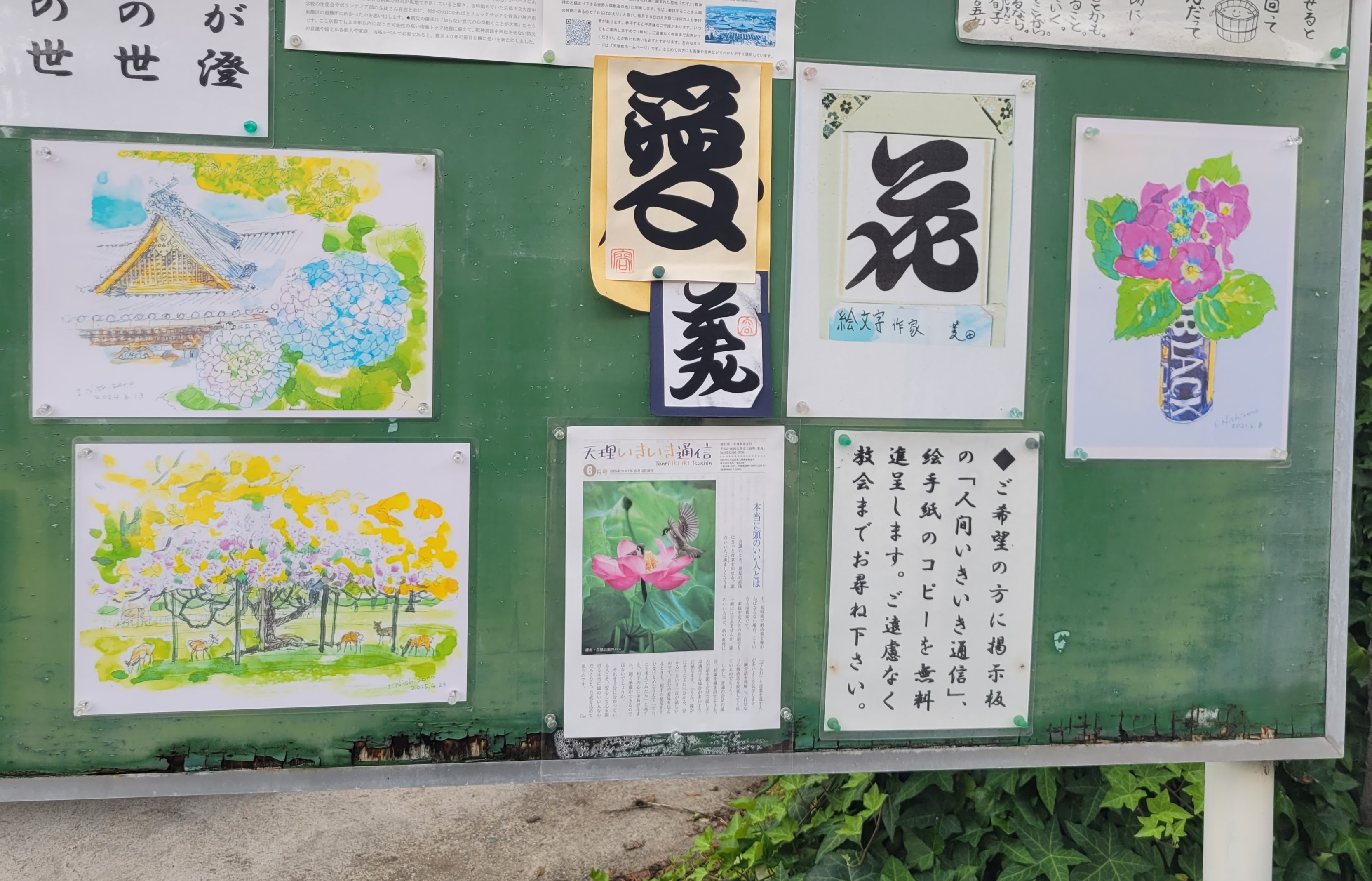


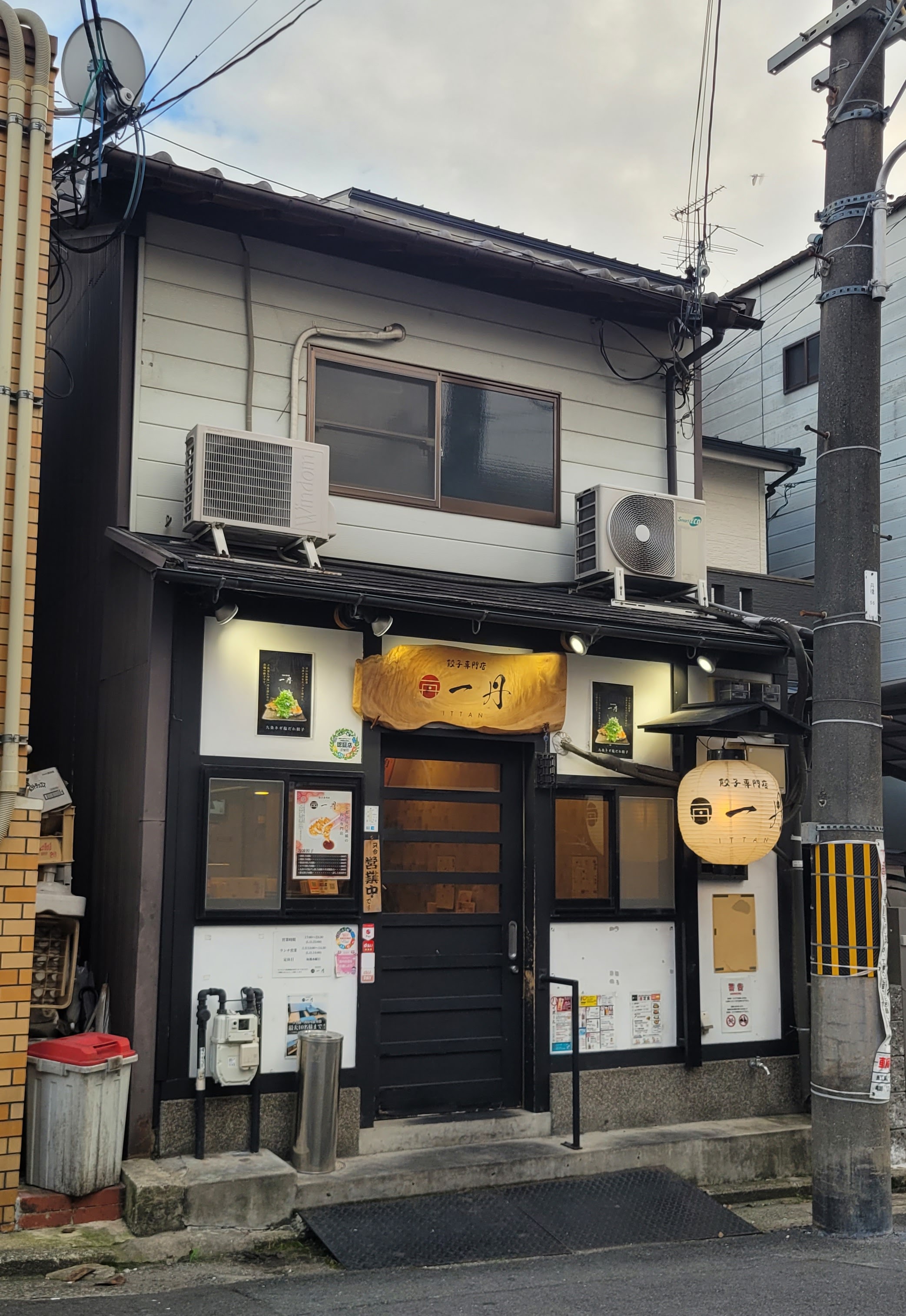
Just walking around the streets of Kyoto amazes me, and I end up taking bunches of photos, or just doing a lot of staring. Here is what typical streets look like. There are wide ones, but most are narrow like these with lots of small houses and shops.
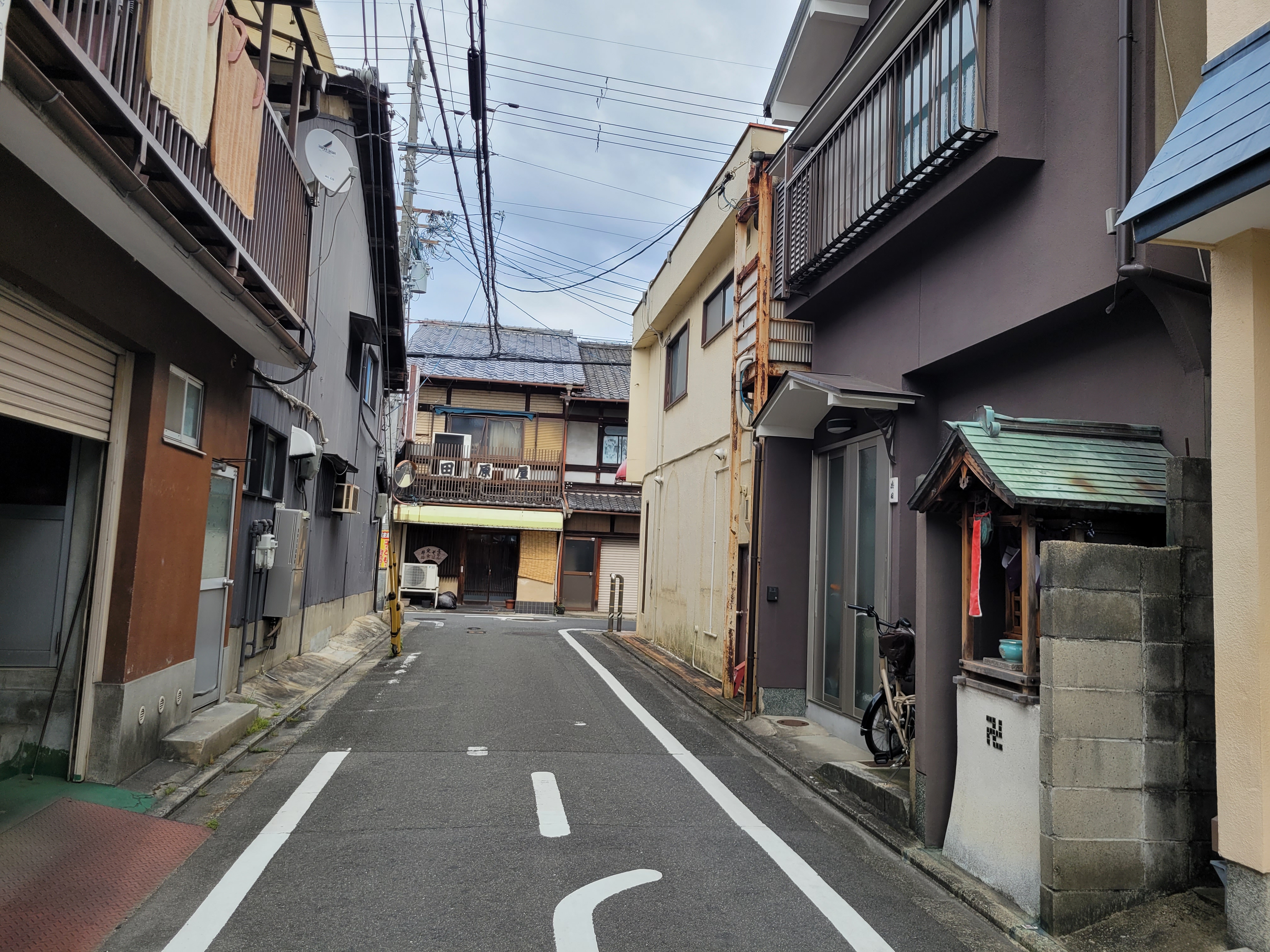
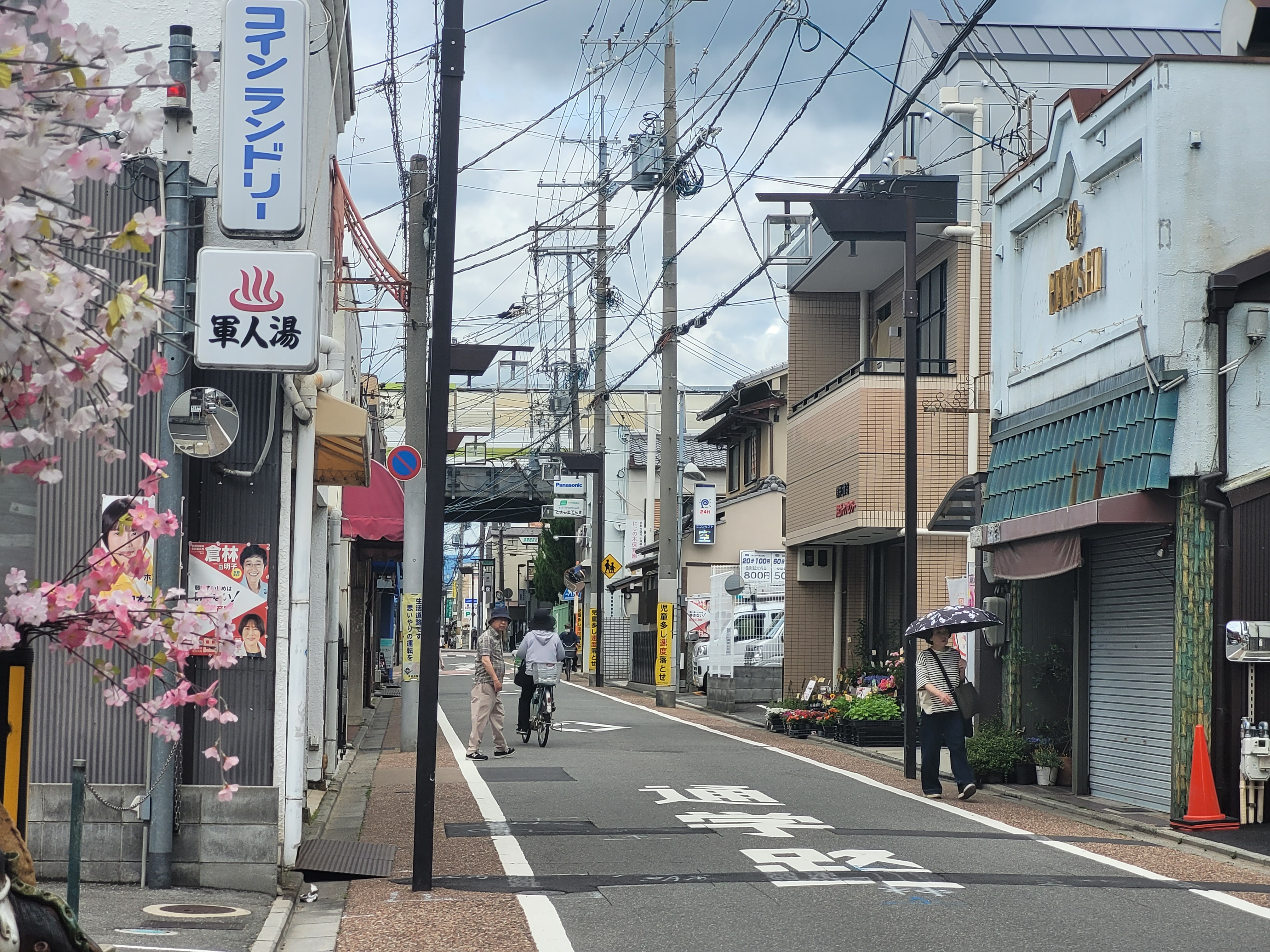
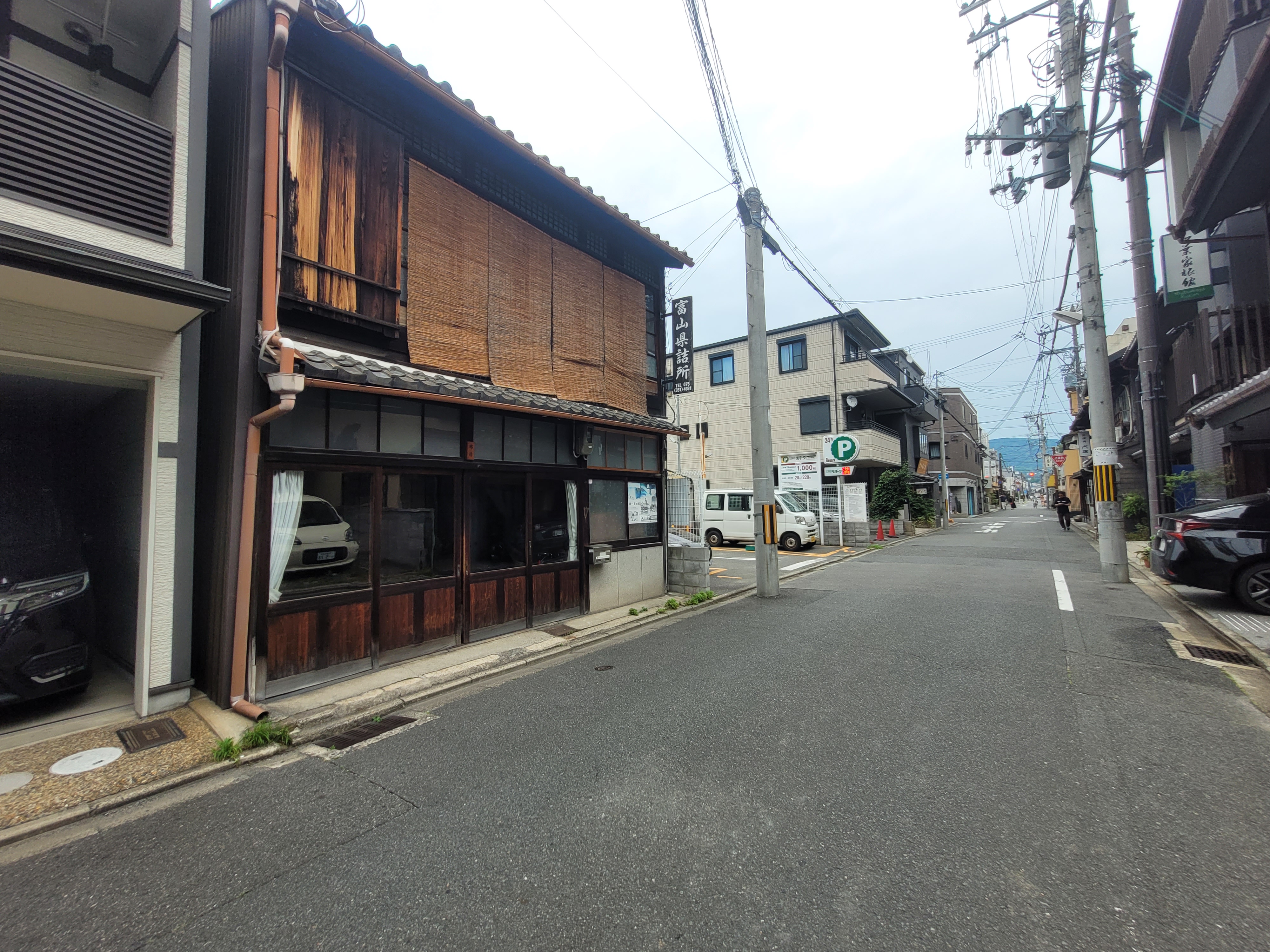
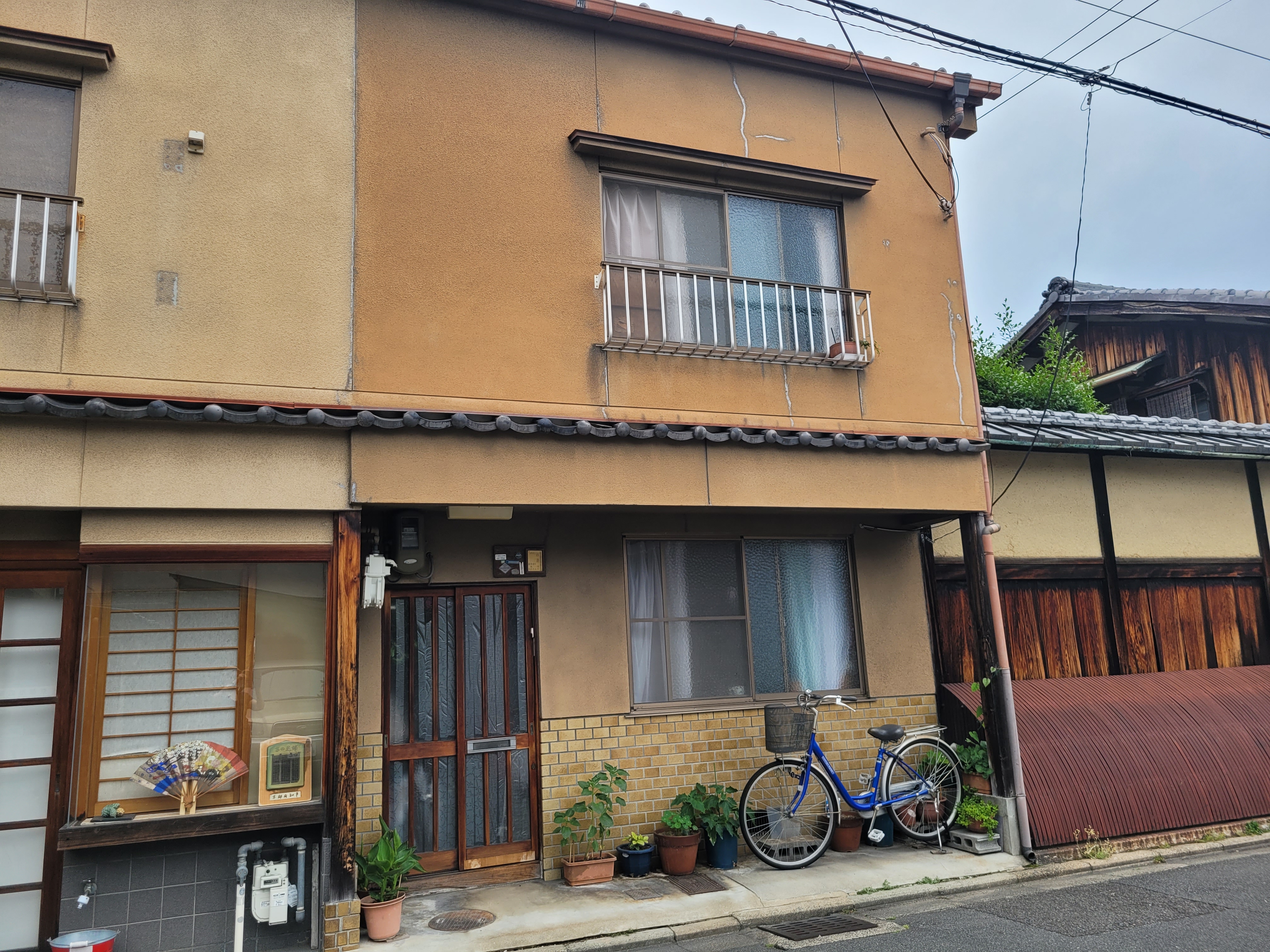

Some buildings here really stand out. I came across the two skinniest buildings I have ever seen.
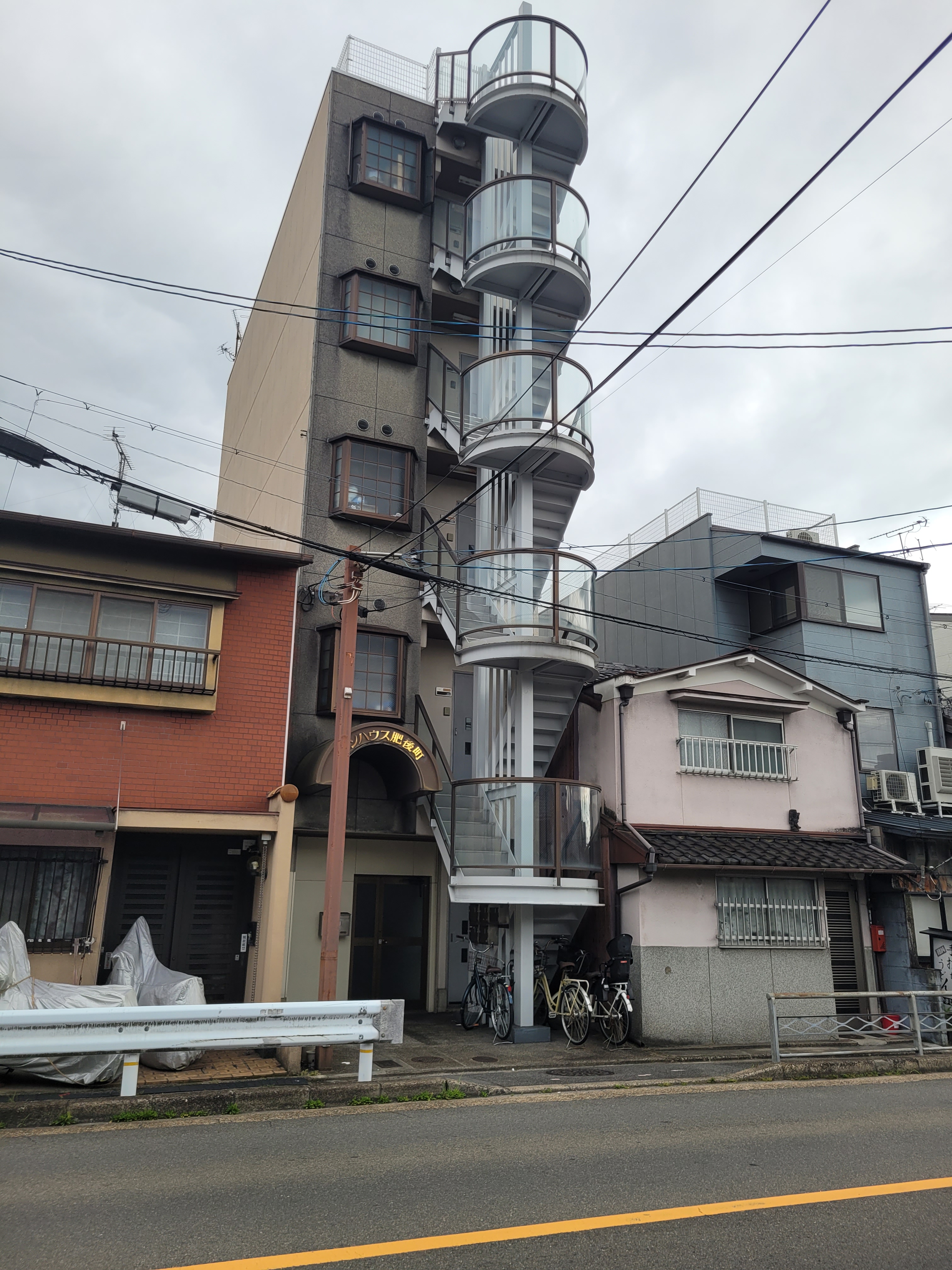

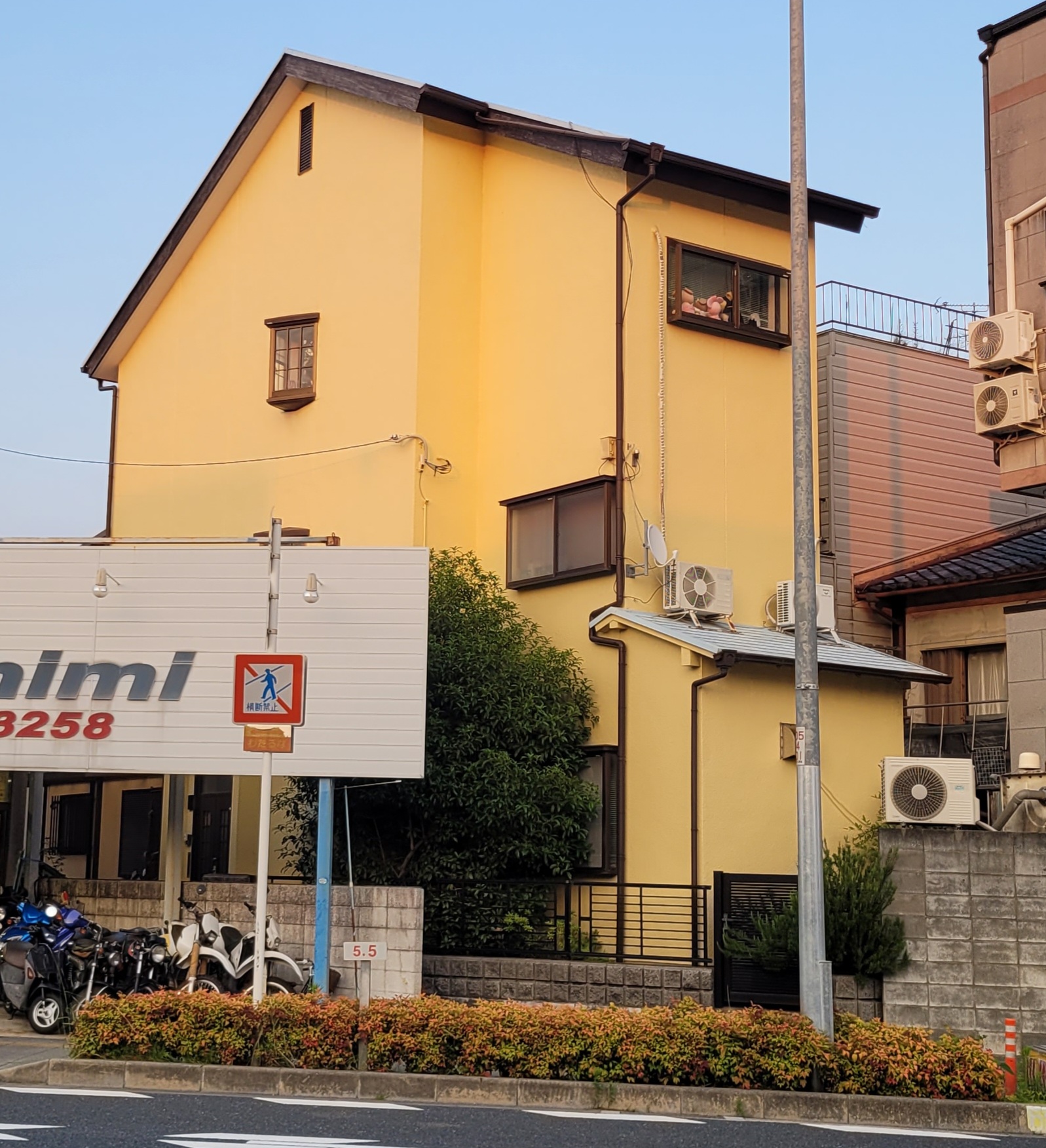
I decided that yellow one looks like a slice of cake.
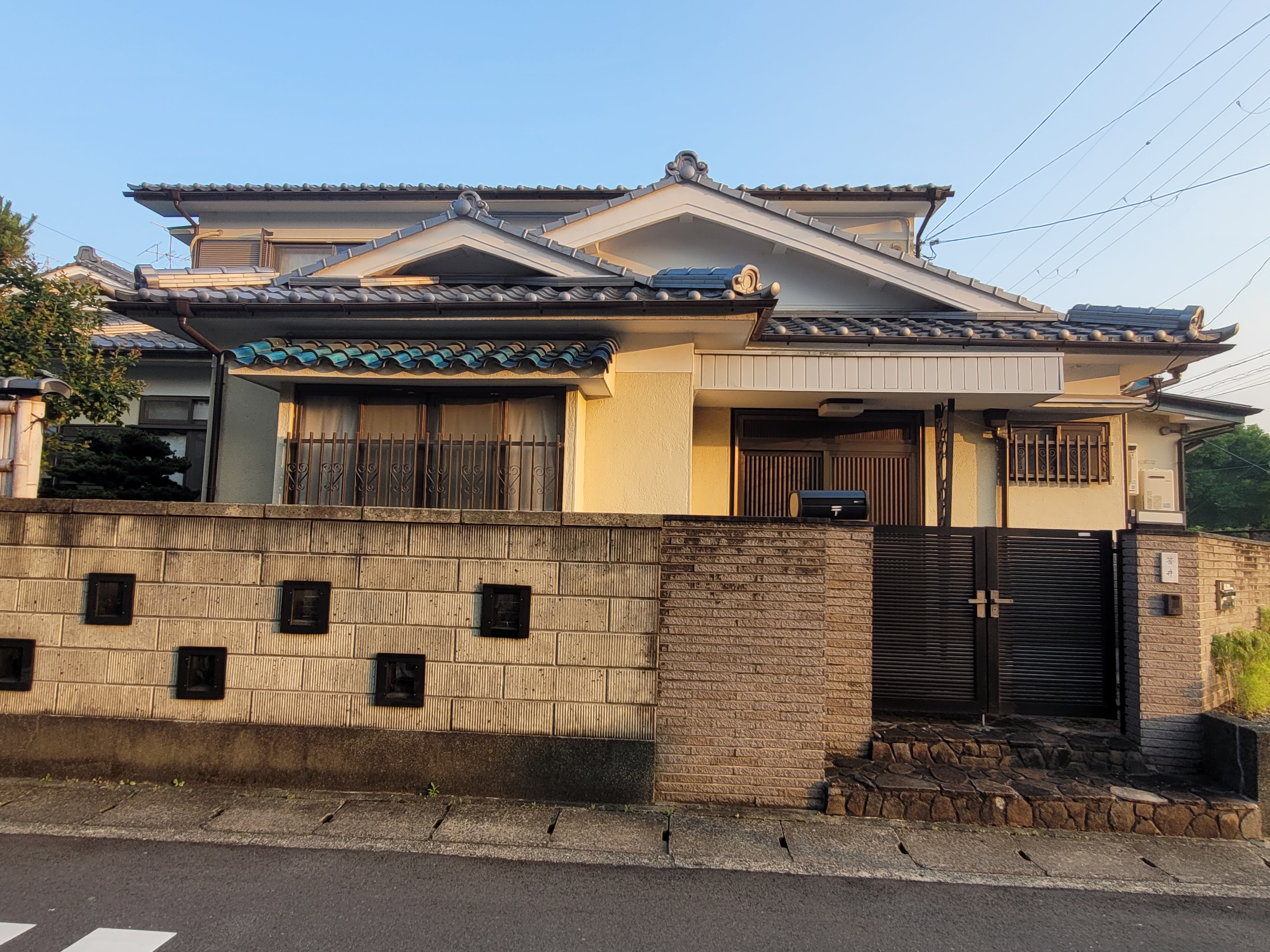
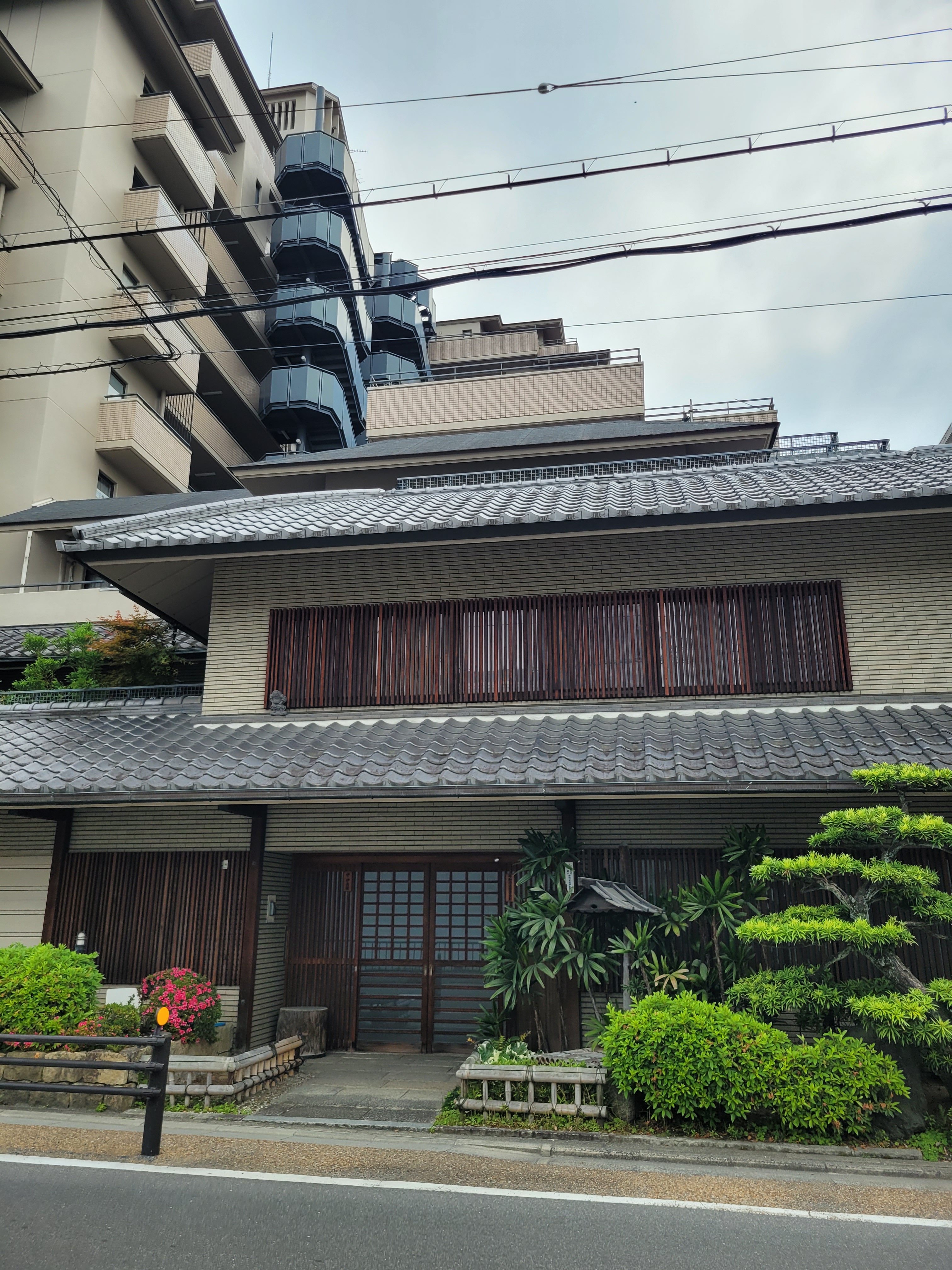
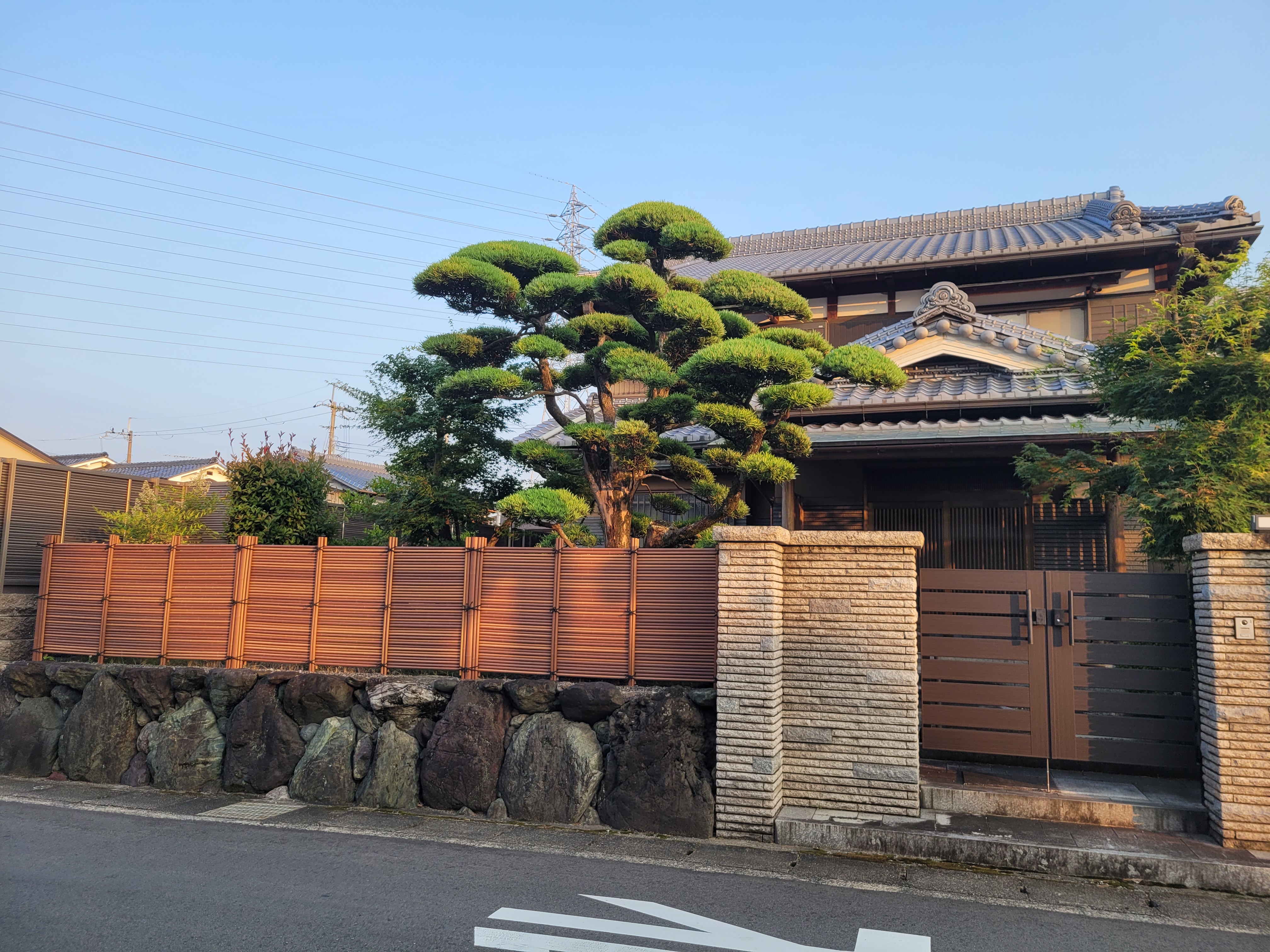
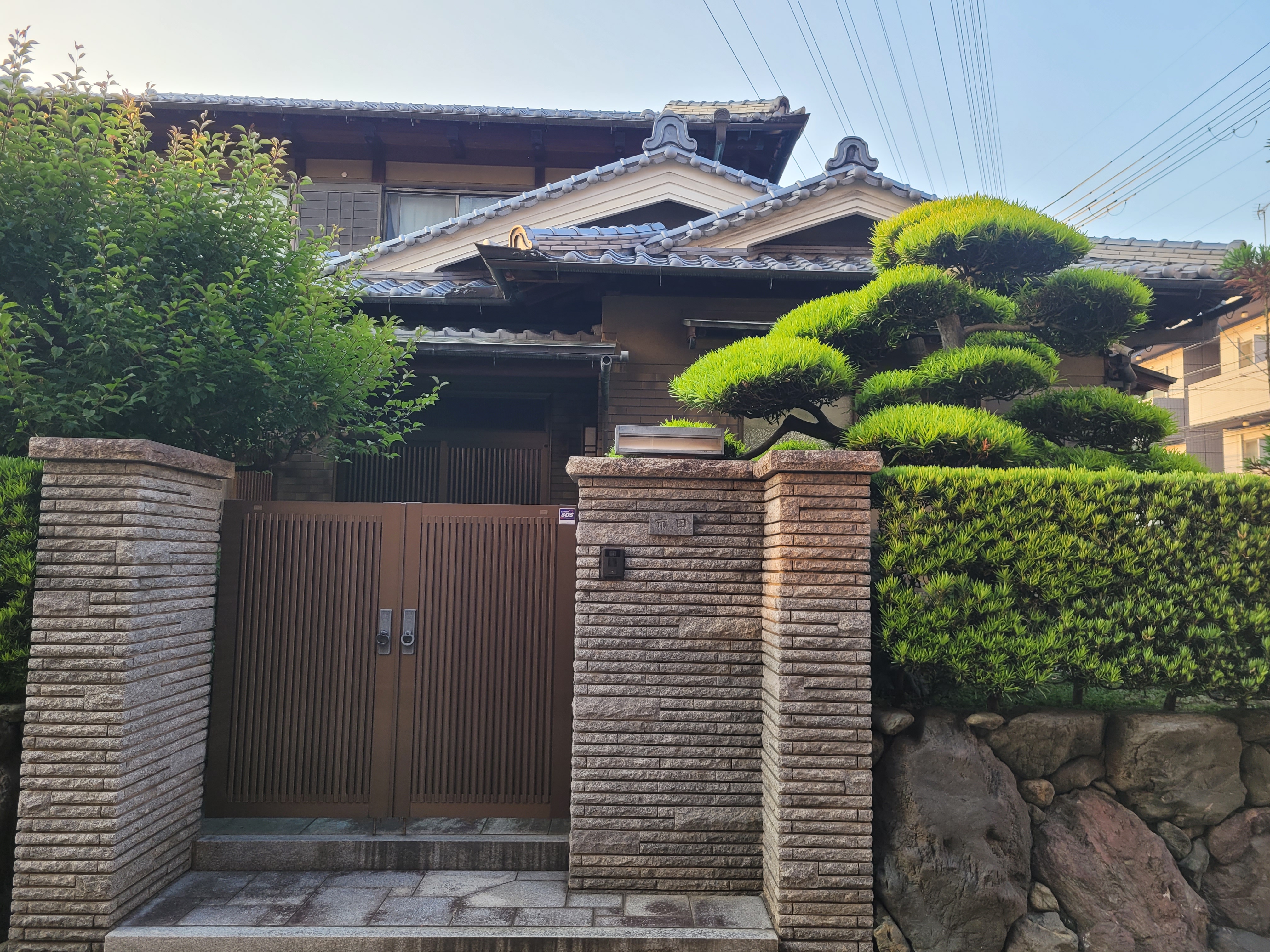
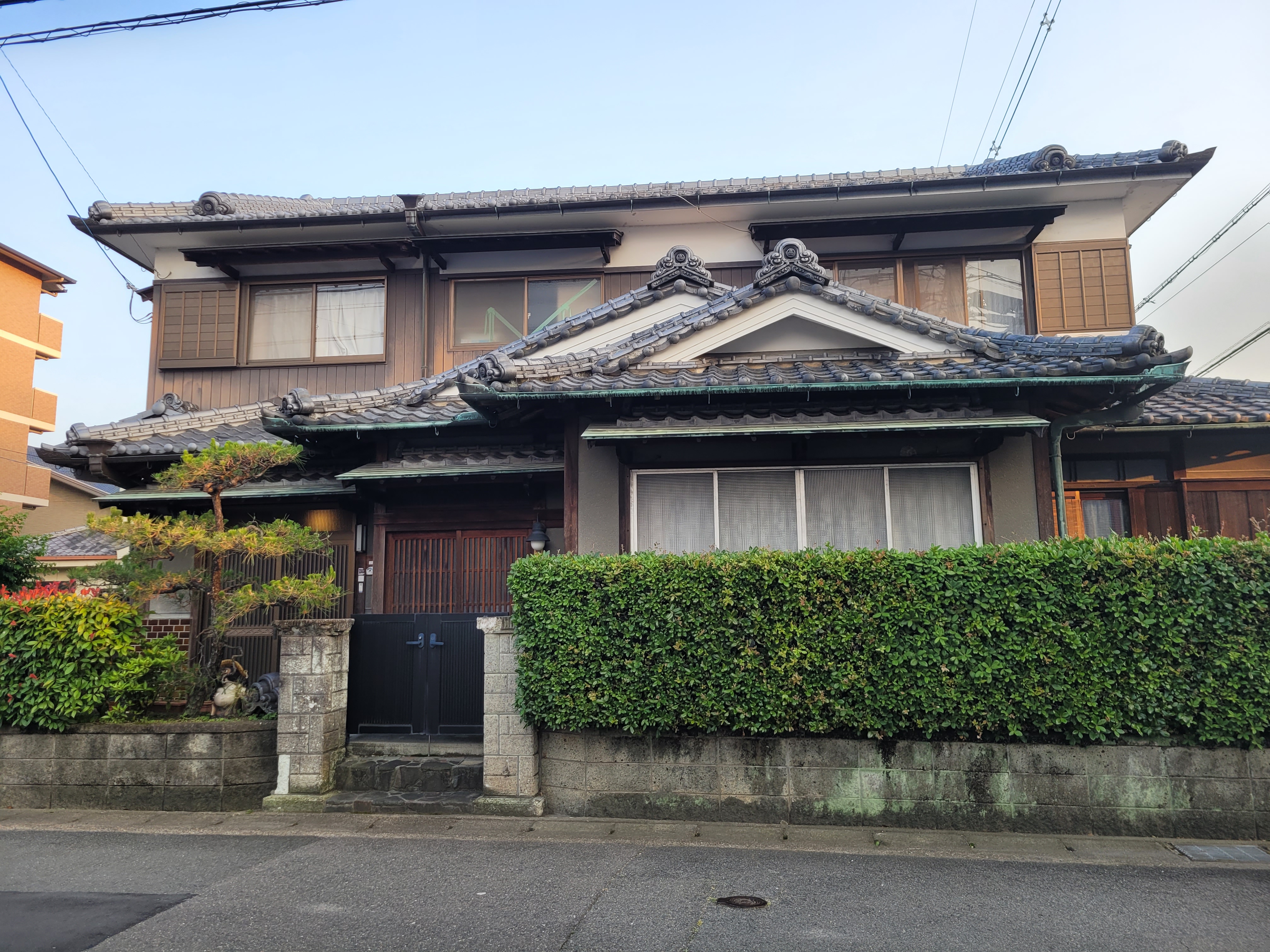
There are apartment buildings, like the one I live in, and a range of modern and traditional houses. Here are some very elegant traditional houses.
Bonsai
While out walking in the neighborhood one day I came across this house which has a very nice display of bonsai trees outside. I have a long love affair with bonsai trees.

When I was 11 years old, I became the youngest-ever member of the Pittsburgh Bonsai Society. The meetings were Tuesday nights in the basement of the Phipps Conservatory. I don’t know about the rest of you, but I spent my early adolescence learning about tap roots and plum trees.
CAT SIGHTINGS IN KYOTO, PART 1.
In feline observation thus far there are only three episodes to report. There do not seem to be a lot of cats out wandering the streets of Kyoto.


None of the real cats (in Sightings #1 and #2) was particularly happy to be sighted and each scurried away. Sighting #3 were pillows. I will keep looking. Where are all the cats? I always expect to see cats.
I’ll tell you what animal I do keep seeing: honking great birds! There are herons and egrets all over the place here. Egrets are white, and Edith Piaf sang about them in a famous song, because she had no egrets. Herons look like butlers who have shown up in formal attire to serve drinks.
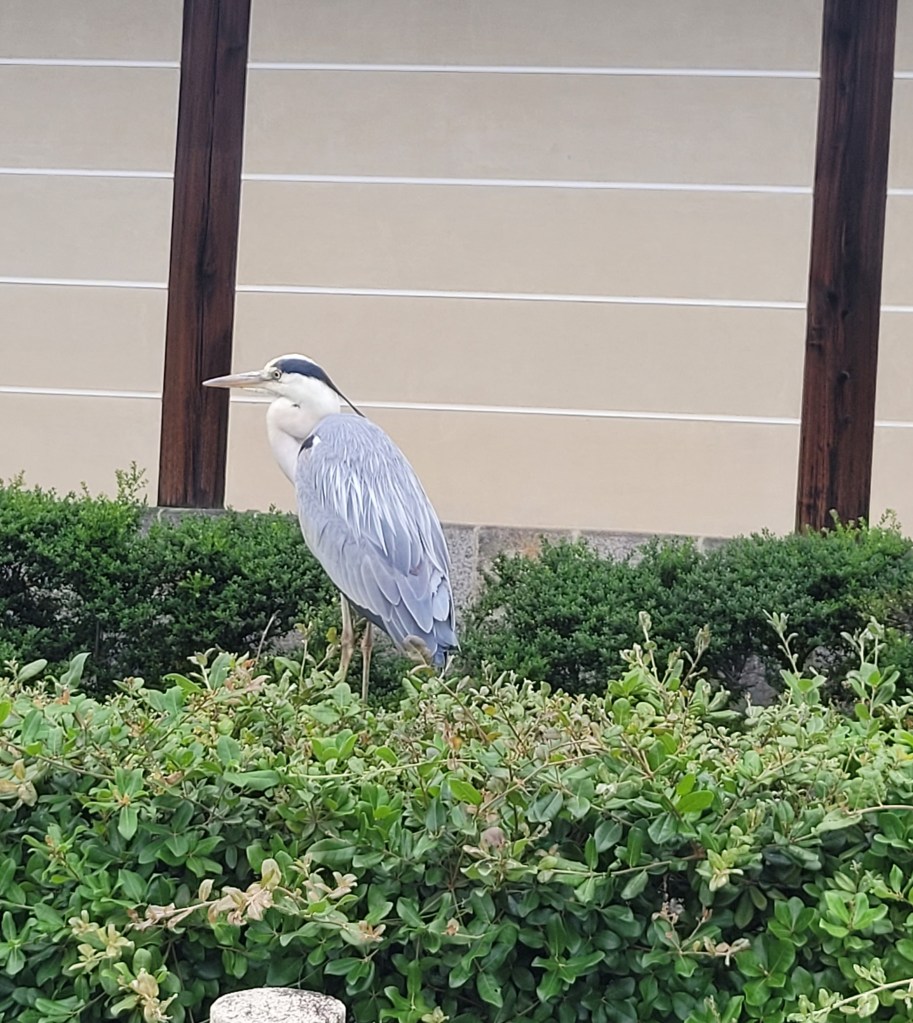
There was no lens adjustment to take this picture. That bird was just a few feet away from me, unbothered on the other side of a hedge.
If I had to give this bird a species name it would be the Blasé Heron, or Heron Indifferentus.
.

I may be the only one who thinks all these huge birds everywhere are actually a big deal.
Exciting Updates in Kyoto Urban Agriculture
A true story: One morning the empty vegetable plots near my apartment, visible from my 5th-floor balcony, were flooded.
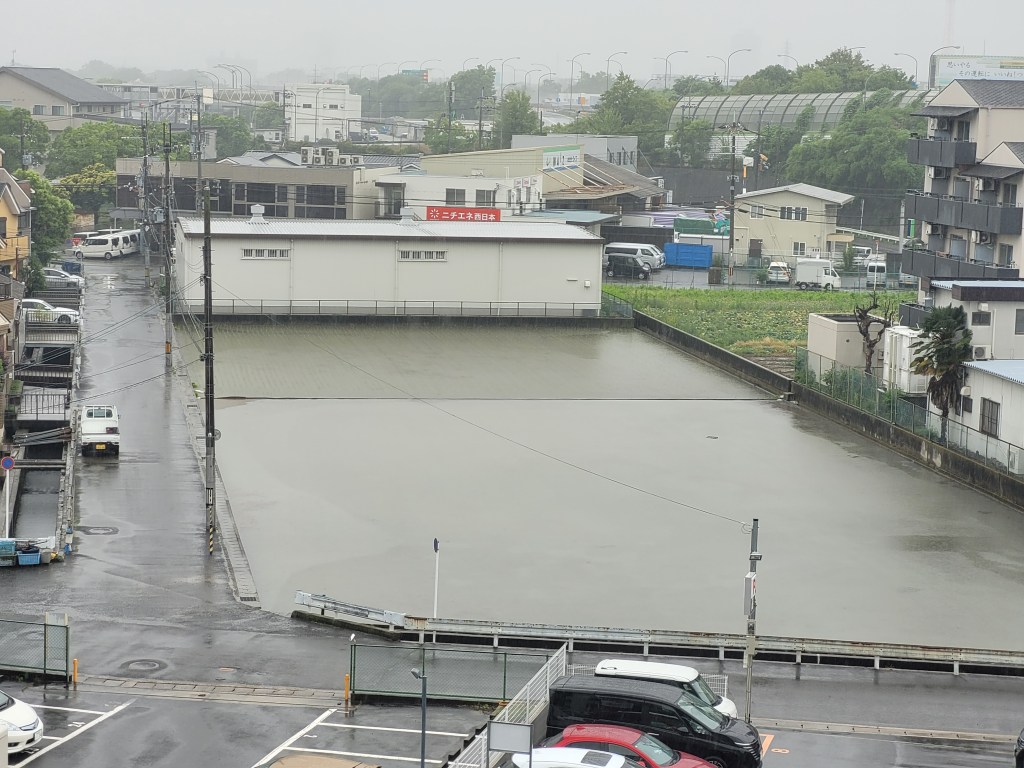
It had been raining a lot, but this was deliberate flooding. That is a lot of water. I had no idea how someone had managed it — Kyoto is criss-crossed with rivers and streams, but how would you direct it so precisely?
I kept an eye on the fields to see what was going to happen next.
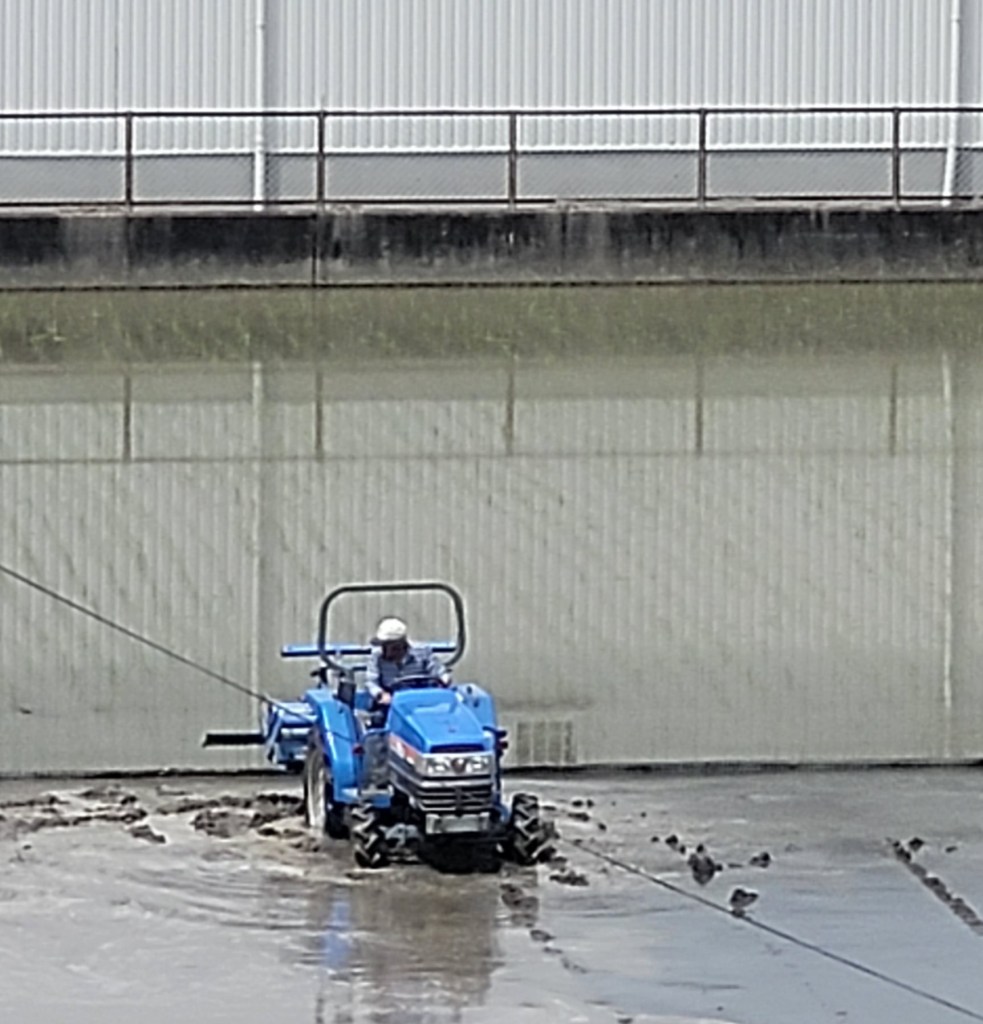
One day a farmer showed up with a bright blue tractor.
It looked like the farmer was creating furrows under the water.
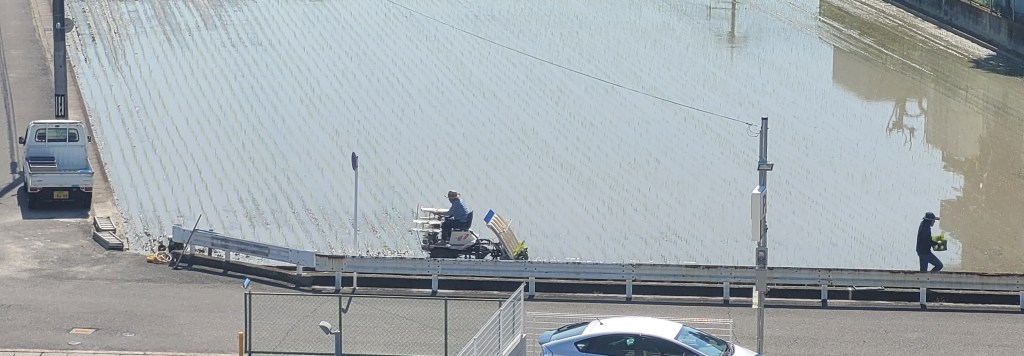
A few days later he returned with a different machine and used it to plant in the watery furrows.
I have no idea what that machine was.
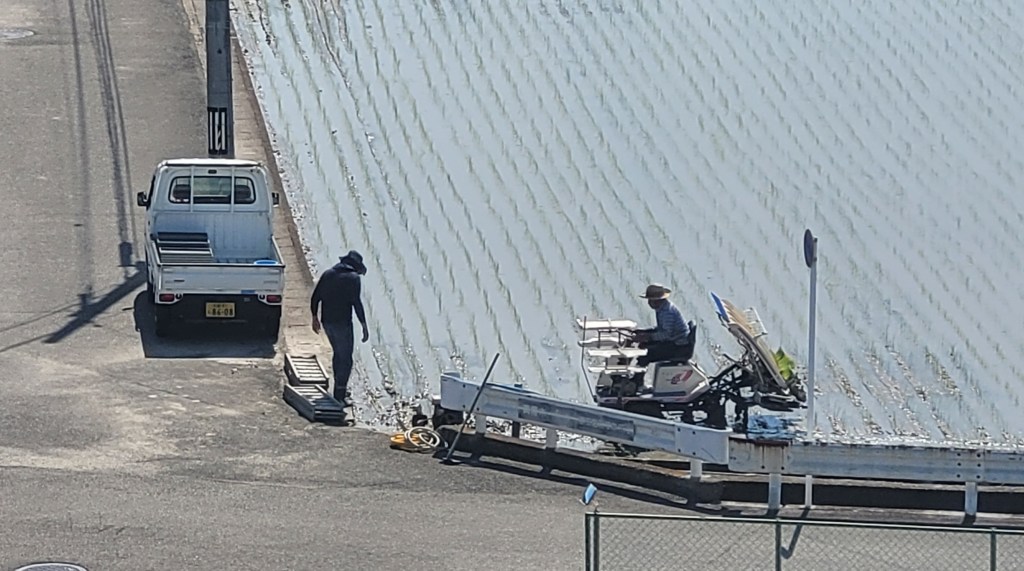
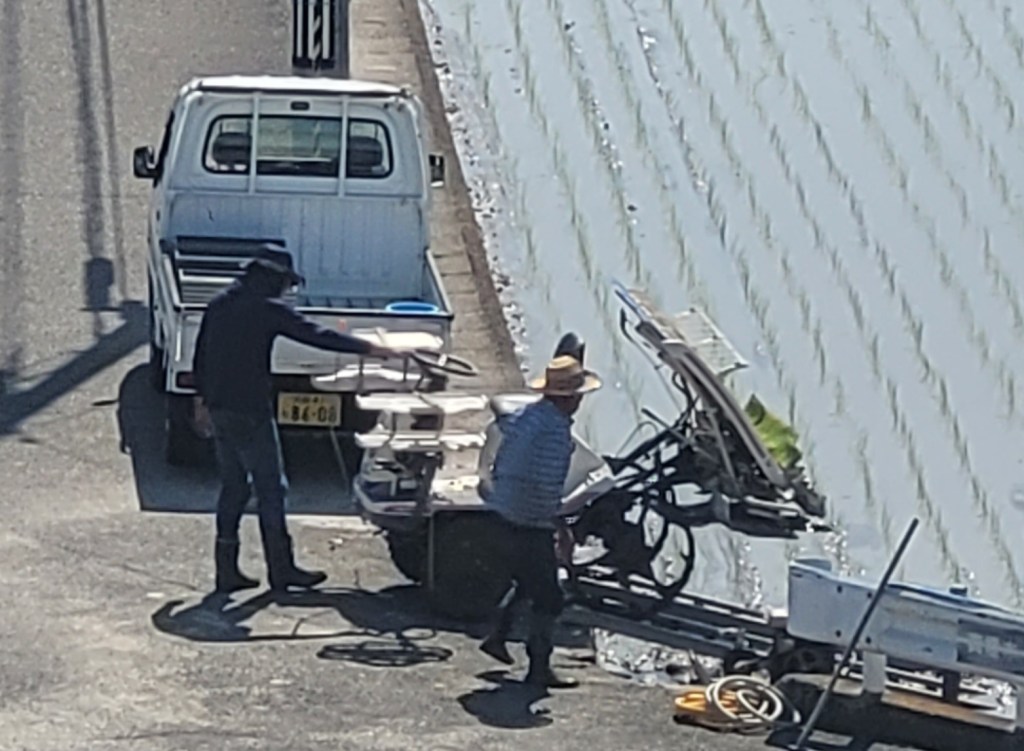
Even though I could see it when he and his partner steered it up and out of the water using ramps they made with two ladders.
They packed whatever that machine was onto their truck before they left that day.


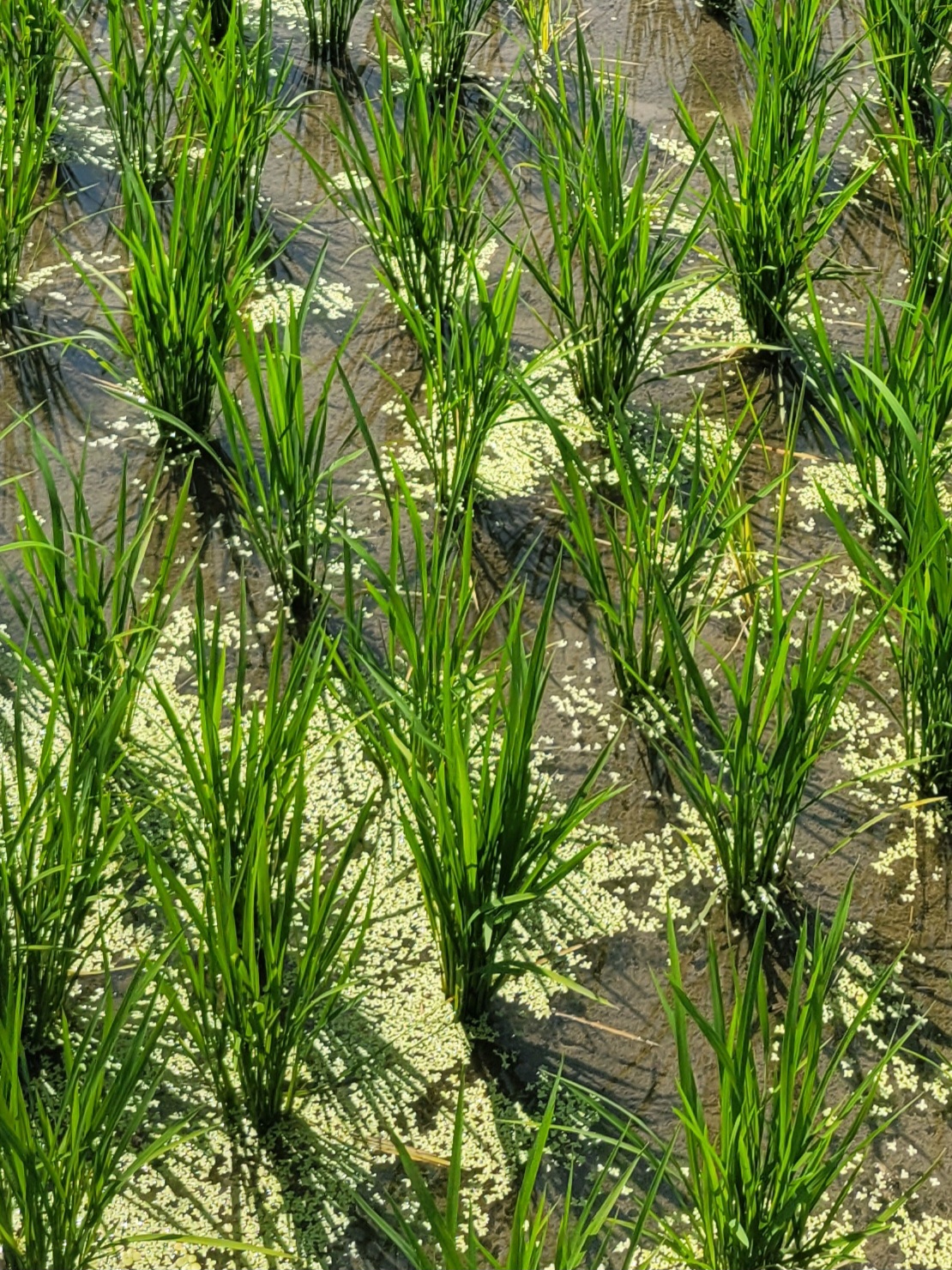
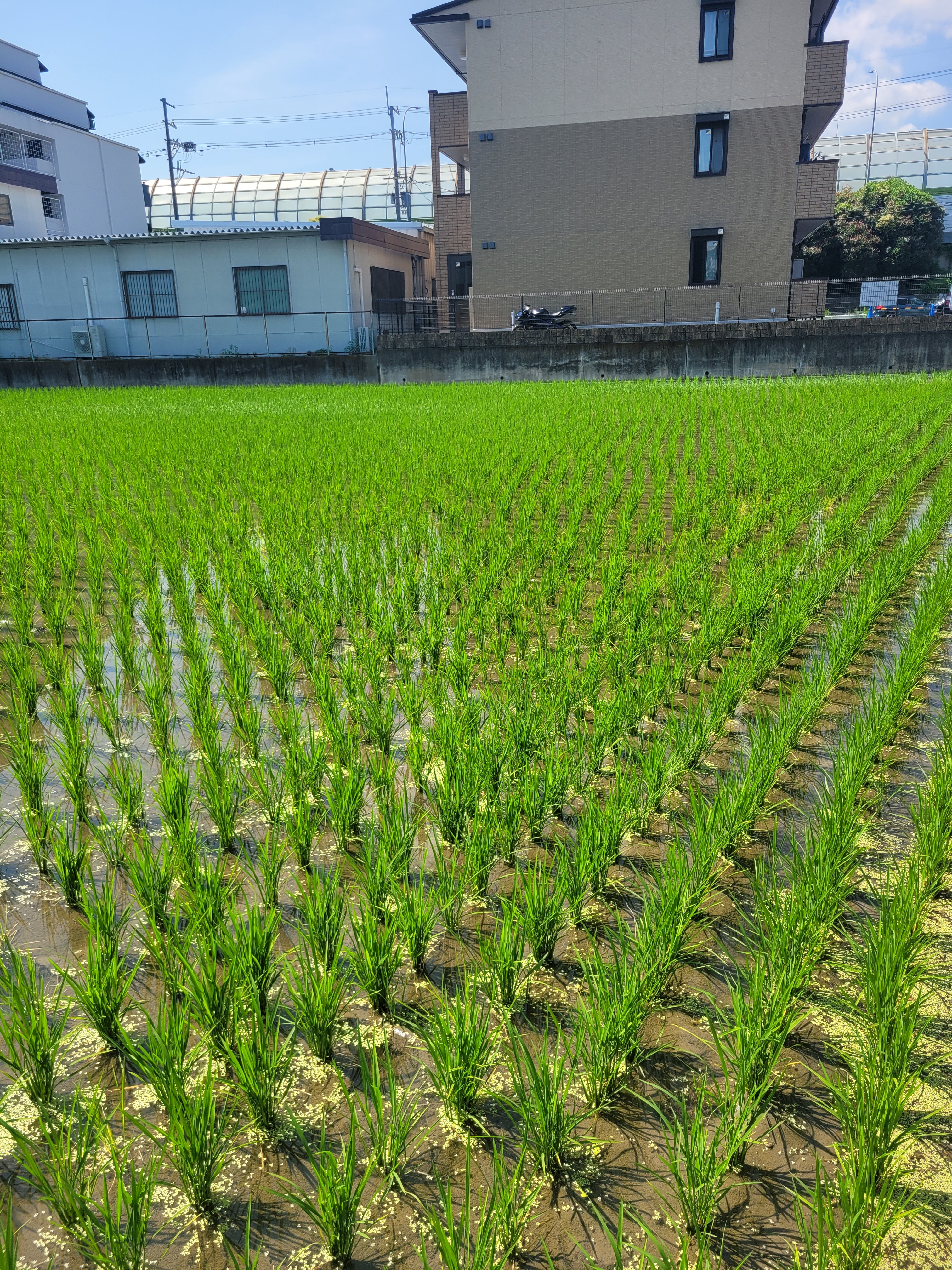
Green shoots quickly broke the surface of the water. It had to be rice! Urban rice paddies now spread out in my neighborhood — there were two more nearby.
The rice grew surprisingly fast.

Here is what it looks like today:

It makes sense that the farmer is growing rice — there is actually a rice shortage in Japan right now. A searingly hot summer in 2023 reduced rice yields, inflation has continued pushing up prices, and apparently increased tourism is also denting rice availability. The headlines in Japan deem it a full-fledged rice crisis.
Some knowledgeable colleagues at work informed me that historically in Japan, a unit called a koku (斛) was used to indicate the amount of rice a person needed to be sustained for a year, and also the land unit required to produce that amount. A koko works out to 180 litres / 150 kilograms / 330 lbs of uncooked rice, and interestingly, if you Google around “rice consumption” on the internet for a bit, the results state 300 lbs of uncooked rice per year per person as the current correct figure for Asia, with some variation by country. I did some math (yeah, yeah, hell must have really frozen over) and came up with the requirement of .16 of an acre or 647 square meters of land to produce one koku of rice.
If you really want to go down this particular rabbit hole, and why wouldn’t you, I recommend a website I only just discovered called Wikifarmer. Type “rice harvesting” into the Library page and I will see you in about 3 weeks to continue this discussion.
An Ancient Rice Ceremony
This all lent real urgency to the springtime rice-planting ceremony, or Taue-sai, held on June 10th at Kyoto’s Fushimi Inari Shrine — the one with all the orange arches ranging up the mountain. (I wrote about it in my first blog post from Japan, “Temples, Temple, Tempo.”) This Shinto shrine is devoted to agriculture, and its guardian fox statues often display rice-related symbols.
Rain poured the entire day and the puddles were already deep by early afternoon, but despite the weather I headed to the event, walking about 20 minutes from our university campus. I reached the shrine pretty sodden despite my umbrella and rainjacket.
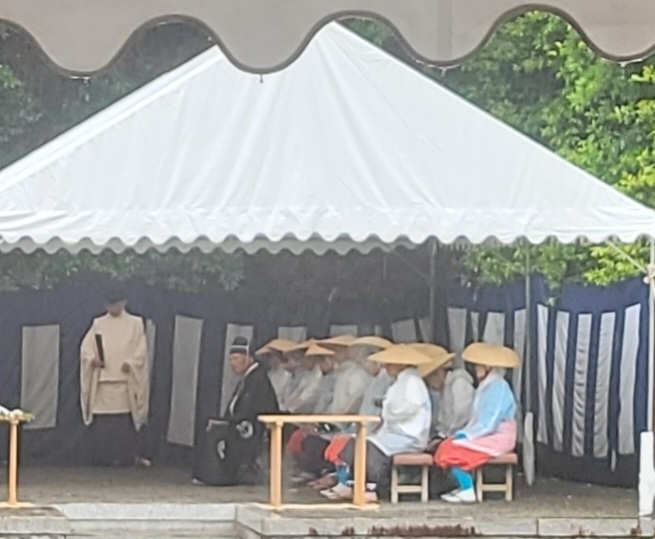
About ten minutes after I arrived people began to file out from the main sanctuary where a private rice-blessing service had just concluded: priests, monks, musicians, dancers, rice planters, and dignitaries. Each person was handed a substantial traditional umbrella as they exited and processed on a path to the northeast. When the last of them fell into line, the police and soldiers waved those of us gathered as on-lookers to join them. We all marched through the rain, but veered away from the tourist hoards and instead turned down a paved side path. We soon arrived at a tent, a bridge, and a rice paddy. The ceremony participants filed over the bridge to the tent. The rest of us, maybe 200 people, stood on the other side of the rice paddy in the downpour.
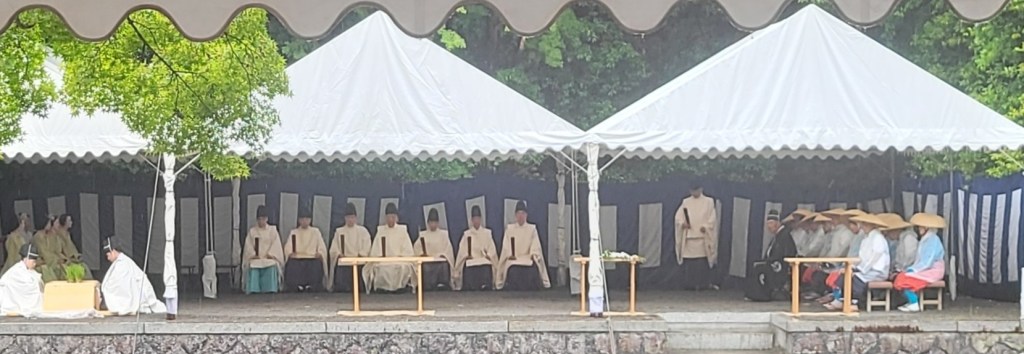
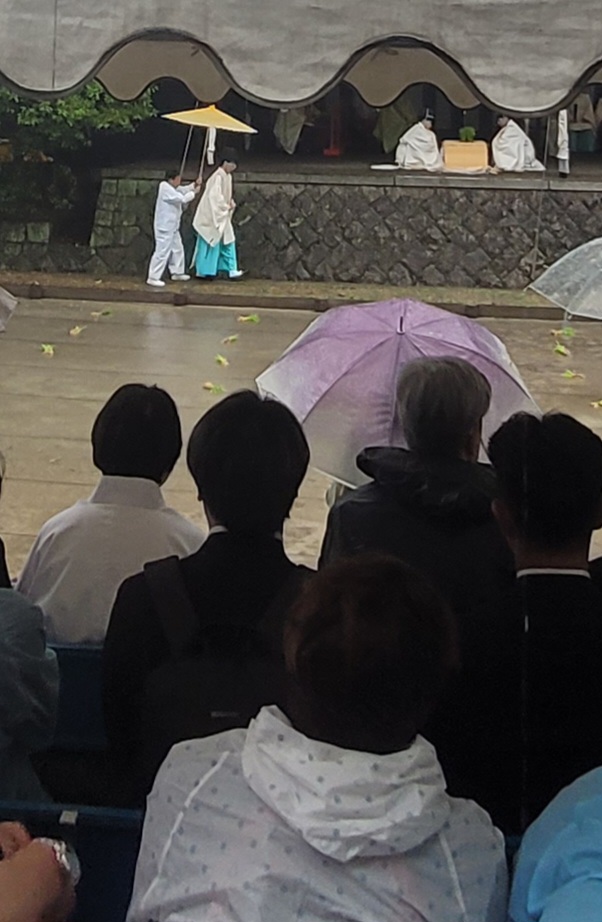
After some prayers from under the tent, the priest moved slowly around the rice paddy to chant a blessing, walking under an umbrella held over him by a young monk.




Next the rice-planters, a very senior crew dressed in traditional costumes and plastic raincoats, gingerly made their barefoot way down onto the bridge, and into the muddy paddy to begin planting rice by hand.
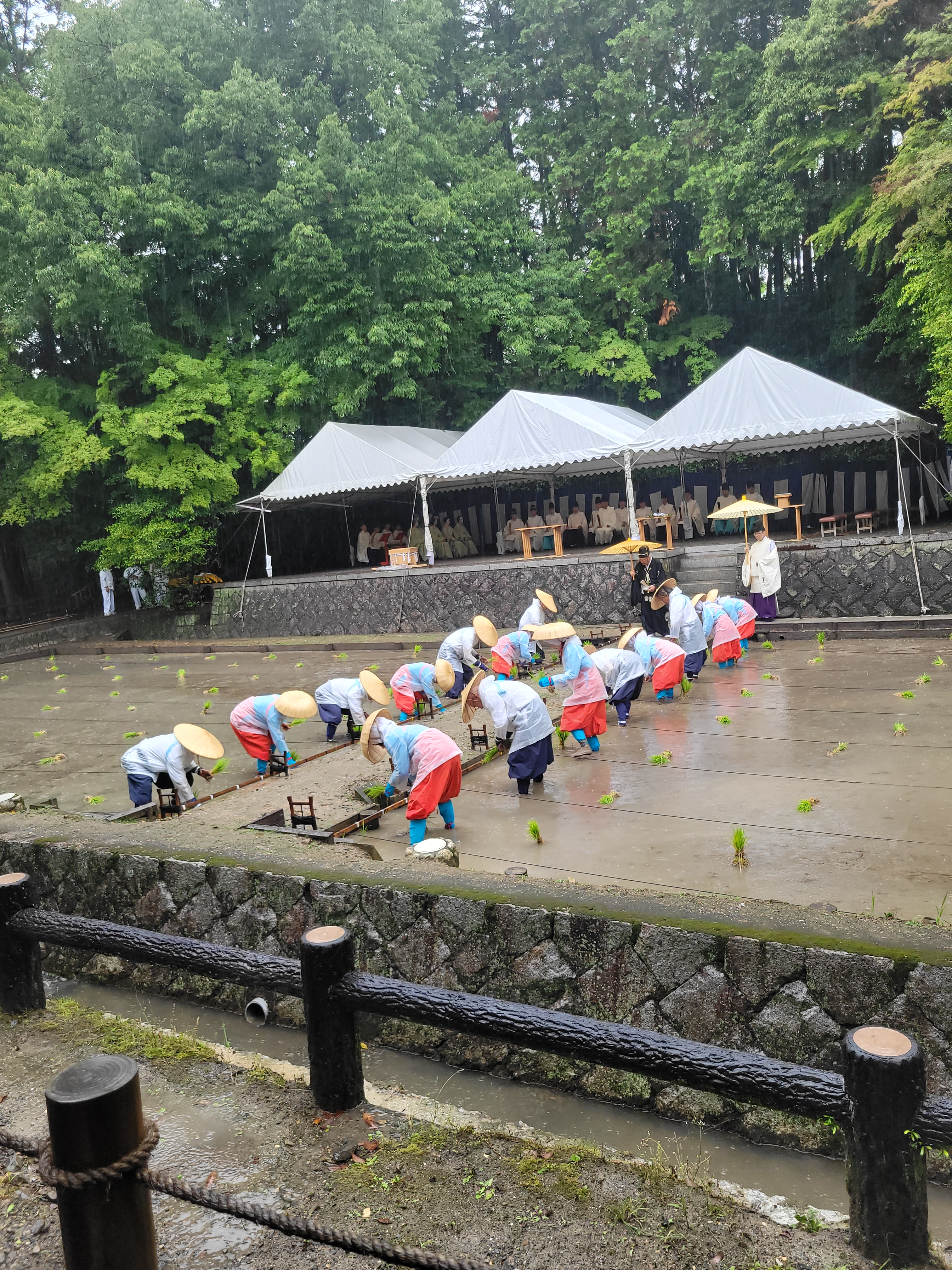

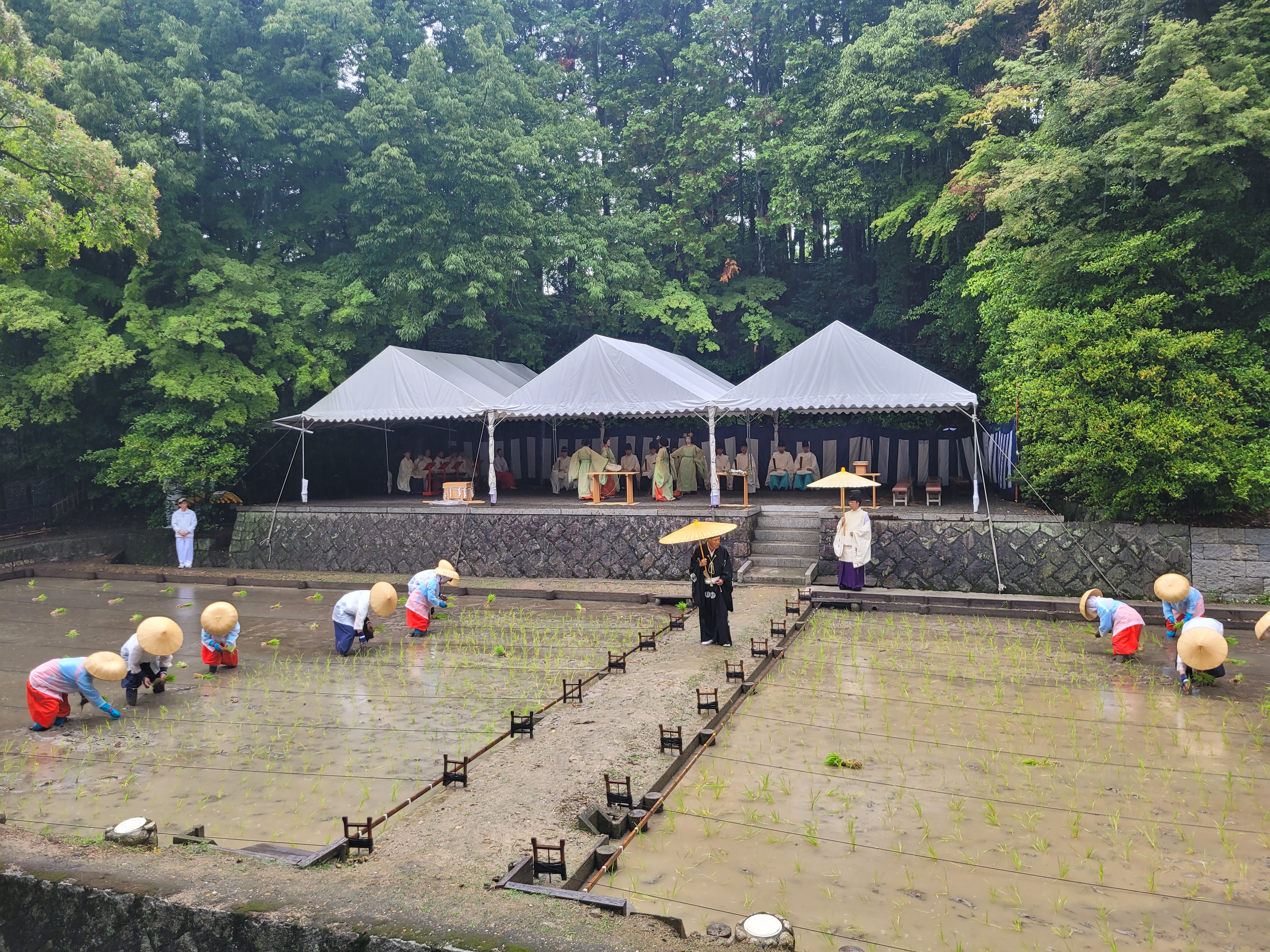
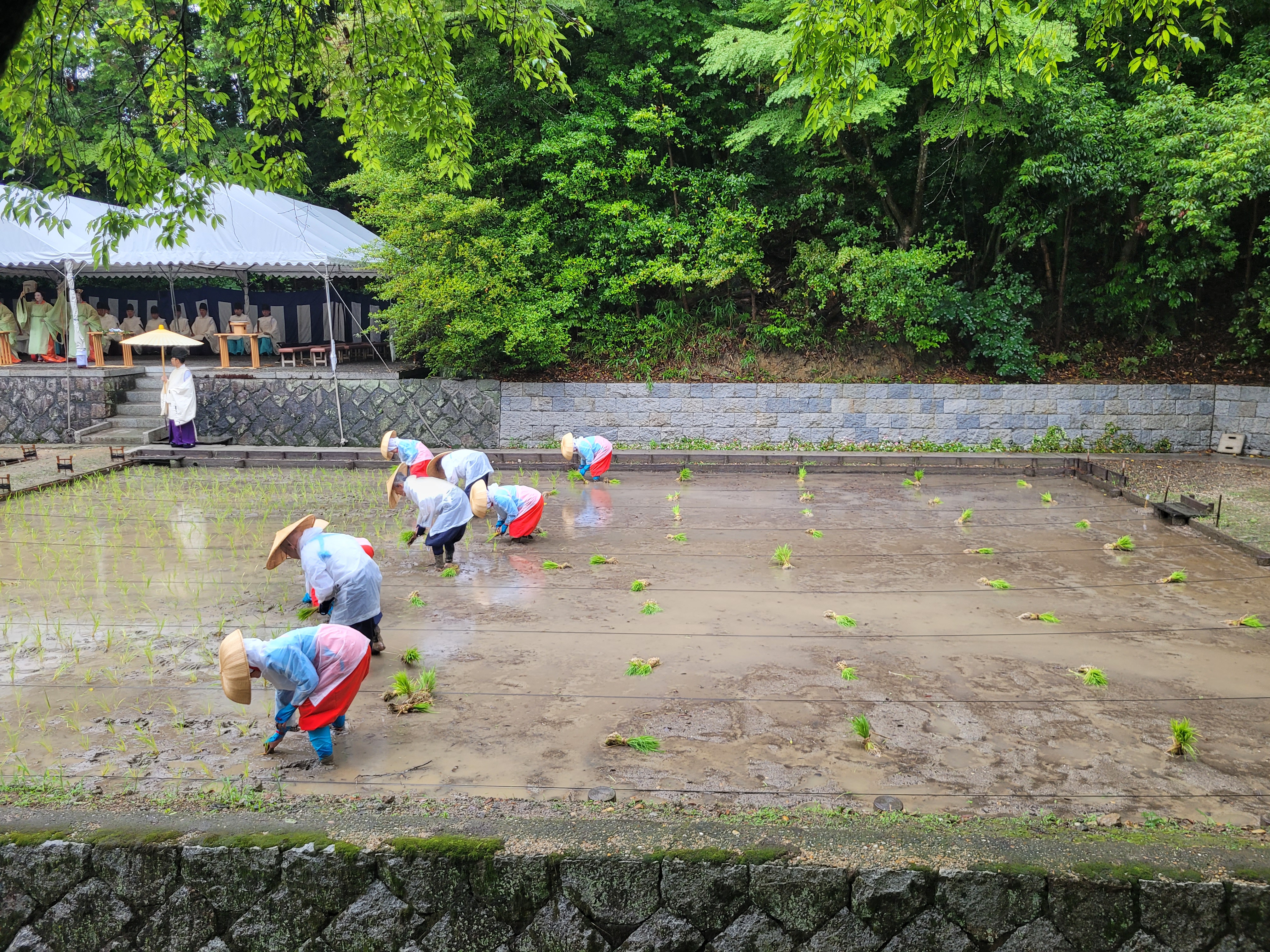
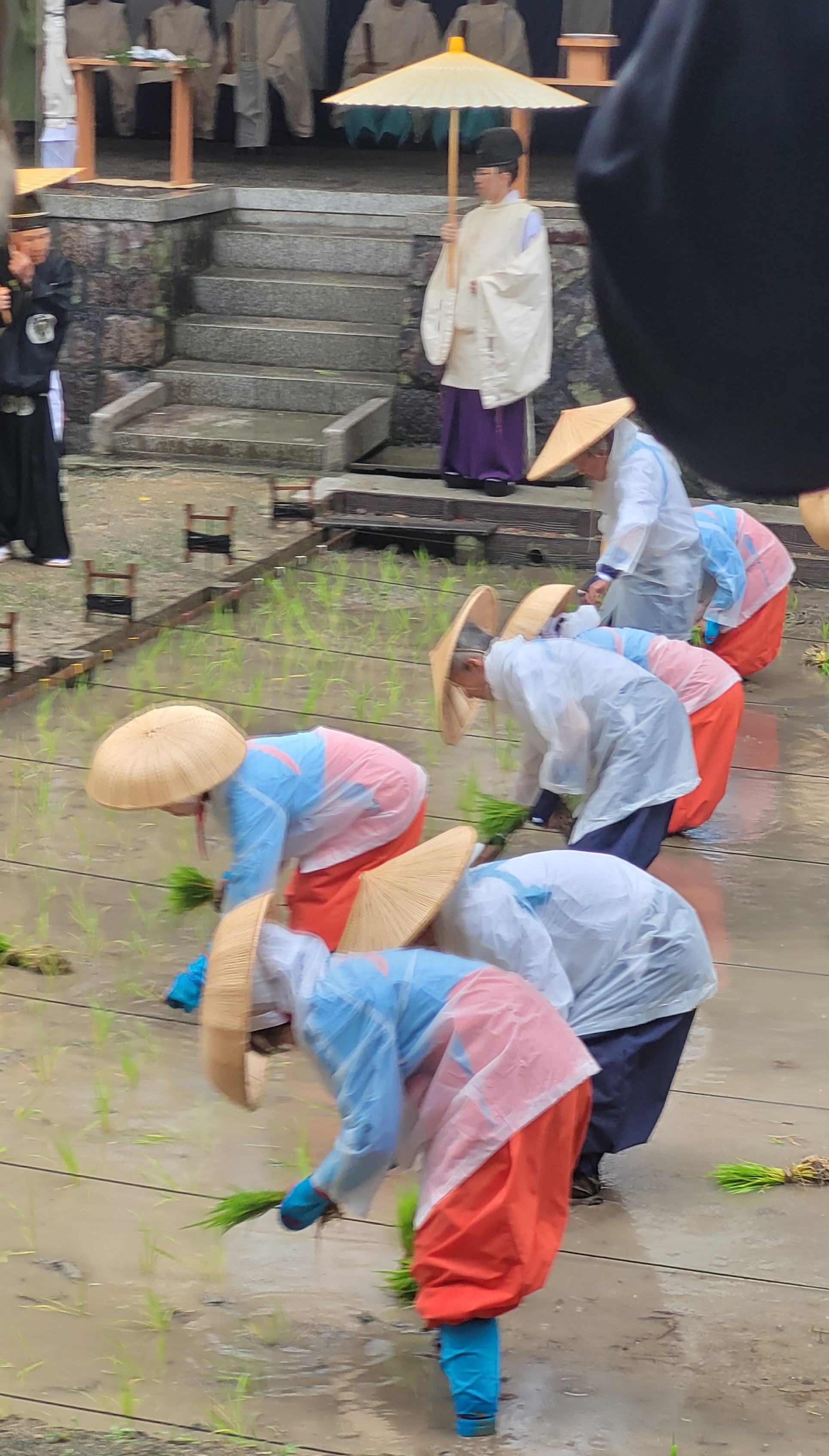
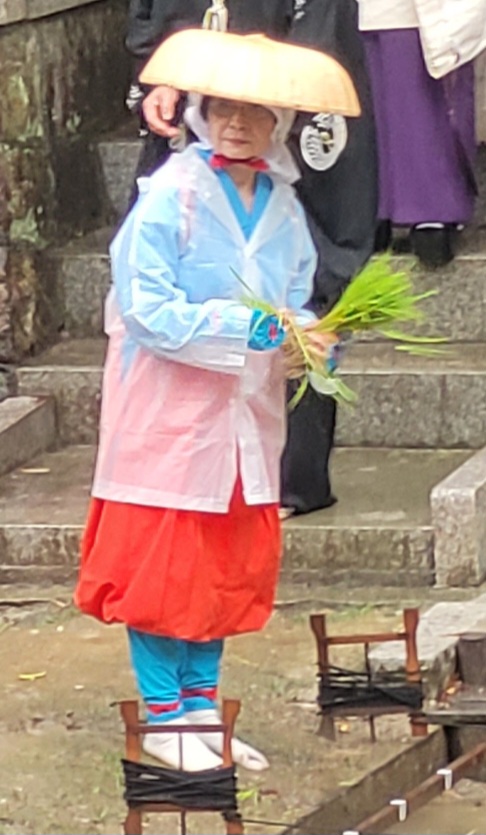
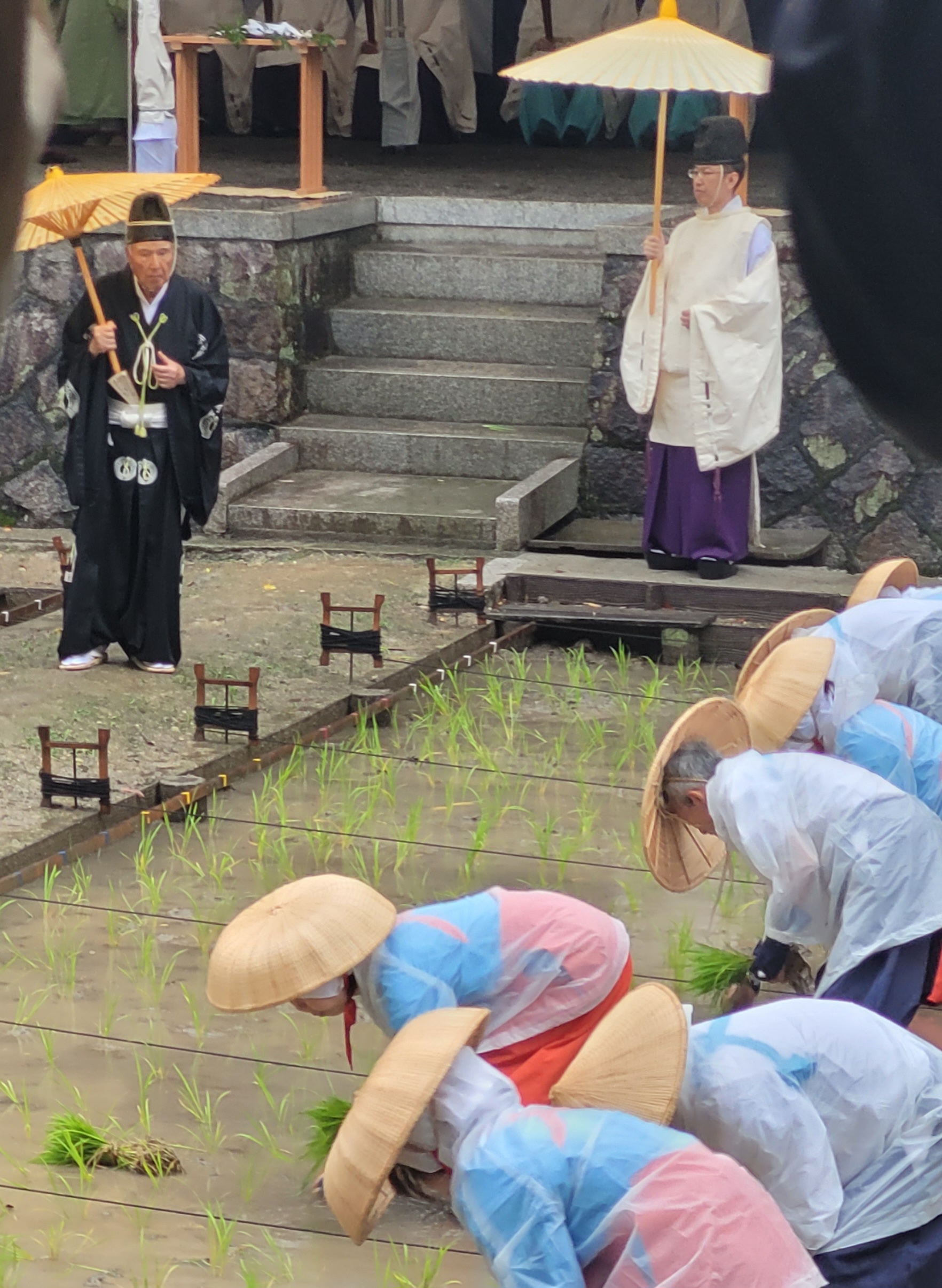
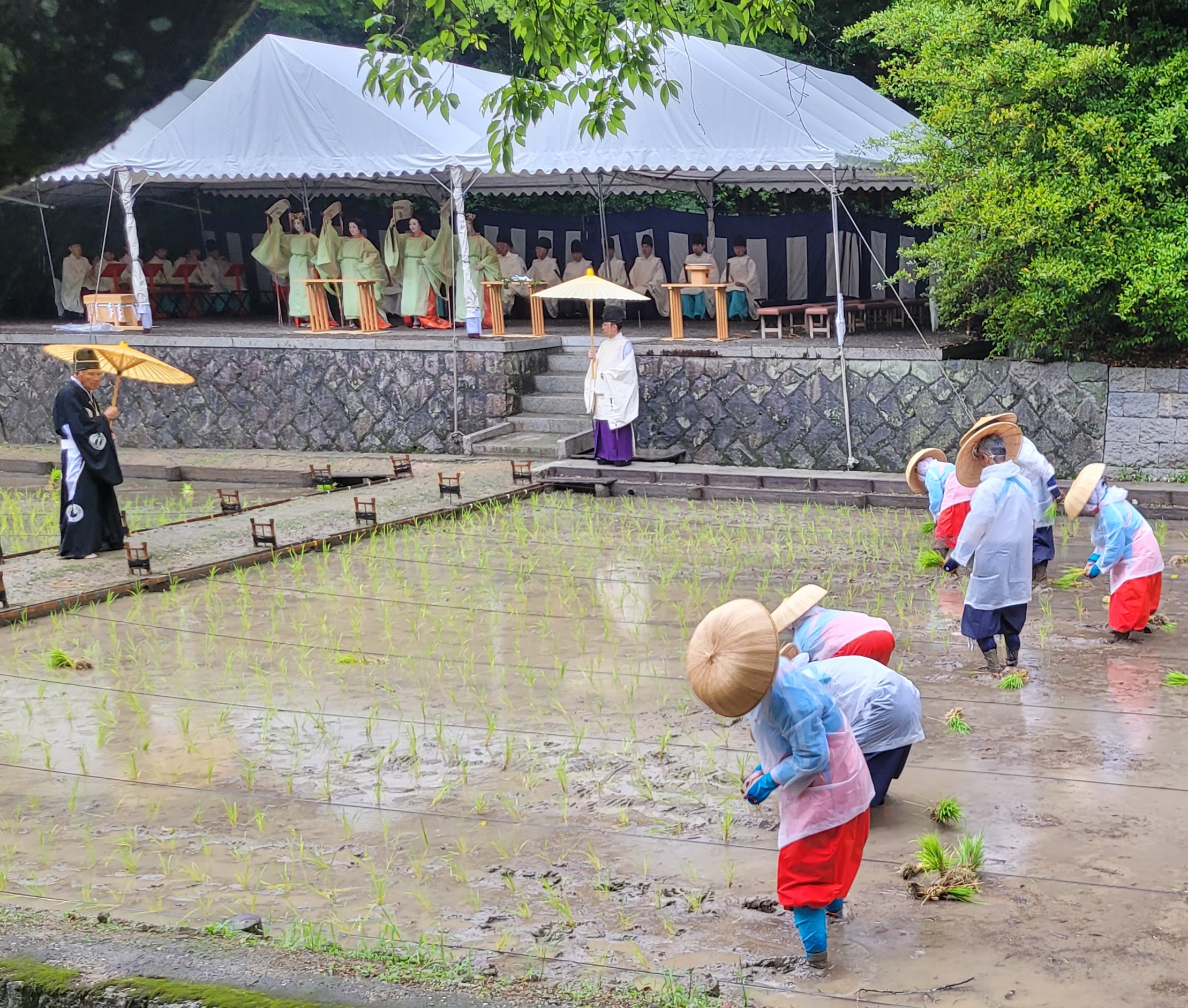
The rice grown in this sacred paddy will be harvested at a ceremony in September and then used as an offering to the agriculture god, Inari.
Despite the rain, there was such an elegance to the proceedings. It was a calm and serious event, undertaken with great humility and focus by each participant.
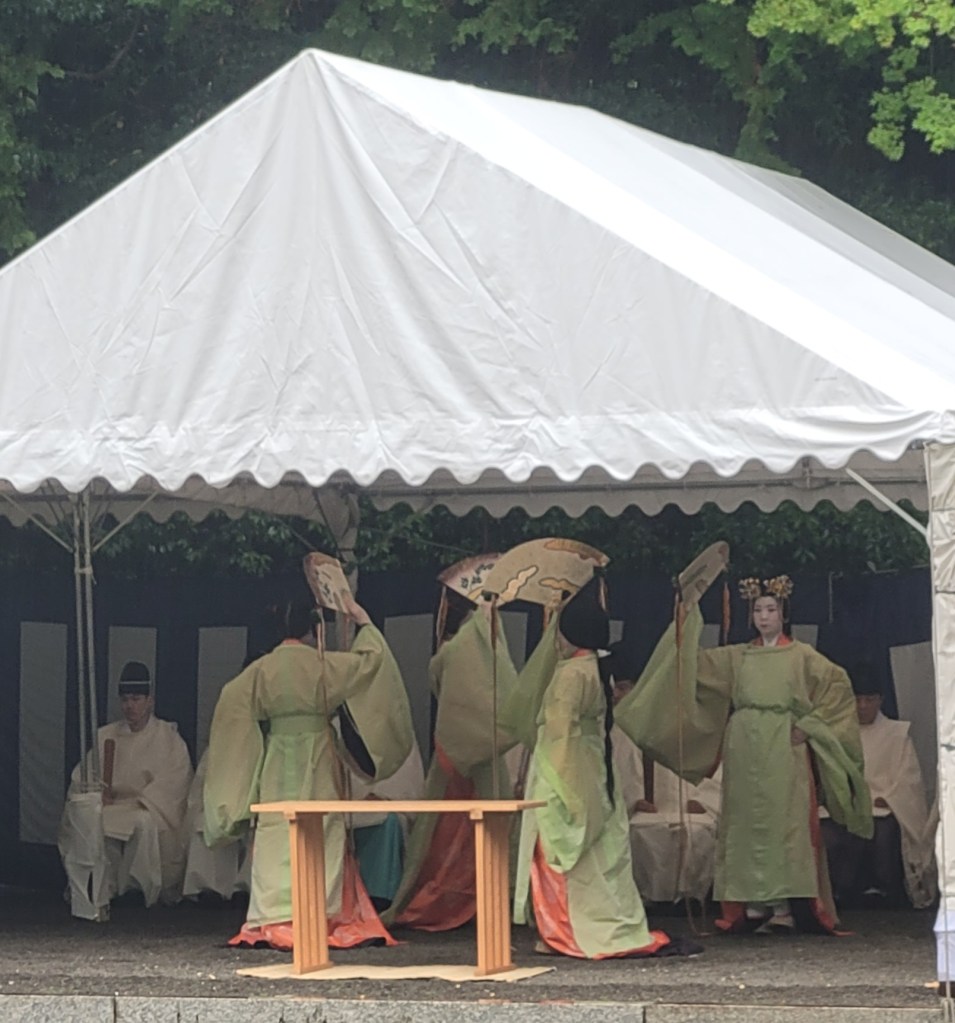
On the stage the dancers moved slowly to flutes and the crack of percussion, and the incessant splats of rain.
I filmed a few short videos, which I like particularly because you can really hear the music and the rain.
The priest recalled all the planters to the stage when the paddy was about halfway planted. The workers carefully extracted themselves from the mud and walked with great care, rinsing their legs in water at the paddy’s edge before re-shoeing to ascend the stage.

I took a picture of the mucky rice ground where the workers extracted their feet and left deep prints.
Then everyone formed a procession back to the main part of the grounds, rejoining the tourist crowds, the thousands who’d been oblivious to this stately ancient ceremony going on nearby.


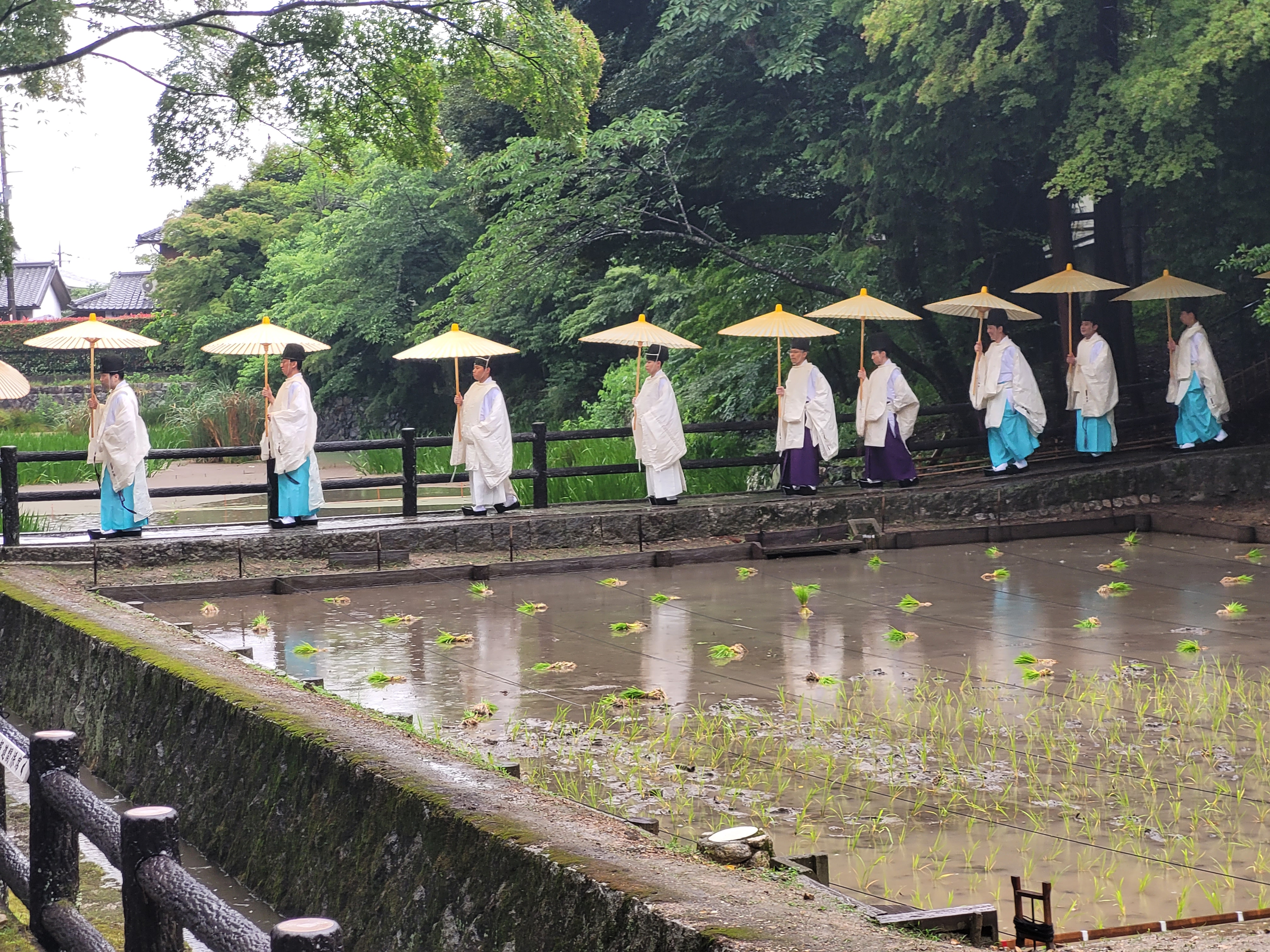


One by one the entire procession disappeared behind a sliding screened door into a temple building. I sincerely hoped dry towels and hot tea awaited them. And then I took my soggy self home.
Just Bowled Over at the Toji Temple Flea Market
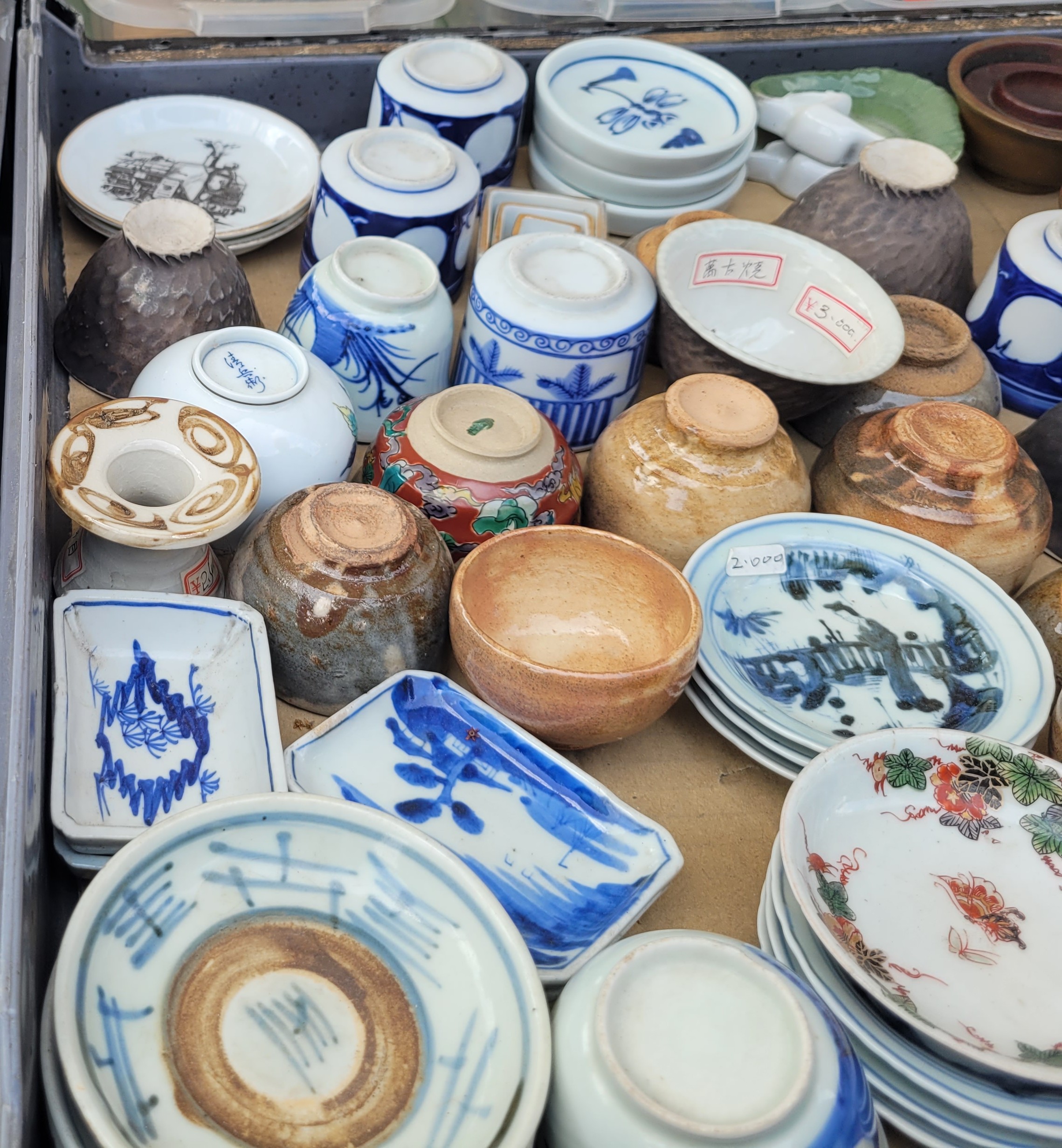
Those of you who have read the South Korea blog posts here from 2024 know about me and bowls. My son said, “I have some research to do at this museum and there is a ceramics exhibit on the 3rd floo–” and I was gone and out of his hair for the next three hours. Bowls! Celadon, porcelain, earthenware, such magical words, and this is why I have 2000 bowl pictures in my Google Photos. So of course nobody was more delighted than I was with the stalls at the Toji Temple monthly flea market last Saturday.


The Toji Temple itself is remarkable, and deservedly a UNESCO World Heritage site. The capital of Japan was moved from Nana to Kyoto in 794, and Toji, which is a Buddhist temple, was founded in Kyoto in 796. And there it all continues to stand for 1200 years, occasionally reconstituted after various fires and earthquakes. There are many buildings on the grounds including several imposing halls for worship, and the 180-foot-tall pagoda, the tallest wooden tower in all of Japan. I took a lot of pagoda photos.


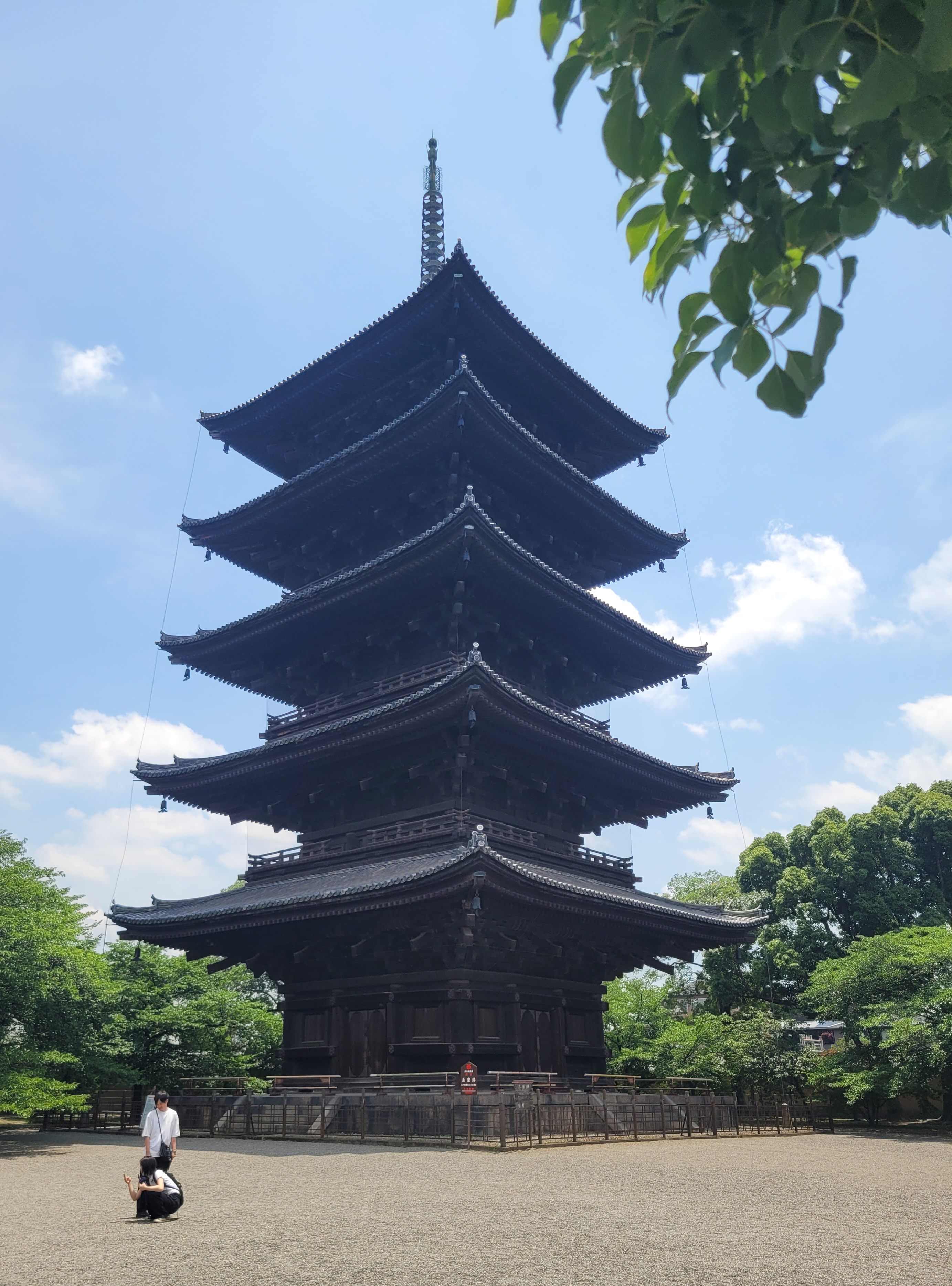
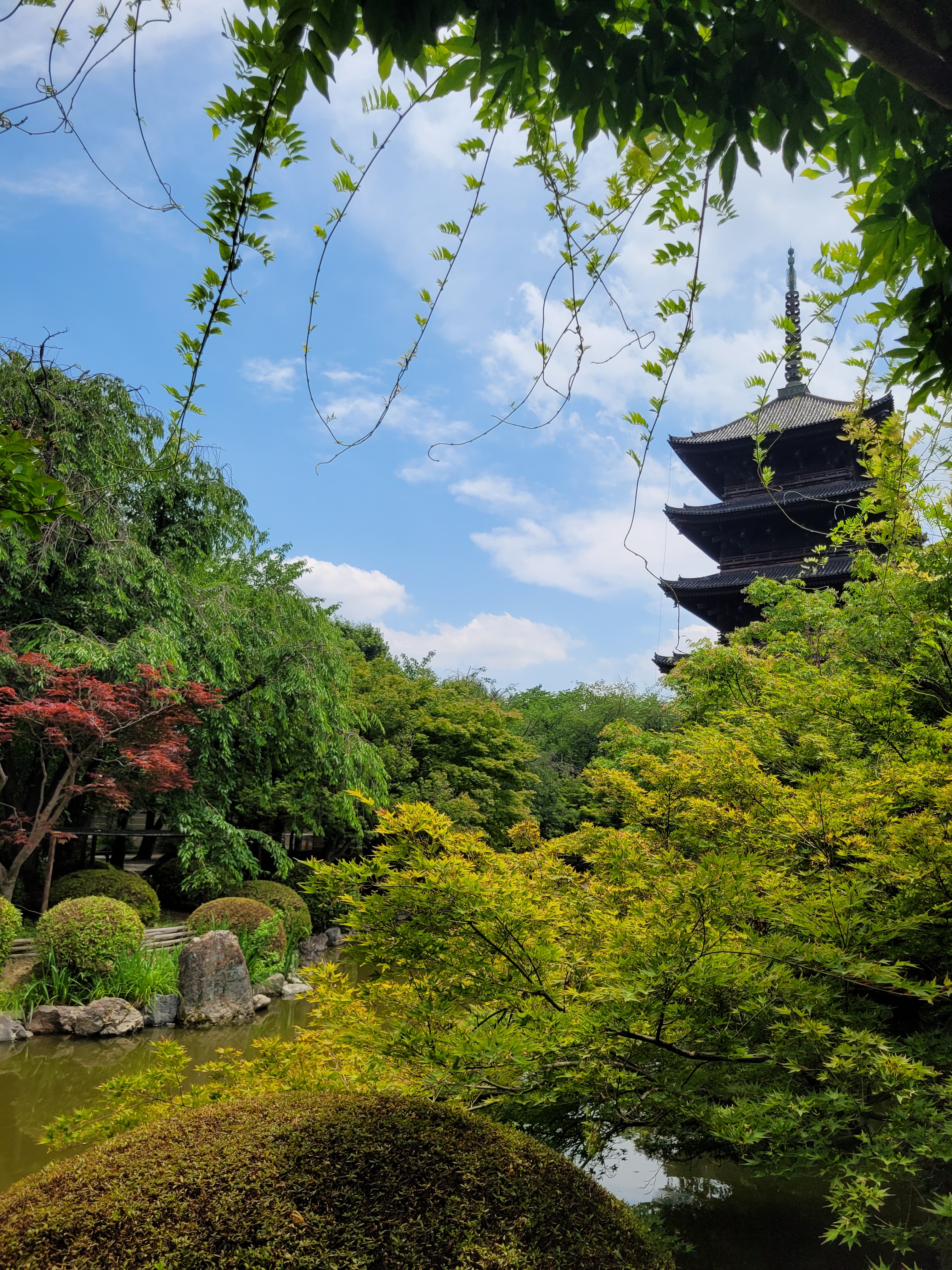
The pagoda was closed that day, but inside are Buddhas and artifacts from antiquity.
The Toji Temple pagoda was astounding to me. I turned the corner making my way from the nearby subway station to the market, and seeing it for the first time conveyed with such a punch: “Yes, you really are in Japan!”
Nothing says “You really are in Japan!” like the indisputable fact of a towering ancient wooden pagoda.

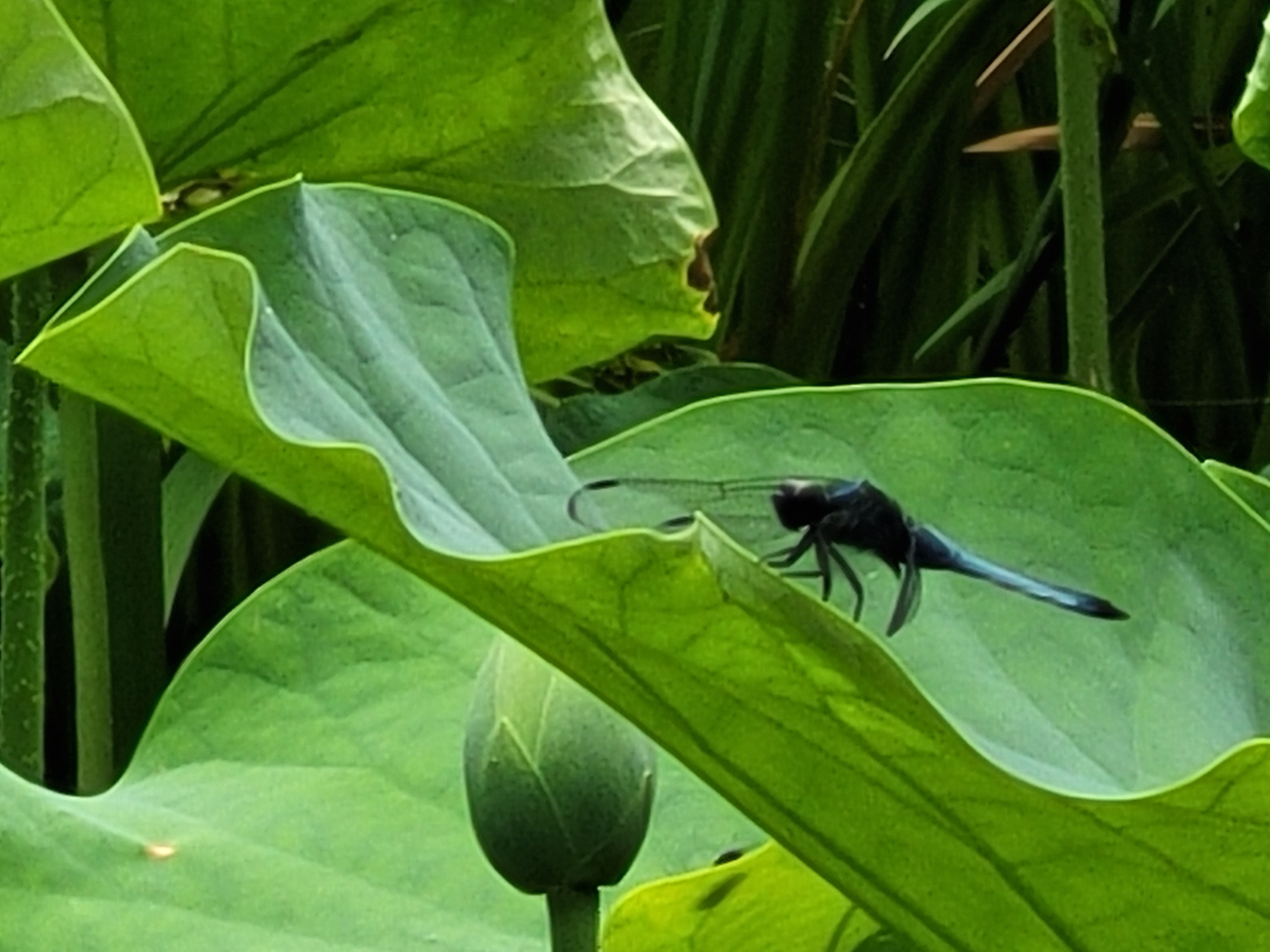
The flea market is free, but the grounds around the pagoda require a ticket for entrance. It is well worth the 800 yen ($5.50) to wander the peaceful paths and pond periphery populated by promenading egrets and a giant dragonfly in calm repose on a lotus leaf.
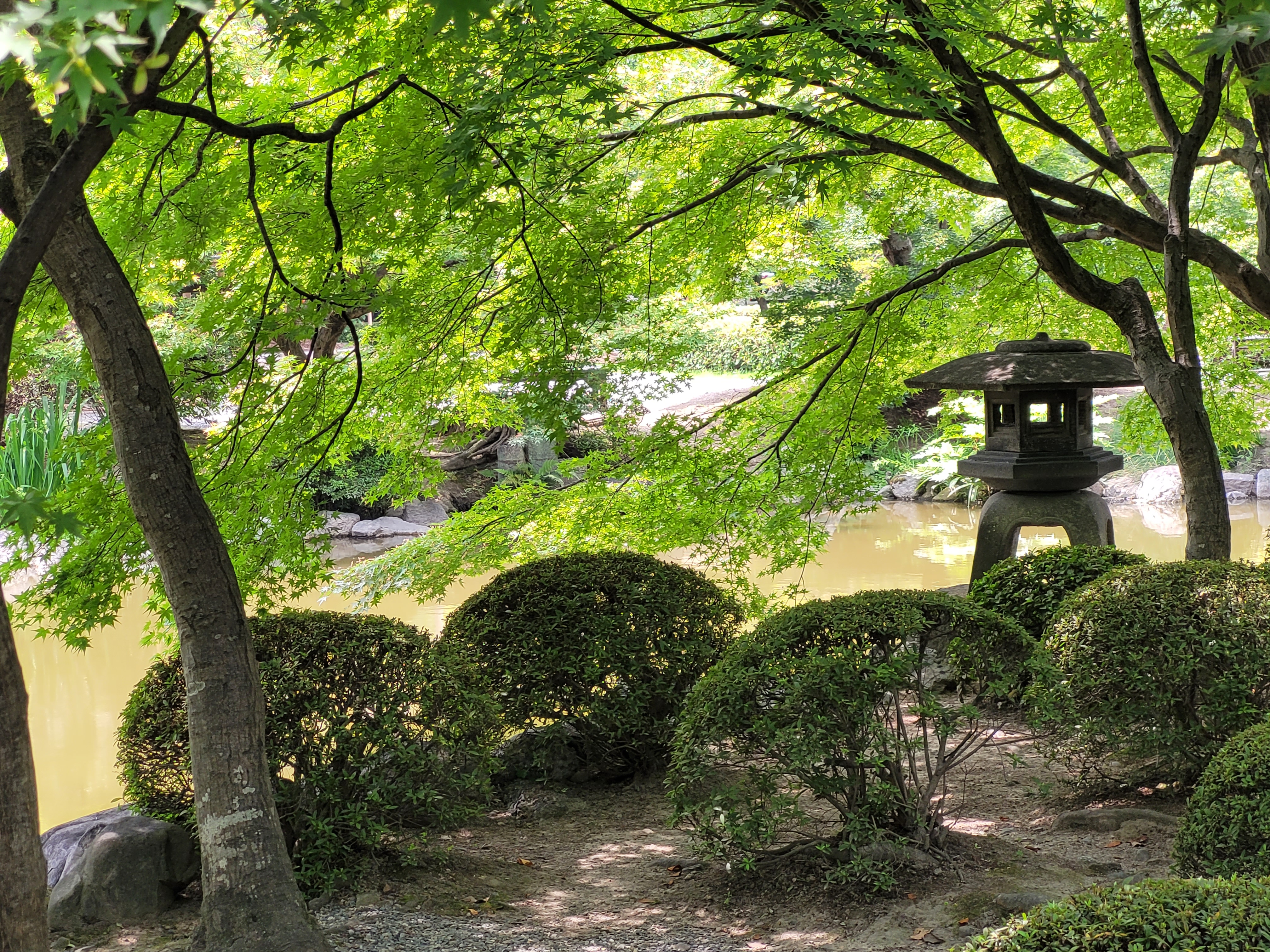


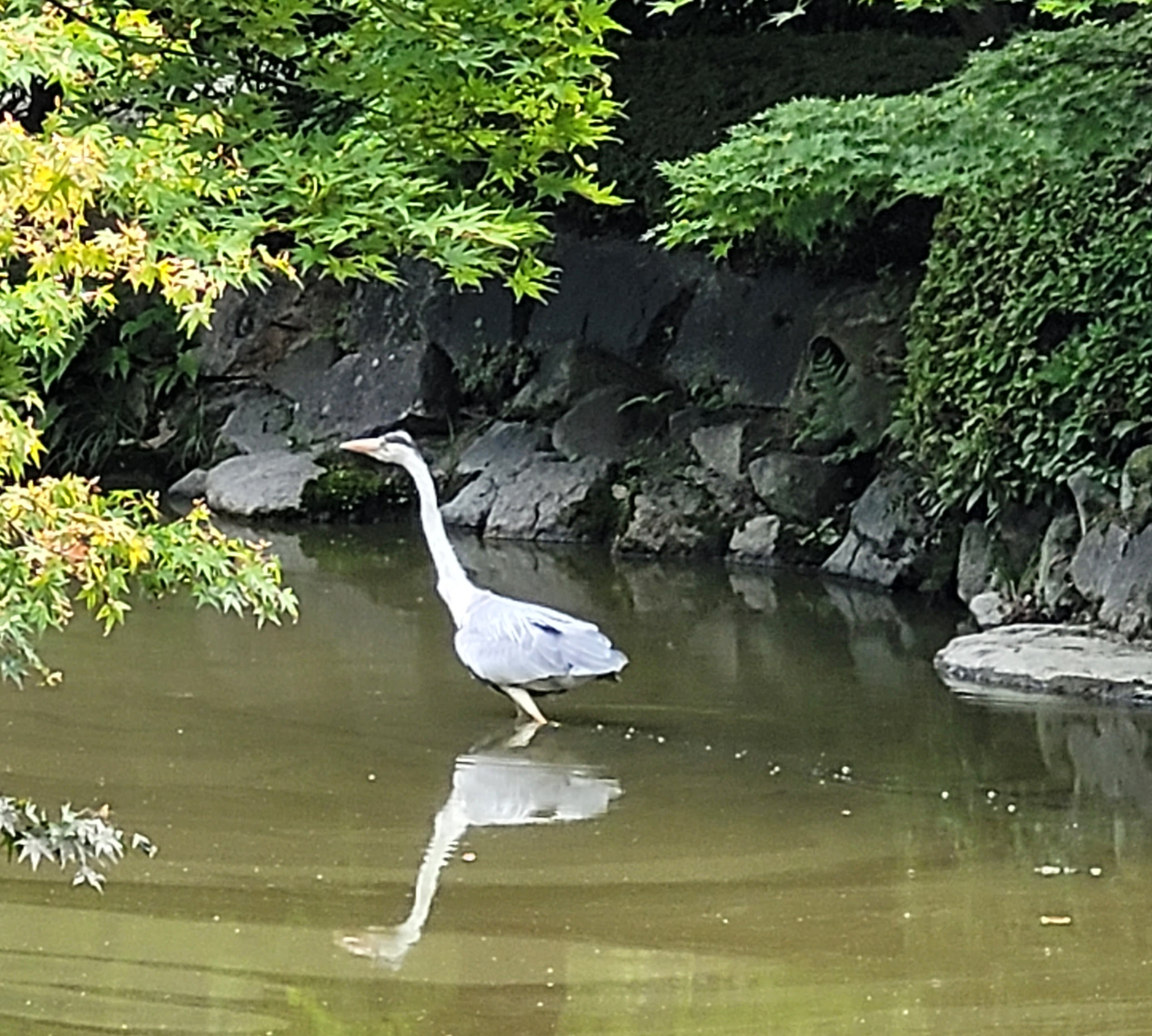

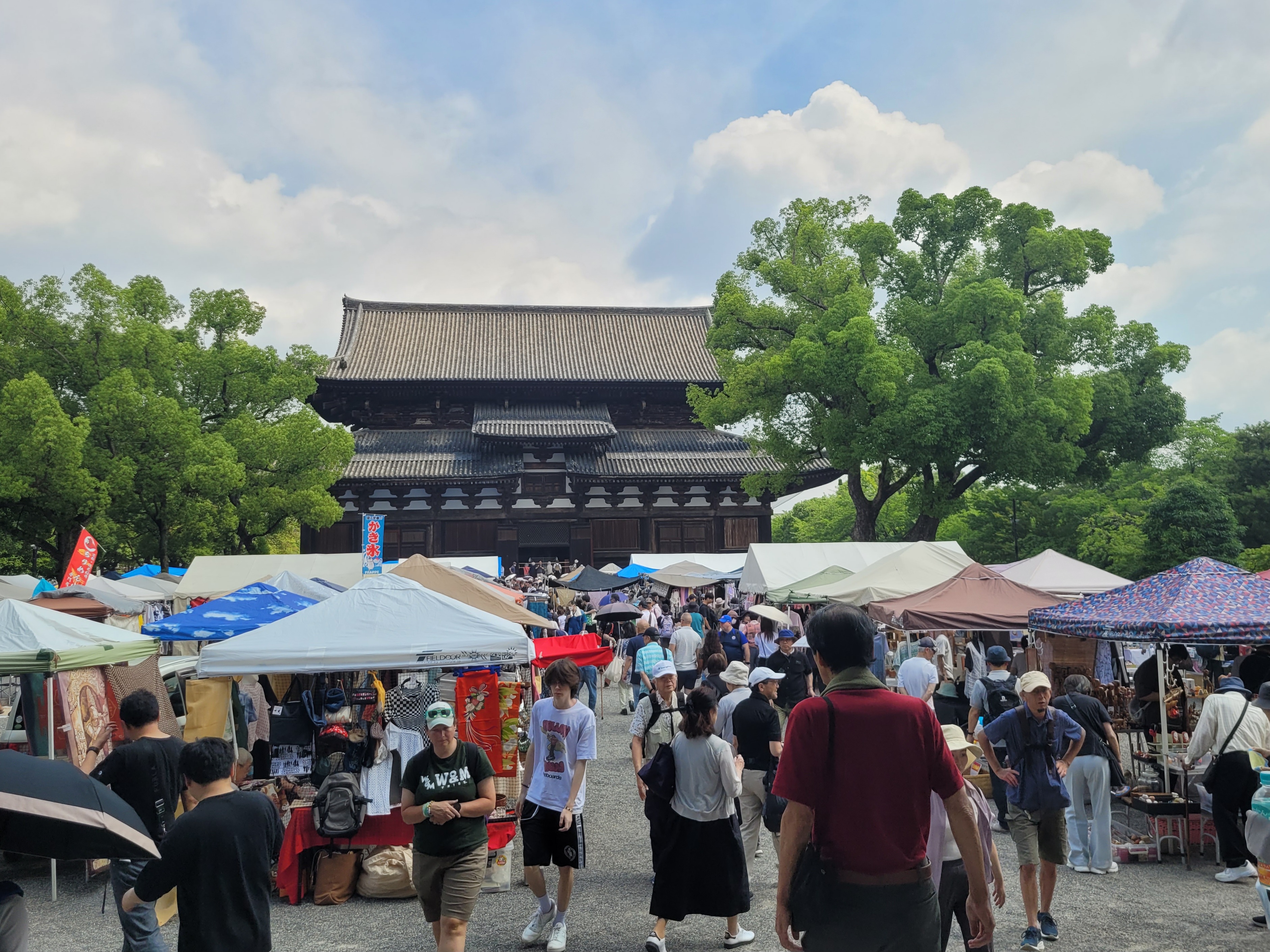
The flea market was in full swing, with hundreds of stalls covering the grounds. One enters from the street up some steps over a moat and then through a formidable gate.

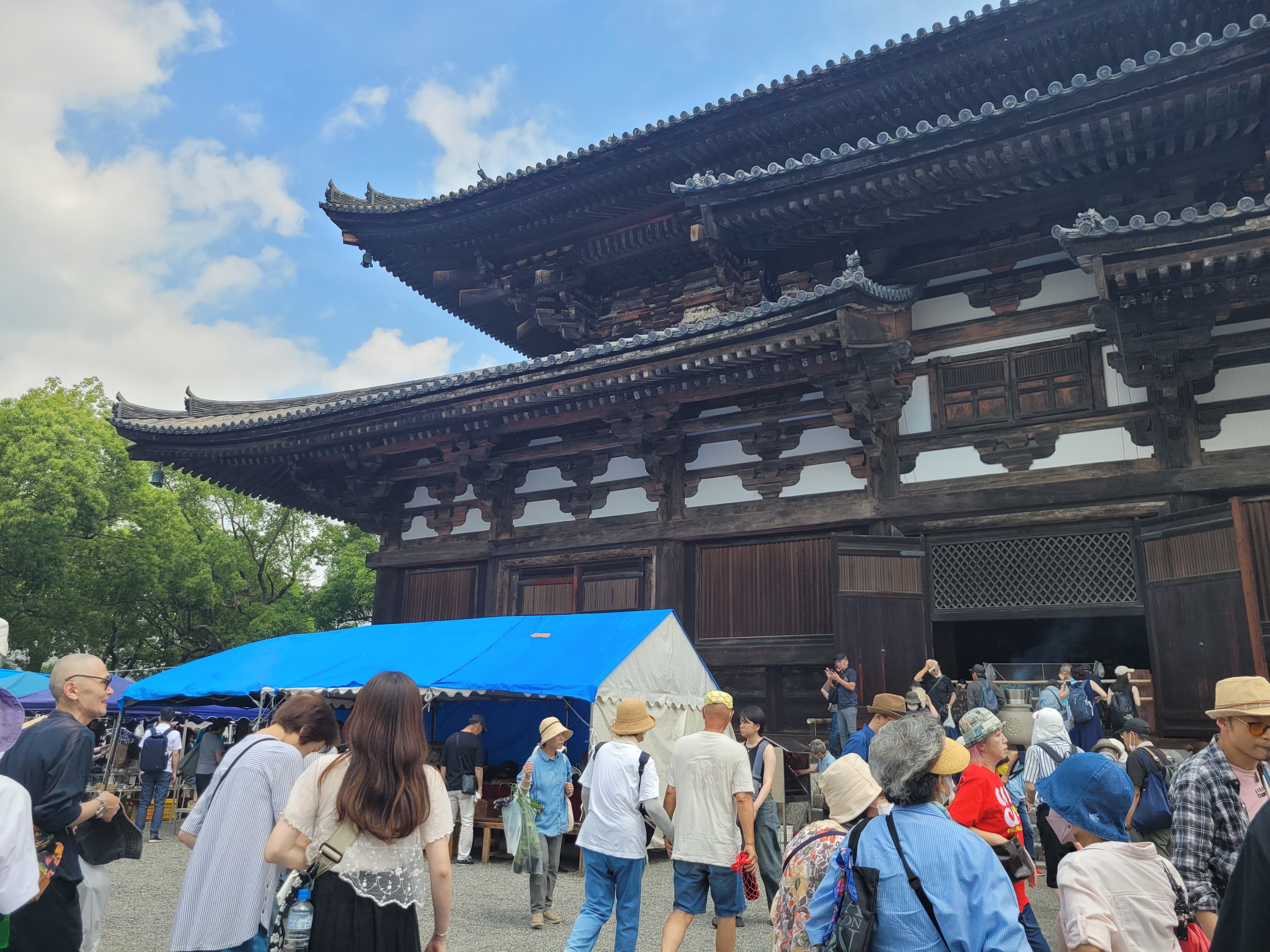

Some people are there to shop, and some to pray in the sandalwood-incense-filled temple halls, bowing at the feet of the giant golden Buddha statues and Bodhisattvas and various fierce guardians. It was actually the summer solstice when I visited the market, set to occur in Japan at 11:42 am. I had hoped to observe the solstice in some manner, but wasn’t sure how that would happen. By chance I took a break from wandering the busy stalls to step into a temple and then noted the fortuitous timing: it was 11:35 am. So at the exact solstice I stood with others facing the massive Buddha while the priest in yellow robes bowed at the front, chanting and striking a gong. I stayed for a while, savoring the scents, sounds, and sights, and also put in a quiet word with the Buddha for some world peace.
That out of the way, I returned to the market as there was still so much more to see.
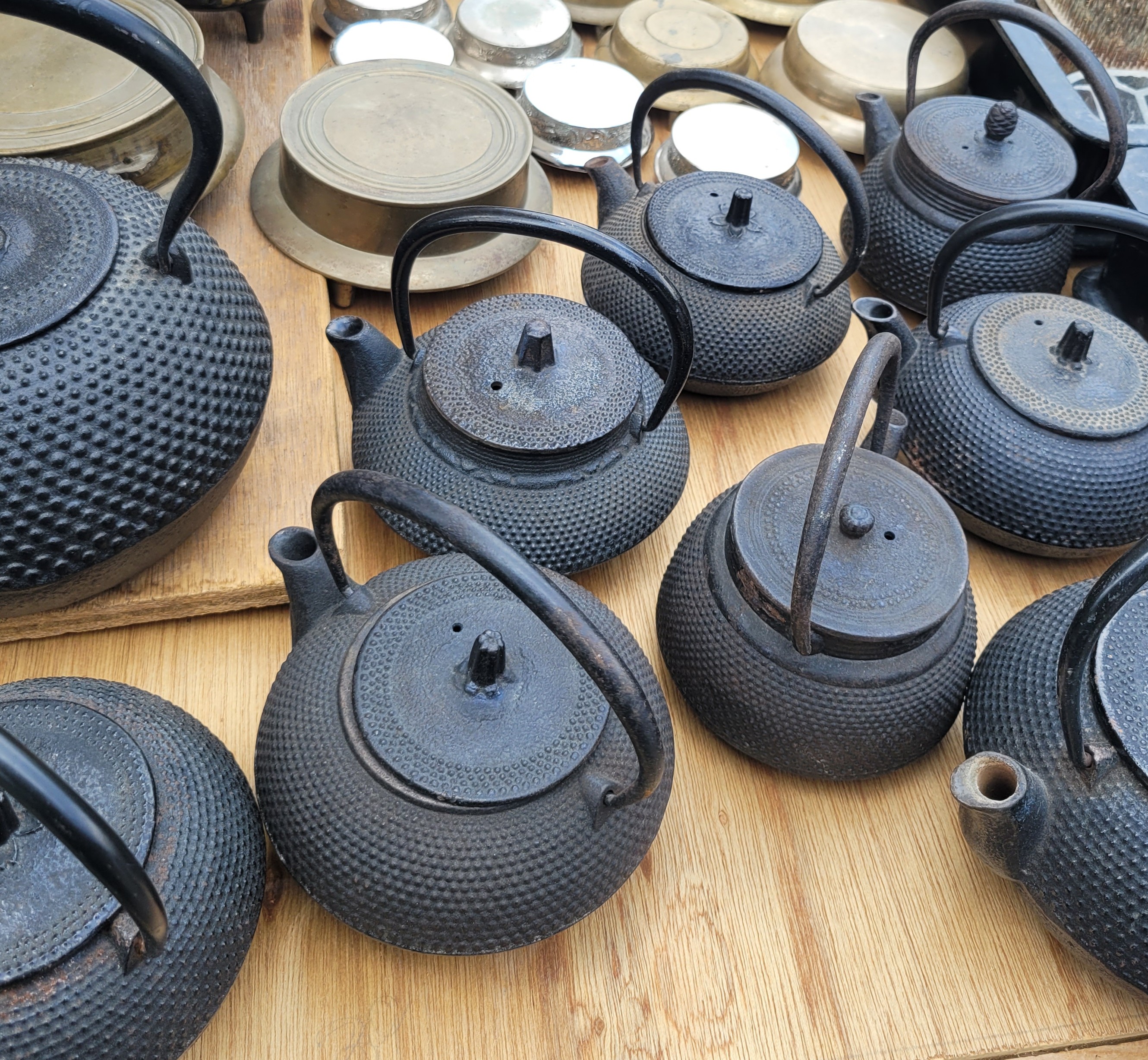
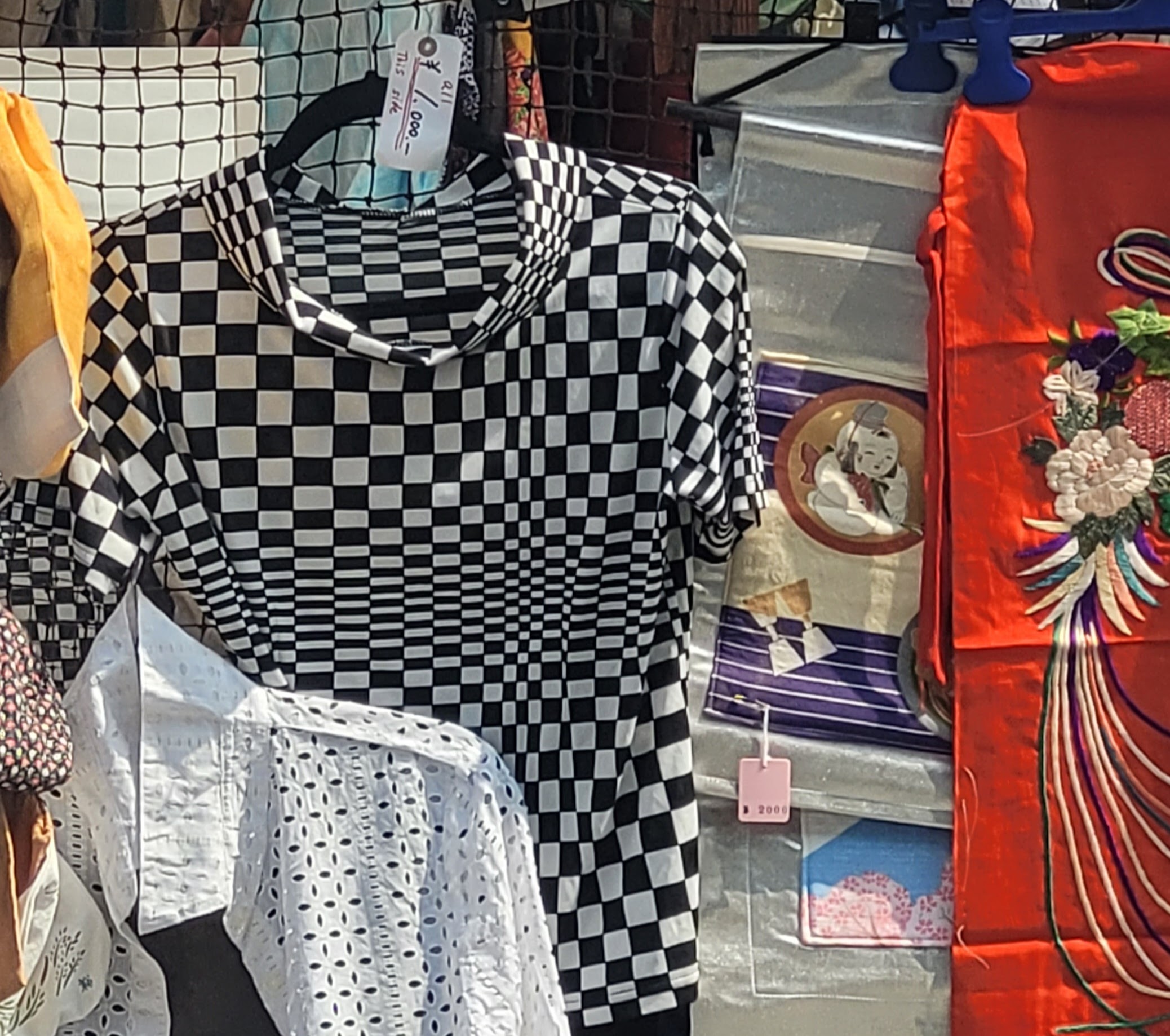
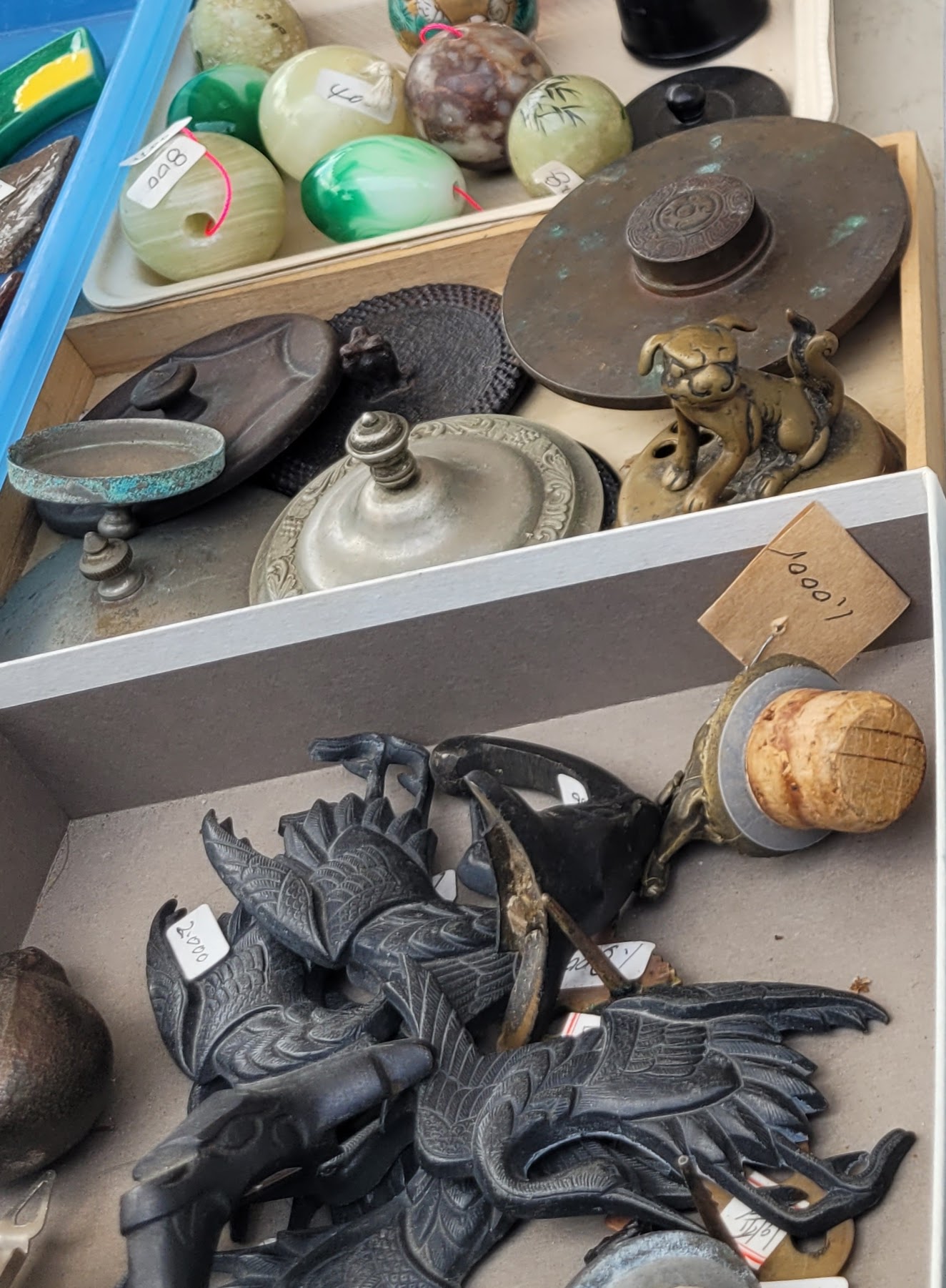

Here are just some of the things I did not buy but really enjoyed looking at: mini pagoda statues for the home, stacks of vintage silk kimonos, barbecued bamboo on a stick (I read one has to boil it first to reduce the level of cyanide before prepping it for human consumption), framed pieces of calligraphy, some sort of branch with narrow green leaves and entire stalls were devoted to selling just these leafy branches in different sizes (edible? seasonal decor?), vintage black-and-white photographs of Tokyo, octopus balls (takoyaki — these are a specialty of the Osaka region and show up often as street food and I will definitely try some as soon as I feel that genuine “Gotta have some octopus balls!” mood engulf my very being), bold wall hangings, a few samurai-type swords, textured metal teapots, unidentifiable things shaped like animals (drawer pulls? bottle openers? both?), bagged varieties of green tea, many kinds of mushrooms, and bowls.


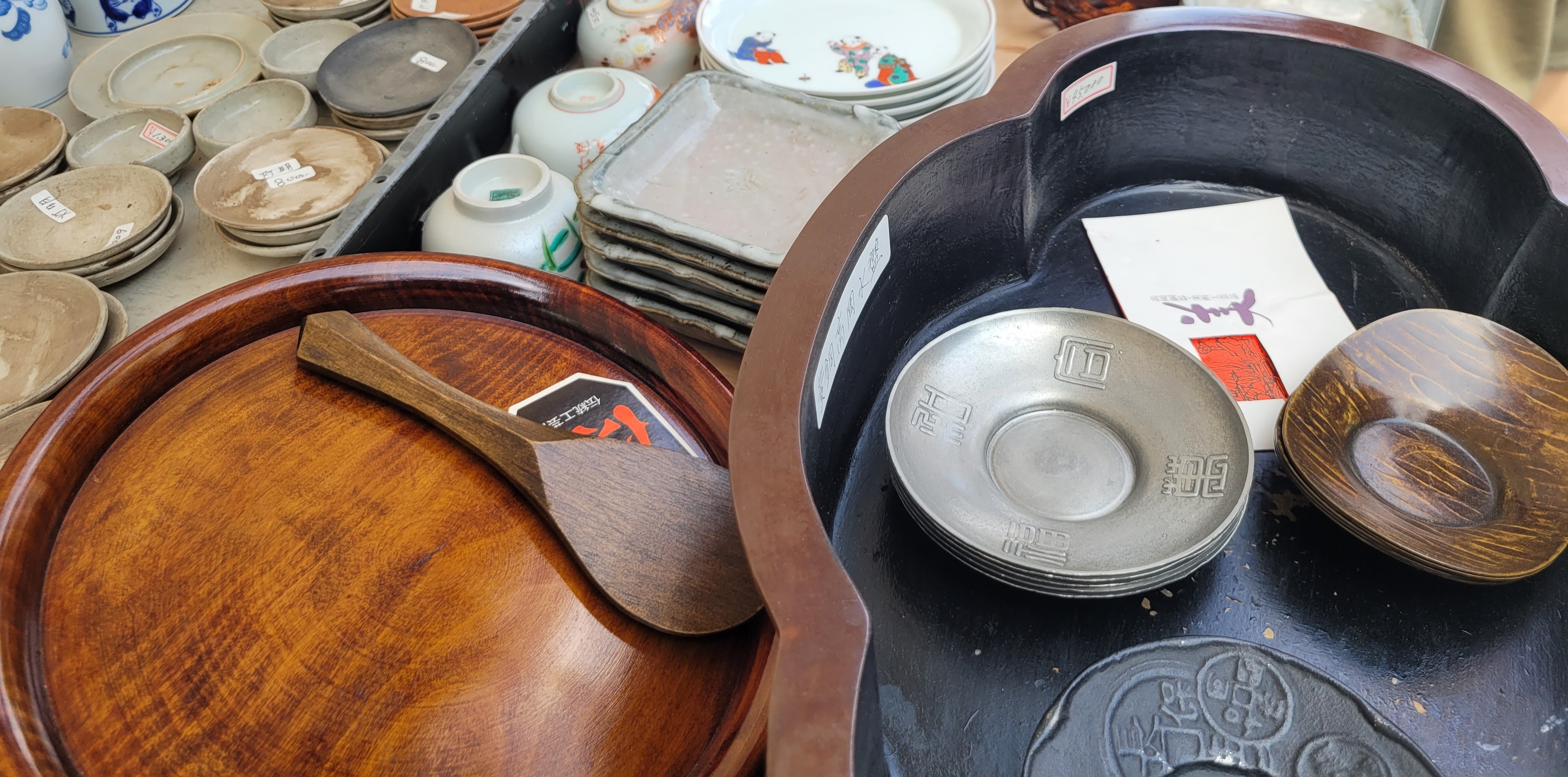
I did not buy any bowls because my thing evidently is taking pictures of bowls. Bowls, being reliably still, make fine photography subjects. And there are many more flea markets around Kyoto in the coming weeks and months, so there will be many more bowls to look at.
Next stop, Kyoto Station
The central train station in Kyoto is a towering modern mountain of a building with activity on many levels at all times.


Everything from local subways to the famous Shinkansen bullet trains to Tokyo arrive and depart from this station. Beneath it is a mall of several levels which I have yet to explore — I thought I’d save it for a very rainy day, now that it is the rainy season here in Kyoto.
CAT SIGHTINGS, PART 2.
I think I am fixated on cat sightings around here because talking about cats is actually one of the few things I can currently manage in Japanese. There are very few Japanese phrases I can utter confidently at present. But here are two of them:
Sore wa neko desu ka? Is that a cat?
Hai! Kore wa neko desu! Yes! This is a cat!
You have to imagine these lines delivered with such a suave degree of confidence that even native Japanese speakers swerve to look for the cat when I utter my sentences, even though there is (so far) never any actual cat and every time I have deployed these lines I have in fact been pointing at air. But these are words I know how to say in Japanese!
I can also ask about the location of the Number 8 bus, with absolutely incredible conviction.
“I Think I’m Learning Japanese, I Think I’m Learning Japanese, I Really Think So”
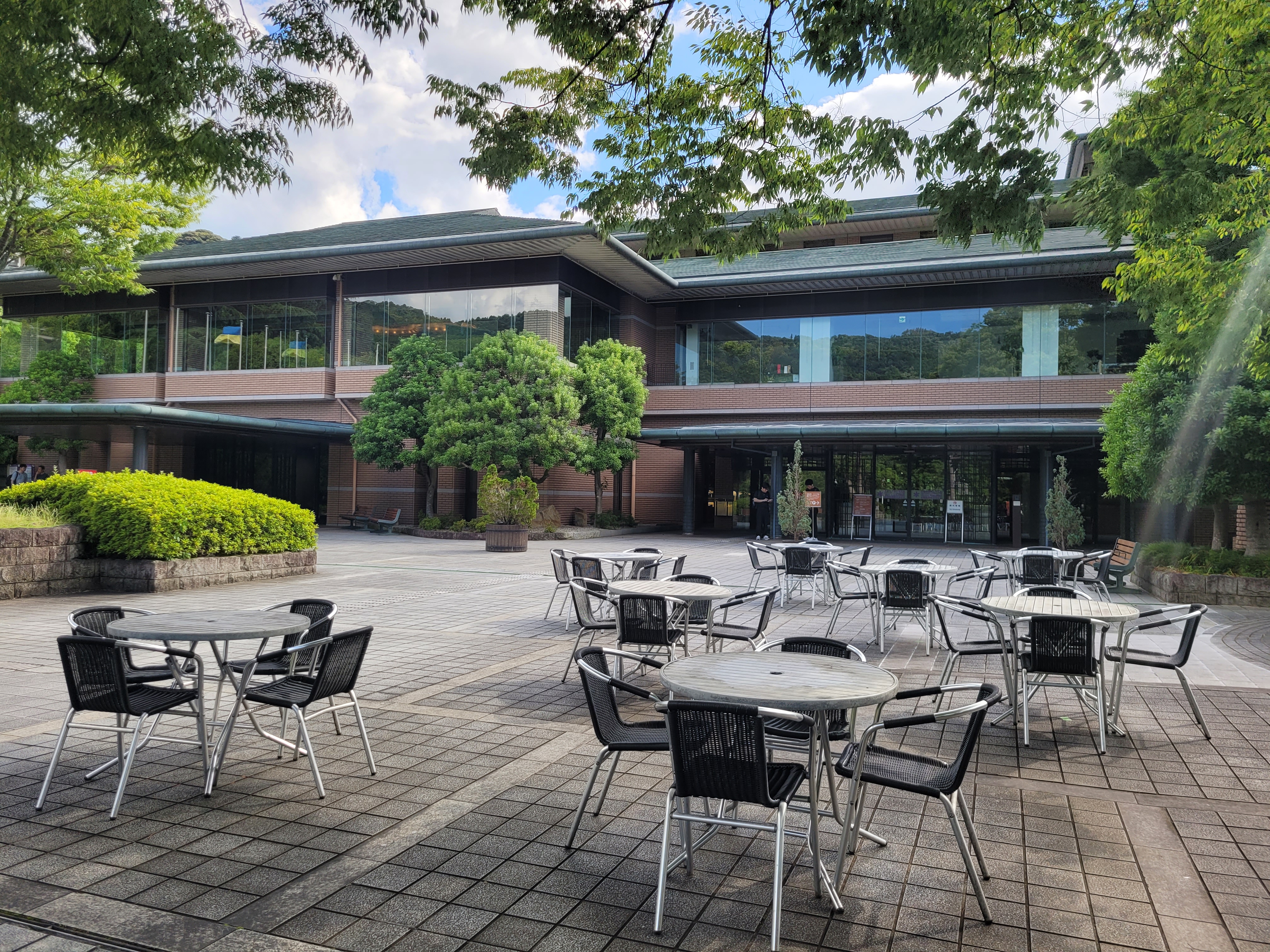
I have started attending Japanese classes at the Kyoto International Community House, called Kokoka. There is a schedule of volunteer-taught classes all week, and I have been fitting them in when I am not at work on campus. The building is some seriously spectacular modernism, and the teachers are all very welcoming and enthusiastic.

At the Toji Temple flea market I tried to do everything using the few Japanese words I know so far. There were triumphs, like when I paid for a new teal silk shirt, and the vendor pointed out that the pattern on the fabric was hand-painted, and I remarked, “Utsukushi desu!” or “It’s beautiful!” Two Japanese women standing nearby beamed and actually applauded my Japanese.
It may never get any better than that.
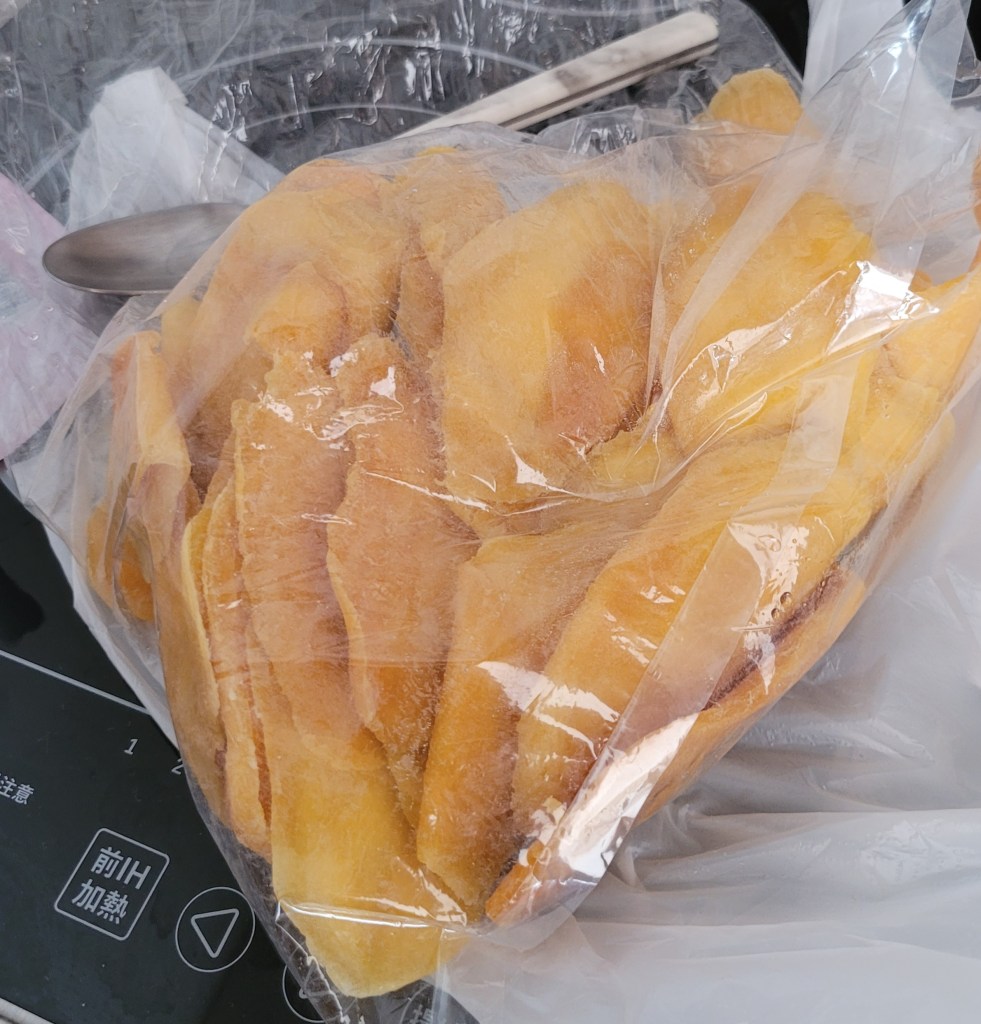
I also managed to accidentally buy a lifetime supply of dried mango slices at the market. I asked for an amount that was “chisai” or small, and tossed the bag into my backpack, only noting when I got home its significant heft, and that I really need to learn more shopping vocabulary: “Not so much!” “How about half of that?”
It is very good dried mango though, and if I see any of you in the next decade or so, please do ask to try some.


 Where No Mangoes
Leave a reply to DanBaoFan Cancel reply