
Location, Location, Location
I have been thinking about what makes places seem special. Much in Japan seems special to me so far — so much is new to me and there is an emphasis everywhere on the beauty of nature.
Other than doing a walk via Google maps online to see a little of the neighborhood where I’d first be living, I did not dig too deeply into previewing Japan before I arrived here. I wanted to be surprised, and so far that has worked out rather well.


I am often surprised in Japan, by Japan.
One of the first surprises was the classroom I’d be teaching in at the new Kyoto campus: a traditional Japanese classroom, or kyōshitsu (教室).
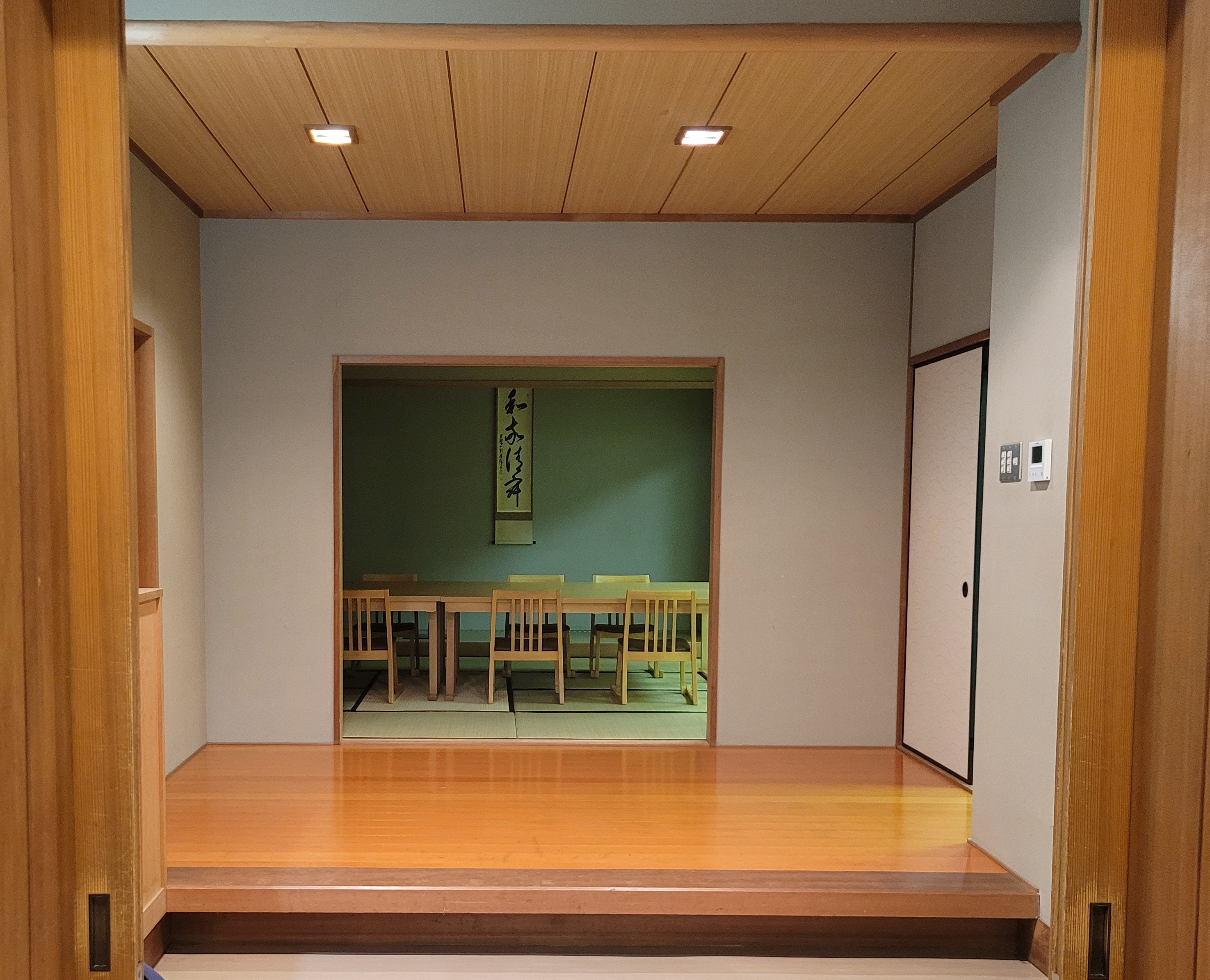
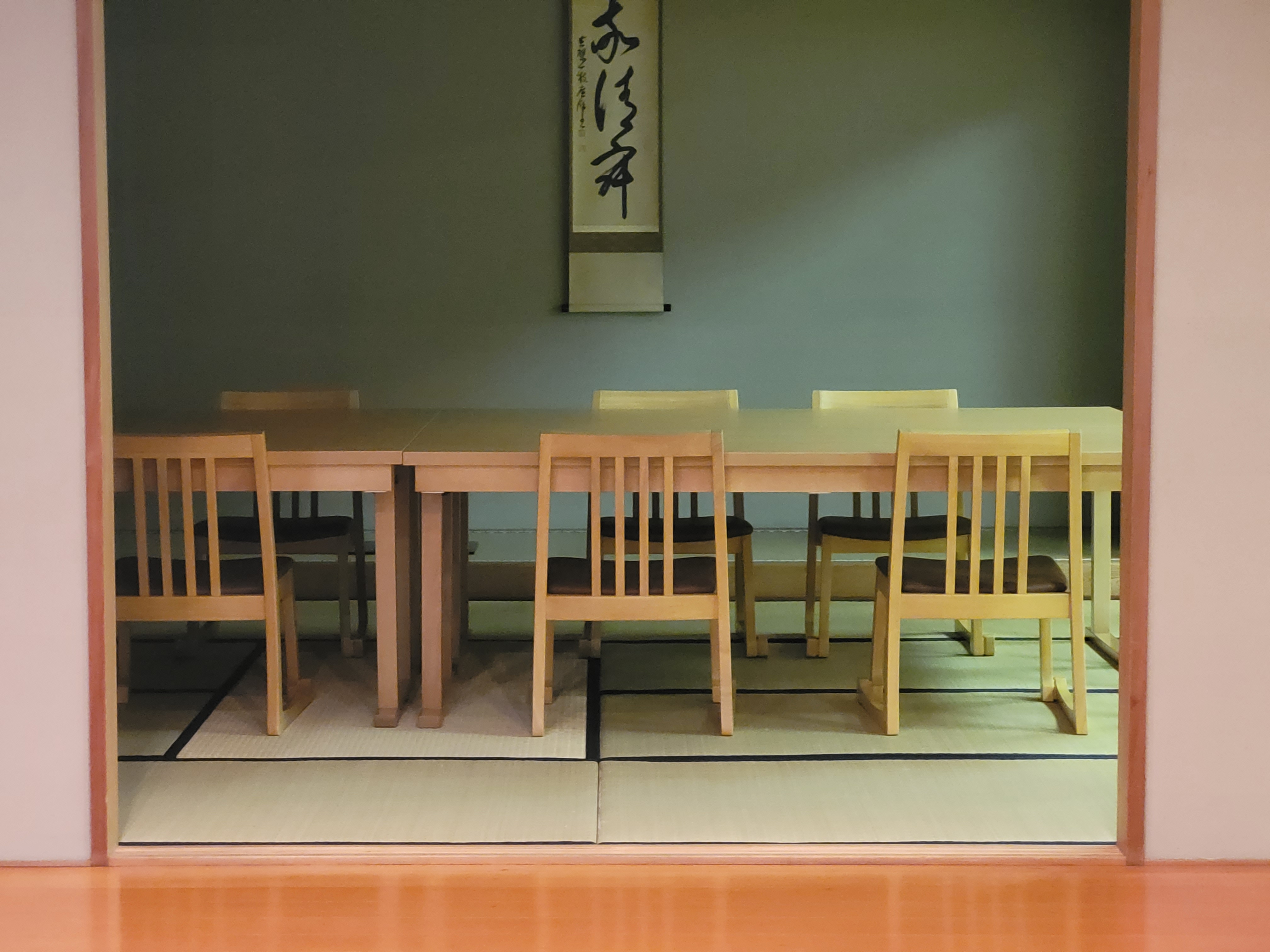
A traditional Japanese classroom! Where you have to remove your shoes before entering, and then pad in in your socks or bare feet. The floor is lined with tatami mats, made of natural textiles from the fields. The mats are woven rushes covering rice straw, which scents the entire room with an herbal sun-baked scent. With lovely low wooden tables and chairs.

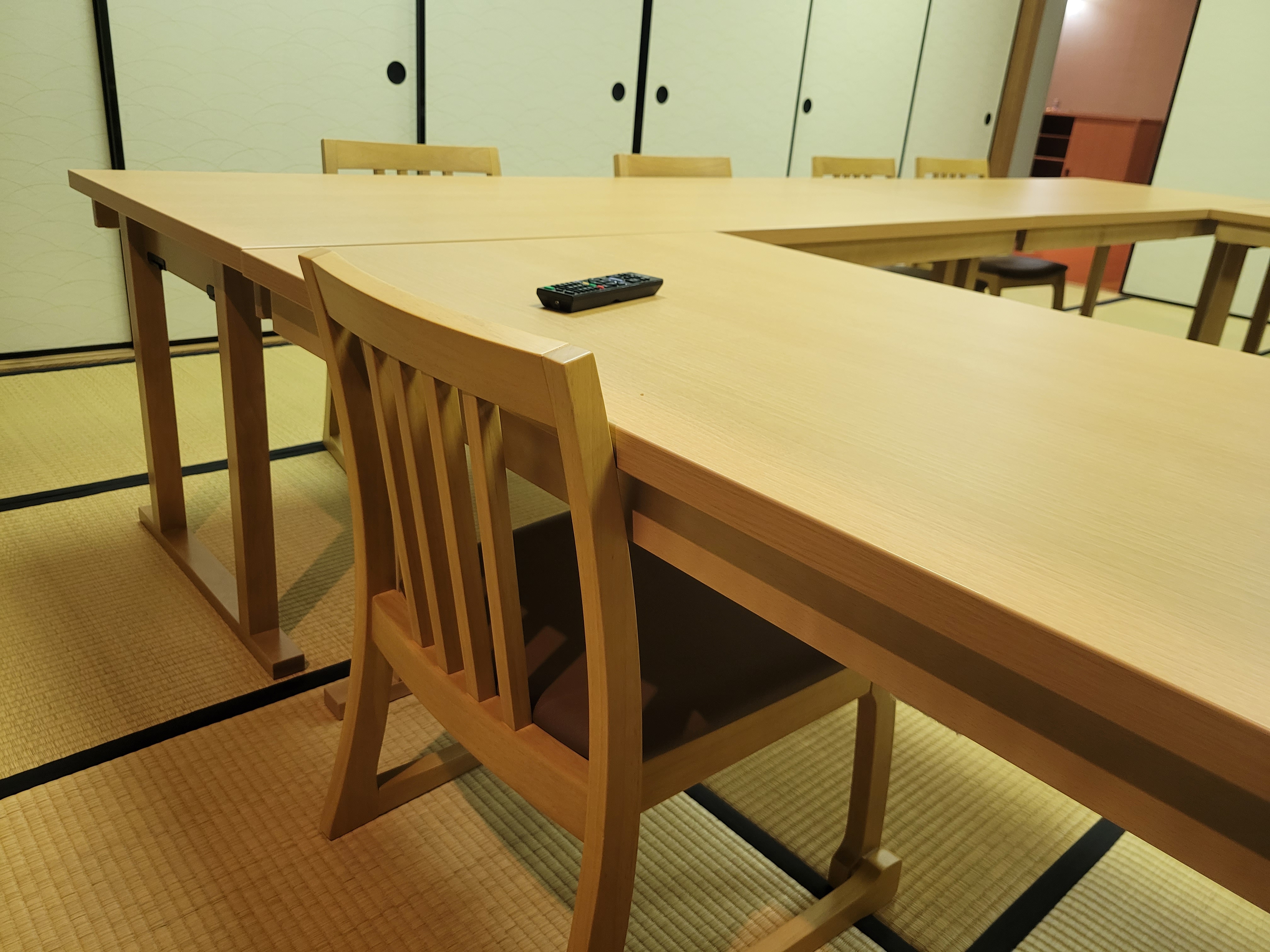
Okay, so having to take off my shoes, which in my case are always black, vegan-leather, high-sole Doc Martens Oxfords, means losing a crucial two inches in height. But Japan is historically unyielding in its “No Shoes On The Tatami Mats Ever” rule, so for every class I shrank two inches, because that is how you show respect for the culture around here.
But I have to admit that seeing the classroom the first time made me emotional. Like, a bit of surprise teary for a moment. And it took me a little time to figure out why.
It was because this was a space built around the idea of honoring teaching and learning. That idea resonated deeply for me. Through the years I have taught with commitment and energy in rooms with dangling broken window blinds, with no windows at all, or packed out with no room for a chair for me to sit down. And I ignored all that, and just got on with the plan. (That was Temple University main campus not that long ago. But when I was assigned a cramped windowless classroom again more recently, I put on my tallest Doc Martens and sent a ferocious email to the scheduling office and got that class moved in a flash to a suitable space with windows and enough desks and chairs.)
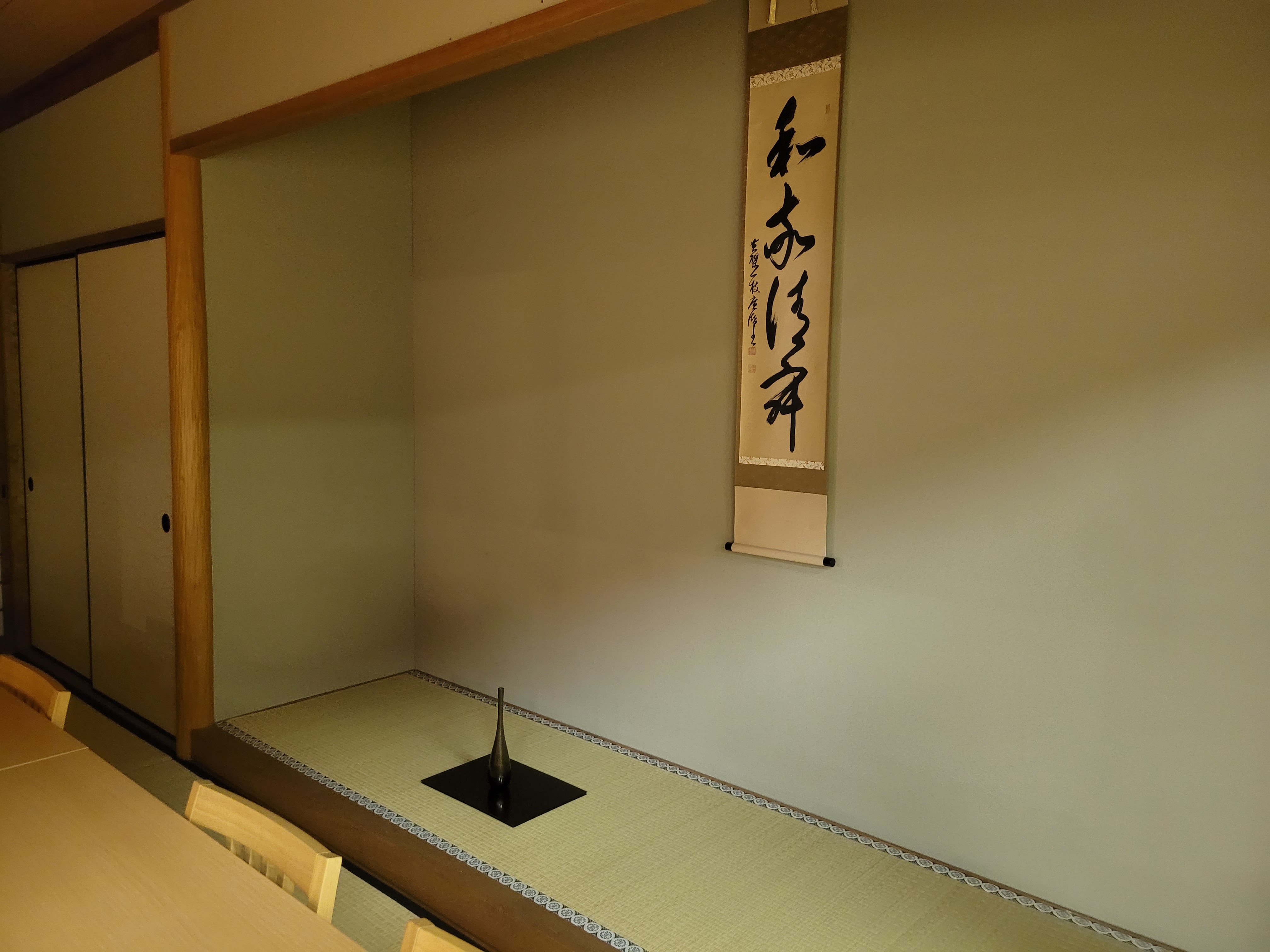
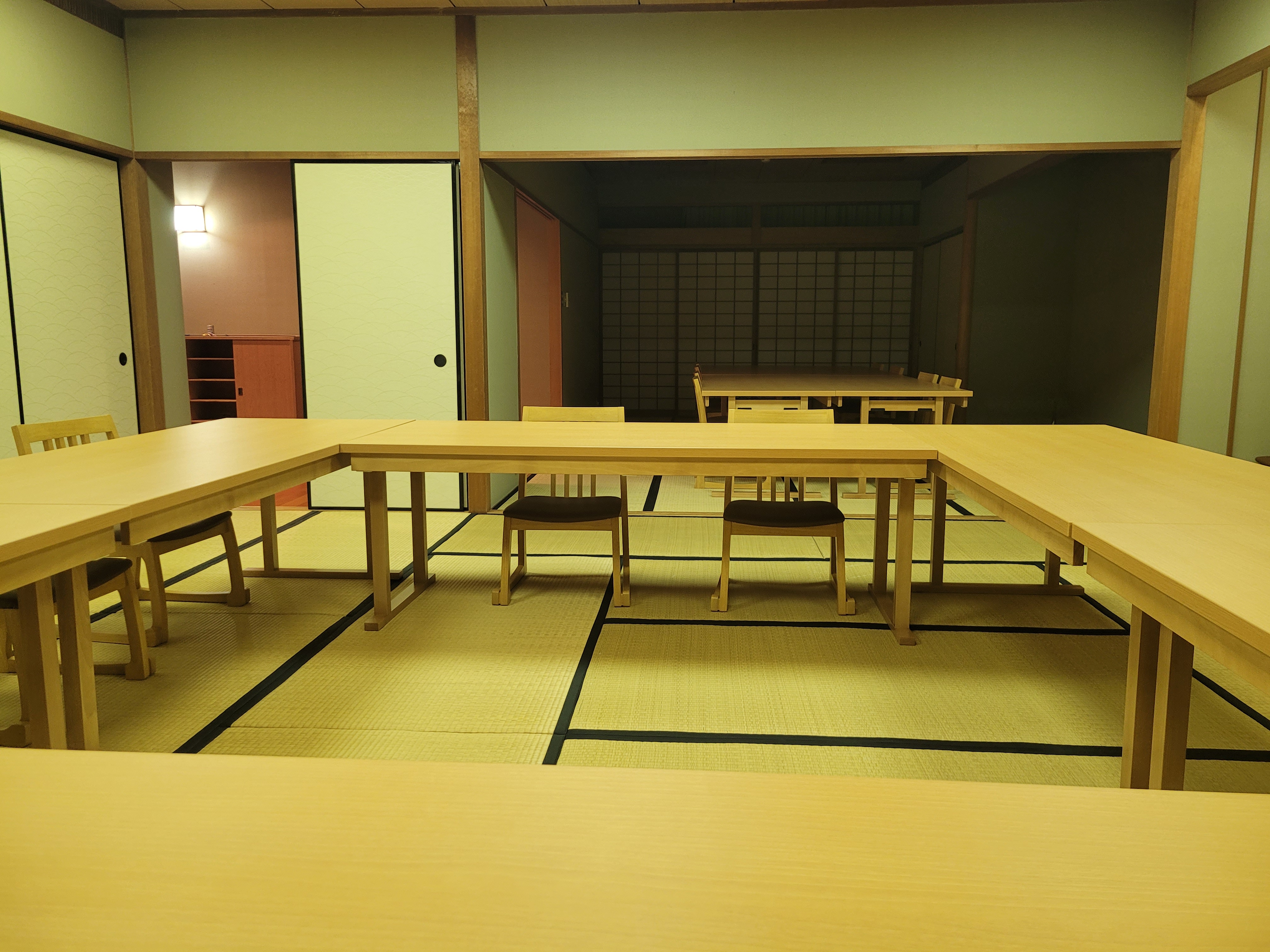
To get to be a teacher in a room which celebrates teaching felt pretty special. I got to work in that room, the only kyōshitsu on the Kyoto campus, for all of the summer term here, and I am very grateful to have had that experience. When fall semester starts I will be based in other rooms, which is also fine because I have already gone on a reconnaisance mission to see my next class spaces, and they are all brand new and absolutely spiffing, with windows, shades, and plenty of space for everybody to sit down.
Not All Temples Have Tourists
Japan is attracting a lot of tourists at present, as the yen is weak, whatever that means, and the country has a reputation for being very safe, which only means one thing and that is no guns, so some places are getting very crowded. (I too am inexplicably drawn to places where nobody is gonna shoot me.) I am a tourist, although one with a work visa and a job here, but I still bumble around speaking terrible Japanese and spending entire evenings translating package labels in the supermarket with my phone. Because: is this pickled beets or pickled octopus?
But it can be unpleasant in an overcrowded place when you can’t see the thing you came to see because of the wall of other people already here seeing it.
I shared my first visit to the famous Fushimi Inari Shinto Shrine in an earlier blog post, as I had shared the shrine with innumerable other visitors on that day. It’s a popular destination and often jammed with tour groups.
But a week later I was walking north of Kyoto Station on a mission to find a Japanese sim card for my phone and some ice cream, and I glimpsed a very decorated building roof, so I headed towards it to investigate.
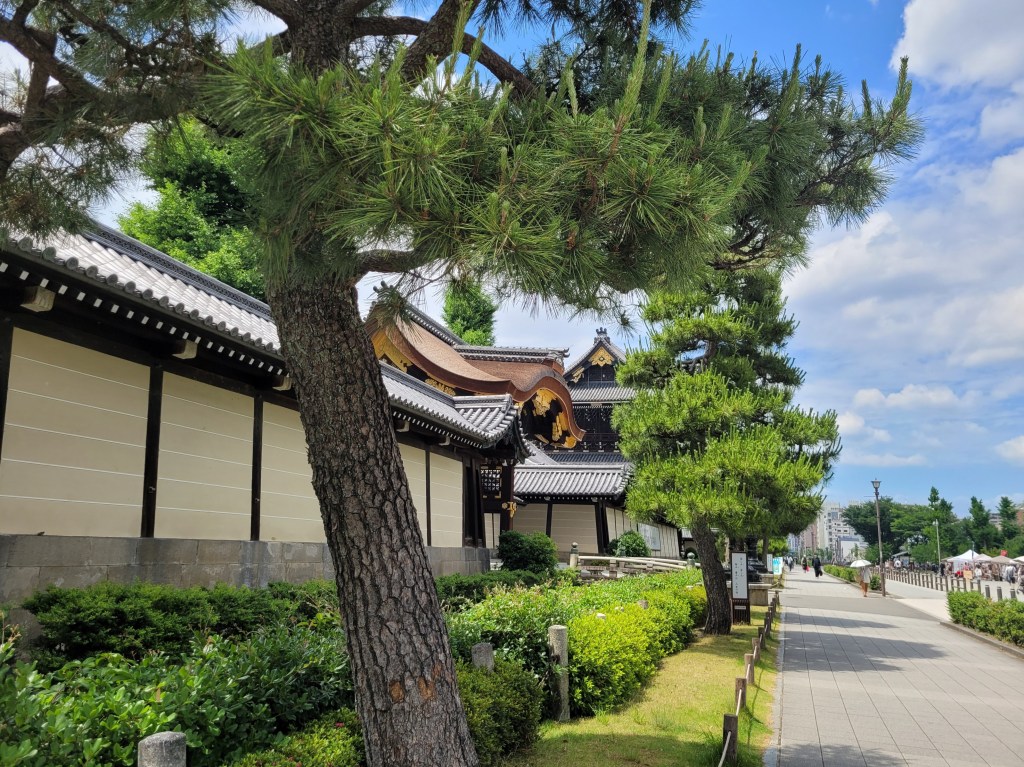
“What ho?” I would have said aloud had I been a character in a jolly P. G. Wodehouse novel! But as I am not I just plodded along and took pictures.
I took pictures of the surprisingly large koi fish swimming towards me in the building’s moat. They were each the size of a loaf of Wonder Bread and seemed to be anticipating the immediate delivery of food.


I took pictures of this massive gate which loomed into view. It was stunning.
I walked through the gate into a vast temple compound. I had discovered the Higashi Hongan-ji Buddhist Temple grounds! And apparently almost no one else had…

The huge gravel courtyard was practically empty. Central Kyoto near the Kyoto train station is one of the busiest locations in the city. But a mere 3 blocks up the road from the bustling station was nearly deserted. But what a location.
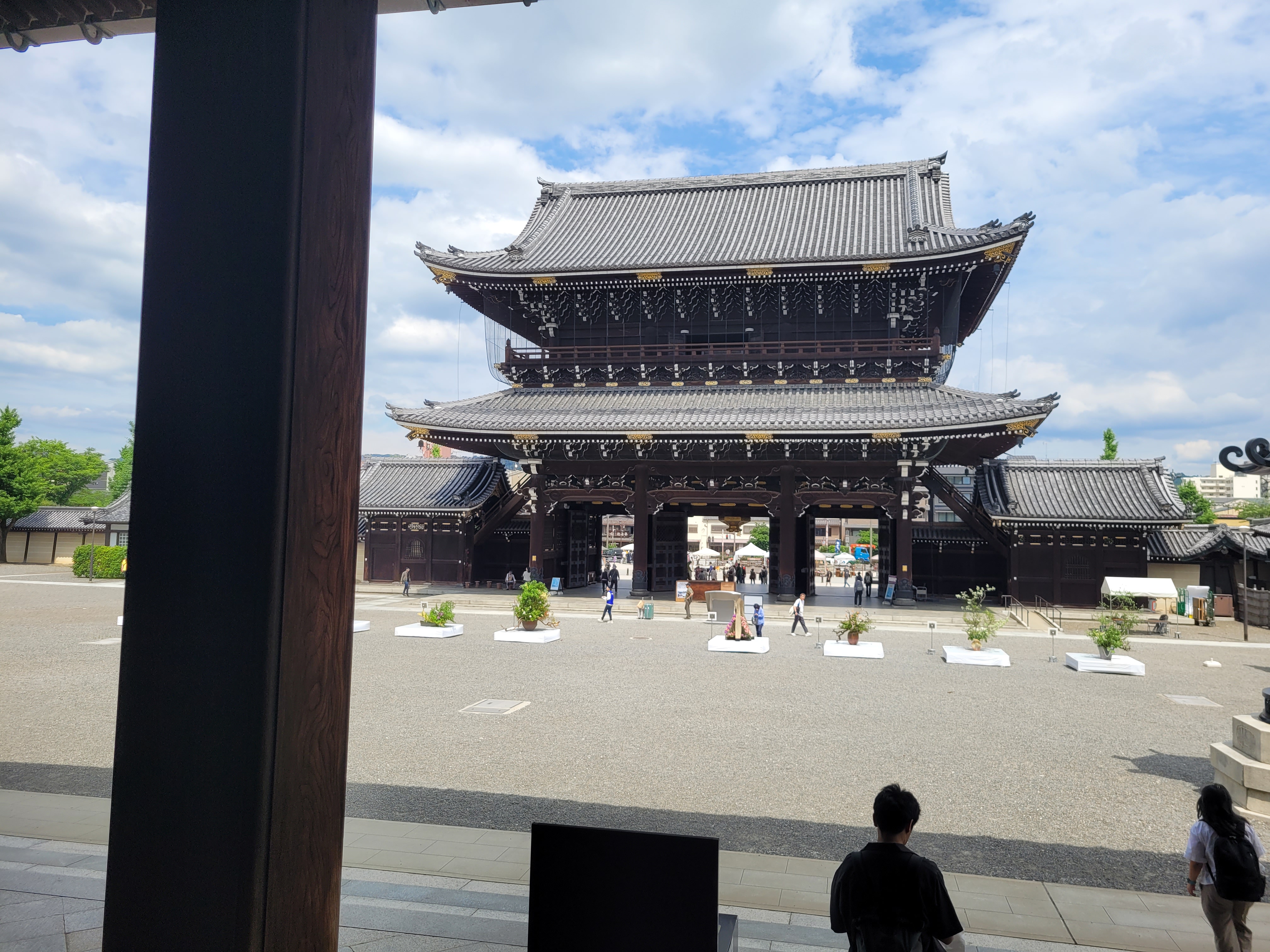


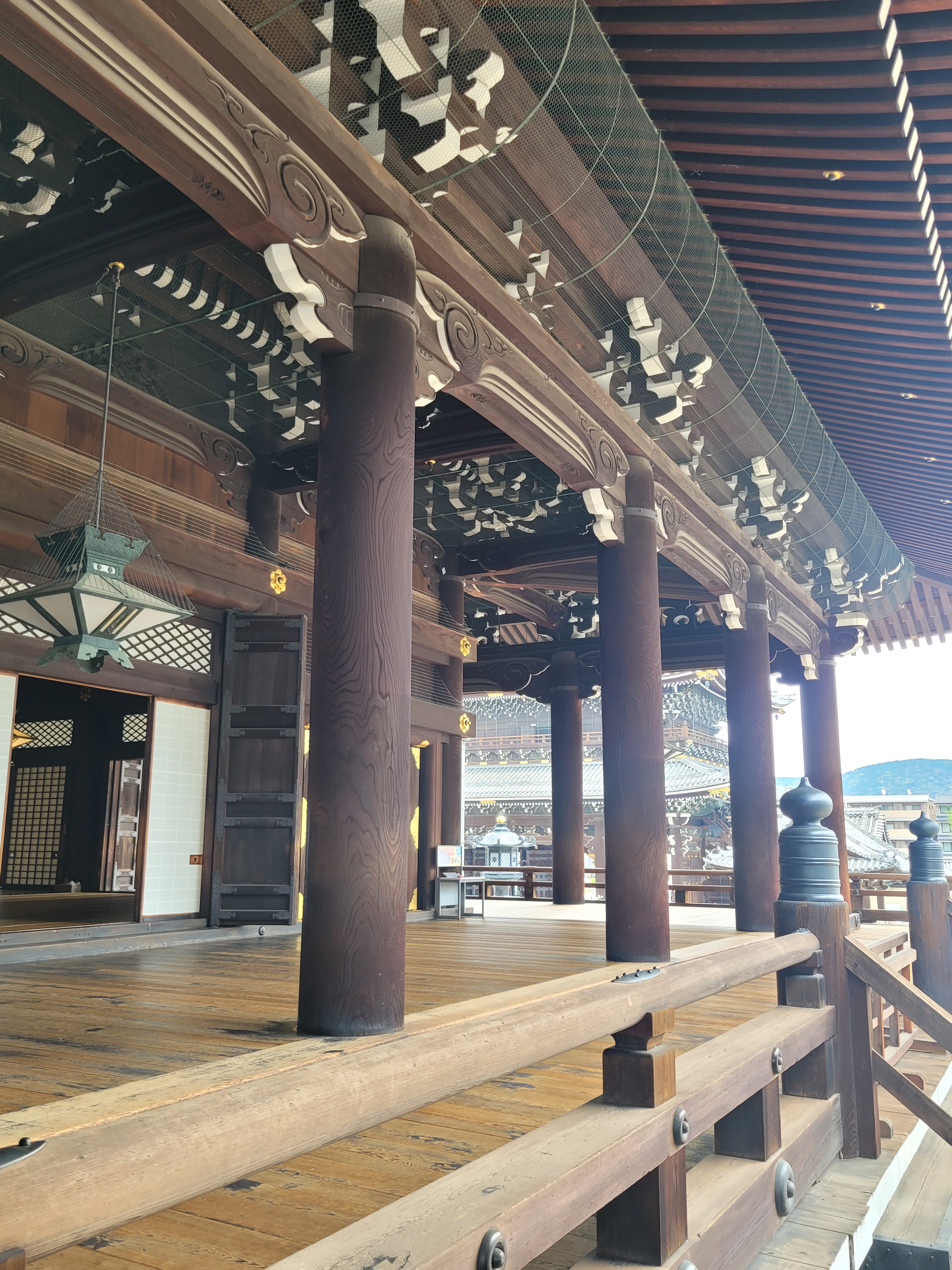

I’d happened upon Founder’s Hall, one of the largest wooden buildings in the world, honoring the founding of one of the branches of Japanese Buddhism. The current building is 130 years old, and a temple has stood on the site since the mid-1600s. There is a sister temple next door connected by porches, Amida Hall, also massive and venerable, and also perfumed with sandalwood incense. And of course there are decorated statues of the Buddha, peaceful among the lotus leaves.
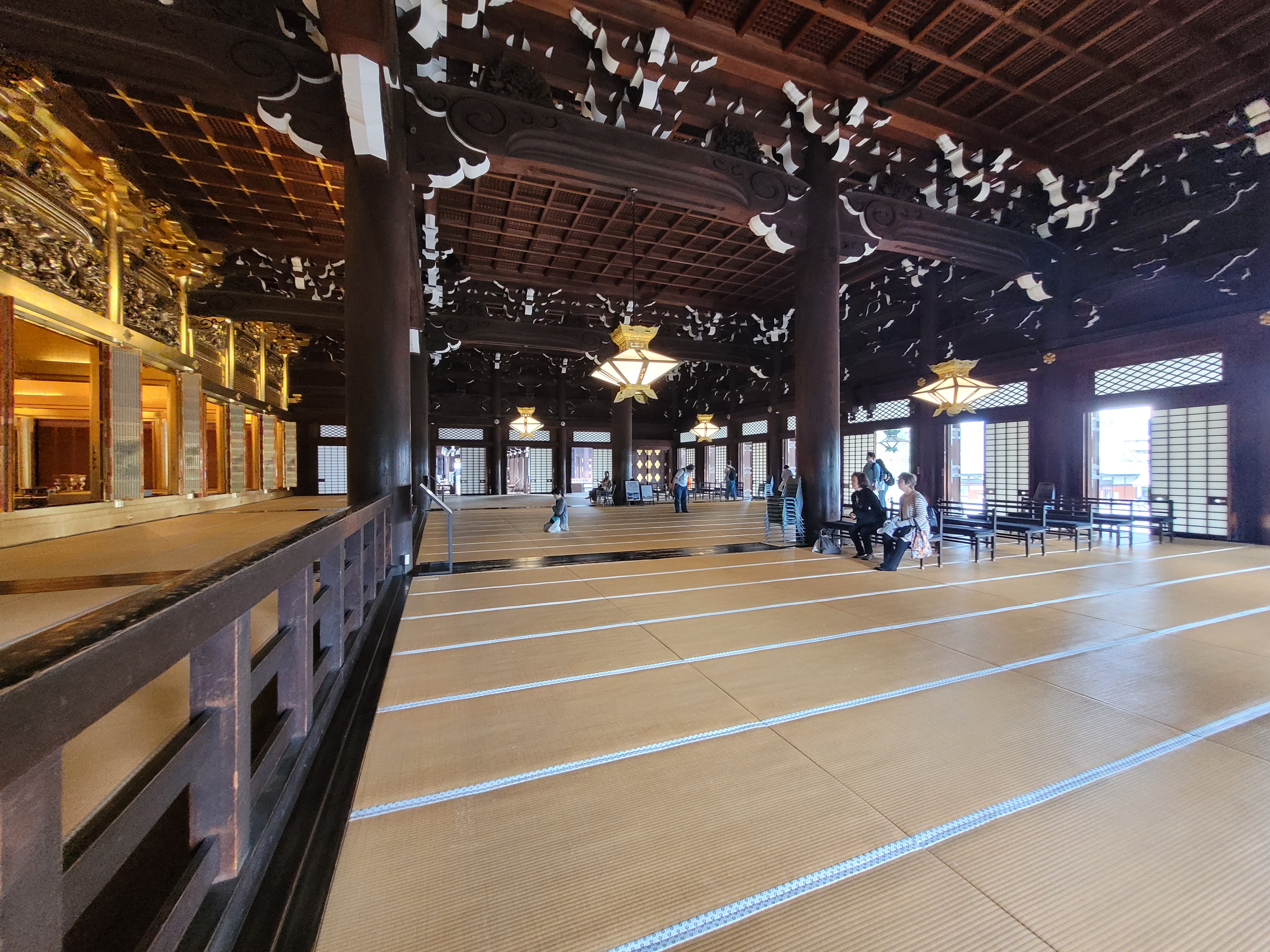
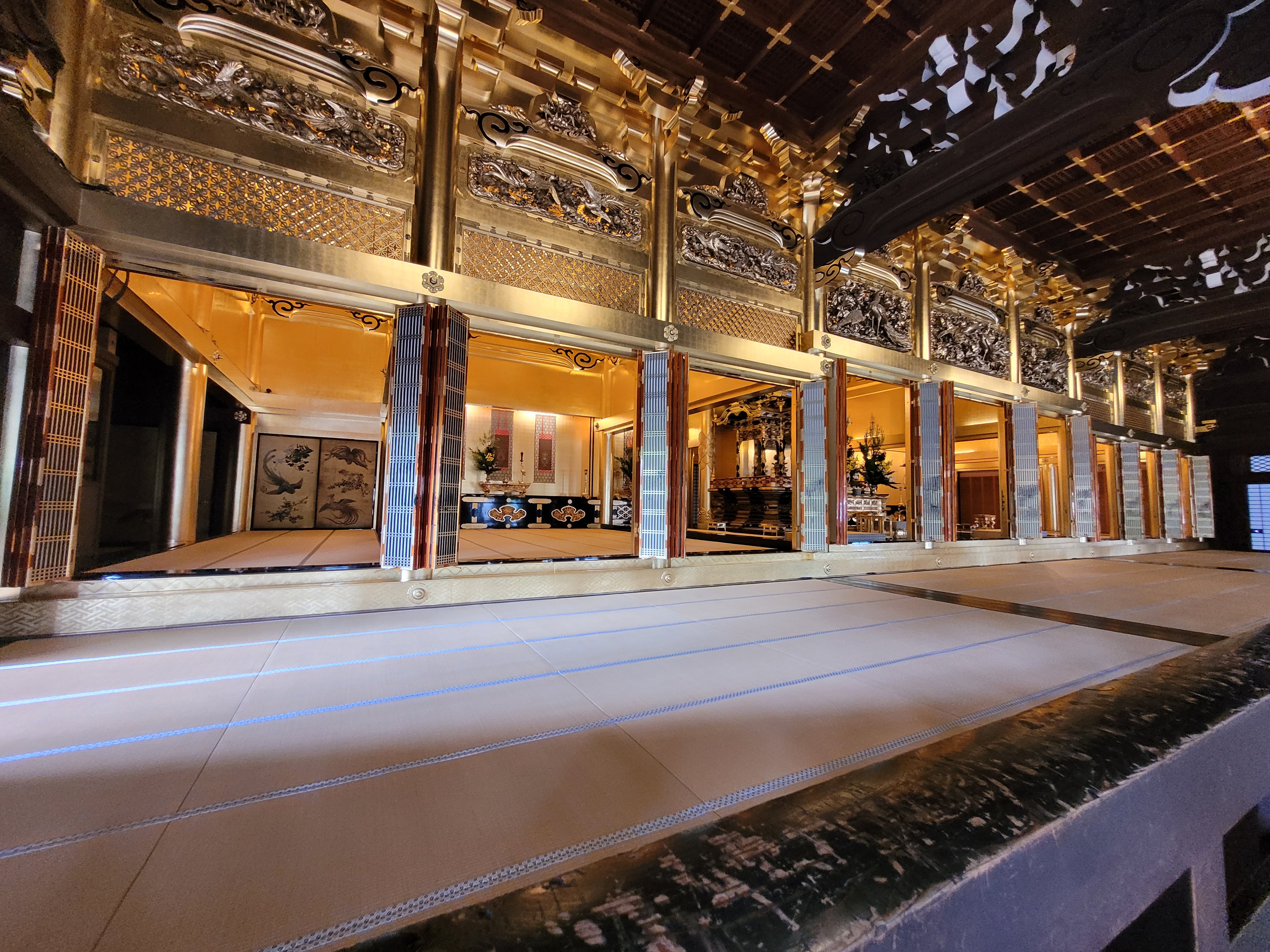
Since only a few adherents slid out of their shoes and padded in to sit in the sanctuaries on chairs or on the floor mats, heads bowed, there was barely any traffic. So I joined them. It is very nice to sit for a while in a temple, thinking one’s thoughts, being peaceful and still. It smells nice and occasionally someone dings a bell. Other than that, not much happens. You can do some nice deep breathing in your lungs, or some remembering in your head, for as long as you can do the sitting still part. I had no idea how long I sat in the temple, which means I probably did it the right way.
It is often a tourism reality that while one specific location gets deemed unmissable and so is always packed with visitors, other nearby visit-worthy spaces just don’t get the same attention. Higashi Hongan-ji has been very quiet every time I have stopped by to breathe the sandalwood air and work on my sitting still.
Temple Gardens Are Worth The Ticket Price
As religious sites can’t charge an admission fee but need to make some money to keep the lights on, some have gardens for which they do charge a fee. Higashi Hongan-ji has a garden just a 10- or so minute walk away from that enormous gravel-lined courtyard, if you head to the east. The garden turns out to be a stunning walled oasis in the city.

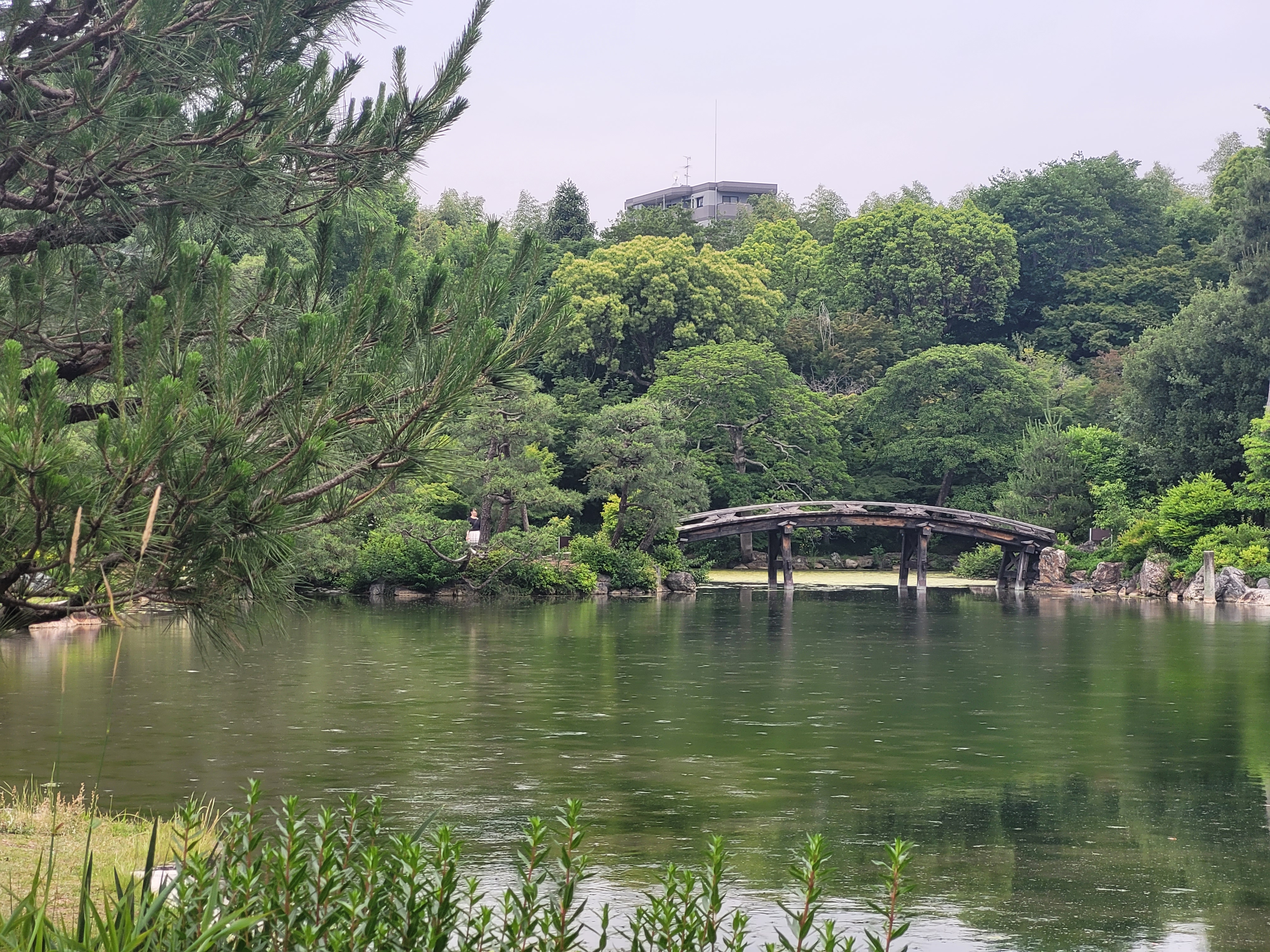


You pay 800 yen to enter, which is about $5.40 at the moment, and can stay as long as you want watching the herons, peering into the lake at the water bugs skittering across the surface, observing turtles and ducks, walking across intricate bridges, and investigating many styles of tea houses set in different landscaped corners of the grounds.
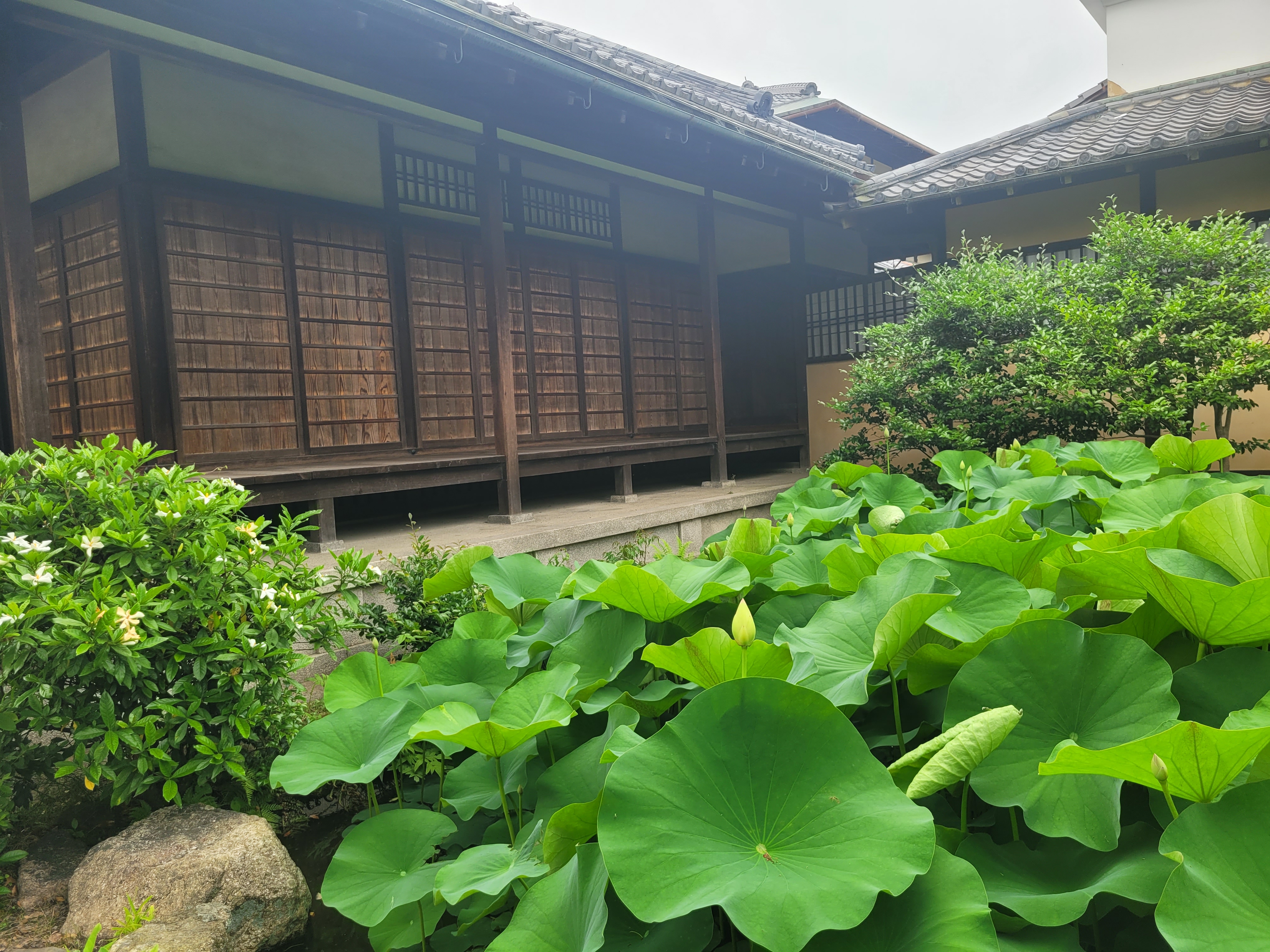
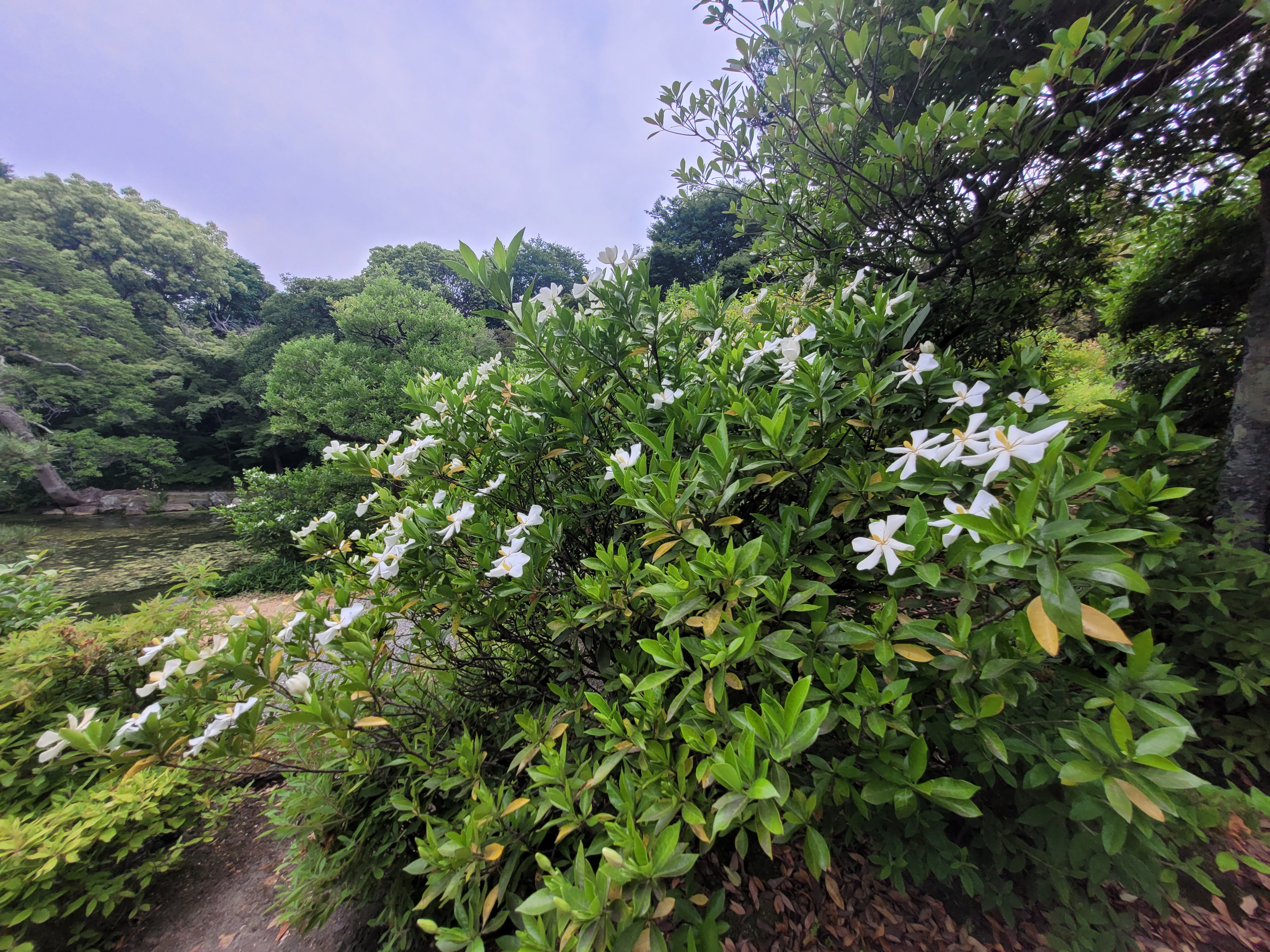

When I went the hydrangeas and gardenias were in full bloom, and the large-leafed lotuses were setting huge buds to open soon. And of course the garden was empty. All the tourists were elsewhere.
Location Card-Nation Narration
Some time before I knew I’d be coming to Japan I signed up for the 2025 Cascadia Poetics Lab Poetry Postcard Fest. It was founded by poets Paul E. Nelson and Lana Ayers in 2007, and today the Lab runs online writing workshops, podcasts about poetry, and a poetry festival, too. For the postcard thing you send in $15, and come August you get a list of people and you send each one a postcard with a poem. And they do likewise.

I sent mine! “35 stamps, please!” in Japanese is “San-juu-go kitte, kudasai!” and an international postcard stamp costs 100 yen, which is 68 US cents. I sent 35 postcards, each with an original haiku. Because I am in Japan, and haiku are Japanese. Location.
The above are actual postcards I sent, with the poets’ details blotted out for privacy, as well as the texts of the haiku I sent — this is according to the Poetry Festival rules, that the poems are embargoed till they have all been sent and received, so I believe my postcard poetry is embargoed till sometime after August.
The ethos of this postcard event is that one should try to compose a new poem each day for a new postcard, and send them day by day, all month. It is billed as “An annual 56-day self-guided workshop in spontaneous composition and community-building,” which I think is pretty apt. The main focus is to compose each day and just write that poem down.
Location, for the Poetry Postcard Fest, is in the moment.
Now, I have been seeing each one of my haiku as a sort of meta poem, an investigation into the haiku form (5 syllables, 7 syllables, 5 syllables) which I think intentionally raises the question of the role of location in composition: Is my haiku actually more authentic for being composed here in Japan? And what is authenticity, even?
So for me, location with regard to my poetry postcards is about: Location.
My festival postcards from other poets will be drifting in all month and beyond, stacking up back in Fulldelfia with the rest of my many months of mail. I have plans to share these postcards with students when I return. Meanwhile, if this sounds like the best kind of fun ever, as it did to me, you can read about the festival at that link above, and even sign up soon for 2026.
They have statistics about the current festival — 493 poets from 8 countries, not counting me in Japan, 42 US states and 4 Canadian provinces! And there are blog posts about the festival, interviews with writers, and links to poetry-writing exercises and suggestions. It is all very inspiring and I highly recommend a visit.
~~~~~~~~~~~~~~~~~~~~~~~~~~~~~~~~~~~~~~~~~~~~~~~~
[If you are still in a reading mood, there is often more to read over at this part of the blog: Extras to Read All About: Japan 2025. I added more there recently. Because it is a Page (instead of a Post) it just keeps getting longer as I write more, and you have to scroll down to the newer part, but I assure you it is worth the journey.]


Leave a Reply