
It’s a Small World. Laughter, All.
This is an Extra Bonus Blog Post for everyone.
As the autumn term gets underway here in Kyoto, Japan, with its meetings and new readings and assignments to map out, I am sharing a never-before-published post from my sabbatical time in Rome during March and April 2024. I had banked it for a busy time like this.
All of the Italy blog posts may be worth a visit if you have not read them. I have been informed by someone not even on my payroll that the Italy blog posts are both “mildly engaging” and “not a total waste of time.” They start here: Home in Rome and they cover some bicycling, okay, a lot of bicycling, and a 2-week stay at the wonderful Artisa Writers and Artists Retreat near San Severino.
And now I hereby dedicate this Extra Bonus post to my Bryn Mawr College pal, Farar Elliot ’87, who as the Curator of the US House of Representatives since 2002, and Chief of the Clerk’s Office of Art and Archives, knowns better than most the nexus of writing, history, things that are bonkers, and of course, coffee.
It’s a Small World. Laughter, All.
The theme of my blog post today is exploding coffee pots.
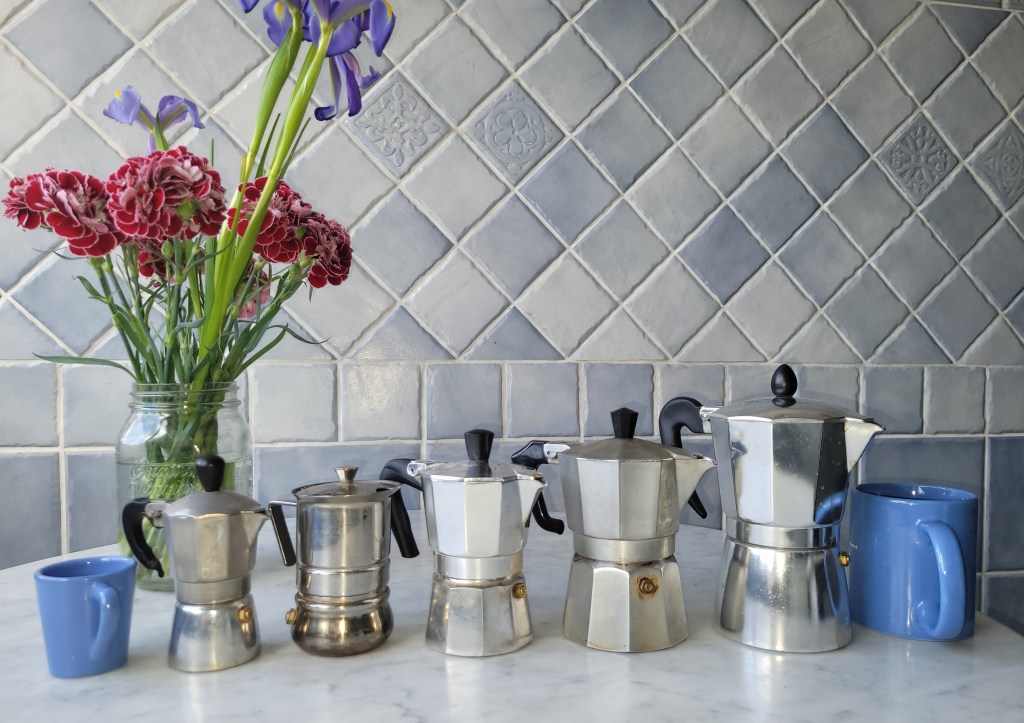
But first I’d like to start with a free book about hotels from 1972.
It is, and I really do mean this, the funniest book in the world.

The book is called A Hotel Is A Place… and from what I know, which could be entirely wrong, it was commissioned by Conrad Hilton of Hilton Hotels in the early 1970s, and for a period which I argue was the absolute pinnacle of human culture which will never be repeated, it was provided free to guests, alongside the usual Gideon Bible in Hilton hotel rooms. Guests were welcome to take either or both books home.
The author is the US comedian Shelley Berman, born Sheldon Leonard Berman in Chicago in 1925. In addition to performing in and writing stage comedy, theater, and films, Berman played Larry David’s father on the tv show Curb Your Enthusiasm. Berman died at the age of 92 in 2017.
In 1973 my late mom attended a women’s rights convention somewhere in the distant Midwest (St. Louis? Bloomington? St. Bloomington? I had never been to the Midwest) and stayed in a Hilton Hotel for several days. She did not bring home her Hilton Gideon Bible.
She brought home the Berman, and she gave it to me. Not to my brothers to share, but to me. (There may have been some conflicted interpretations of this sequence of events at the time, but I distinctly remember that the book was mine.) I immediately read it cover to cover, dying with laughter. Falling out of bed with laughter. Curled on the floor with laughter.
The book is a series of mini-essays and comic vignettes about the things that can happen when you stay in an hotel. The tone roles along the range of satire, from curious to sarcastic to scathing. Berman is in no way complimentary to hotels, only focused on the many aspects of a stay that can go disastrously wrong: misunderstood room service orders, a closet of weird hookless hangers, overly enthusiastic housekeeping visits, and the lurking myriad unavoidable staff expecting yet another generous tip.
I saved my copy, kept taping it back together, and had it at hand many years later when my son and I embarked on a life of happy hotel stays.
We stayed at the Red Caboose when he was two, a hotel made entirely of train cabooses, and later at the Fulton Steamboat Inn Hotel, built to look like a river paddleboat, both in Lancaster, PA. We stayed in a Howard Johnson’s motel only because driving by we’d spotted that it had water slides exiting and re-entering the building, and after a phone call established that only residing guests could use their vast indoor Caribbean-themed water park, we moved in and spent two entire days swimming and floating around the fabulous indoor lagoons.
We got ourselves on the last-minute list at the fancy downtown Philadelphia Loew’s Hotel at 12th and Market Streets; they sent emails on Thursdays for hugely-discounted weekend stays to avoid having empty rooms, which meant we sometimes stayed an entire weekend for super-cheap in an art-deco top-floor room, with a private lounge with free breakfasts and cocktail-hour snacks served only for top-floor guests. We discovered their hotel room service included the loan of large-scale toys for the weekend, so we ordered giant toy dinosaurs and Lego kits. We read books in the top-floor private library, watched free movies, and dined on discounted bar snacks in the lobby bar, while we watched the crazy world parade by outside.
We shared many hotel adventures over the years, and we always brought along Shelley Berman’s A Hotel Is A Place… to read aloud. We’d take turns reading the essays, doing all the voices, ordering some room service snacks, and having a fine old time. To this day, we still use some of Berman’s phrases in our texts and conversations, as a sort of private language.
Because even if it isn’t very far from your home, a hotel is a great vacation. Even in a very small world, a mom and a son can have a bonkers good time together.
These days you can sometimes find a copy of Berman’s book for sale online, but it can also be accessed free here: A hotel is a place .. : Berman, Shelley : Free Download, Borrow, and Streaming : Internet Archive. You just have to make an account, and read away! You are very welcome.
Today I wish to draw some attention to Berman’s piece on the hotel housekeeping experience. Although I first readily acknowledge that his exquisite disquisition on a hotel shower’s inevitable Wayward Shpritzer is also incredibly funny and memorable: “Hotels have several methods for flooding your bathroom floor but their favorite is the ‘WS’ or ‘Wayward Shpritzer’” (76).
And he dispenses multiple valuable nuggets of wisdom throughout: “In the dark a closed toilet lid is not exactly a sleepy man’s best friend” (85).
But it is the mounting suspense of the epistolary chapter, “A Hotel Is A Place… That Gives Free Soap,” that I want to focus on here today. The chapter is a dramatic tale told in correspondence (“epistolary” is a story entirely told in exchanged letters and notes) between Berman himself and a series of housekeeping staff. Some hilarious miscommunication results in Berman’s acquiring 54 small bars of individually wrapped Cashmere Bouquet, Camay, and Ivory soaps in the first 6 days of a two-week stay at the fictional Briney-Hiverly Hotel, when all he really wants is the bar of bath-sized Dial he brought with him, and which has now disappeared.
Something a bit similar occurred when I was staying at the Zip Hotel in Seoul during the South Korea chapter of my sabbatical travels, but there I had pretty much no communication with housekeeping staff, due to the language barrier, since my Korean vocabulary ran from “Hello” to “Thank You,” and then stopped abruptly at the words required to order fresh fruit encased in a hard sugar shell on a stick. Instead, many Zip Hotel-provided cosmetic and hygiene items just showed up and then disappeared in a very irregular fashion. I ended up with a lot of toothbrush-and-toothpaste kits and a lifetime supply of hair spray, while my scrubby shower cloths kept disappearing until I started ingeniously hiding them.
Which brings us finally to the start of today’s topic, namely Exploding Coffeemakers, and how I ended up with an entire shelf of Moka Pots in my Rome kitchen.
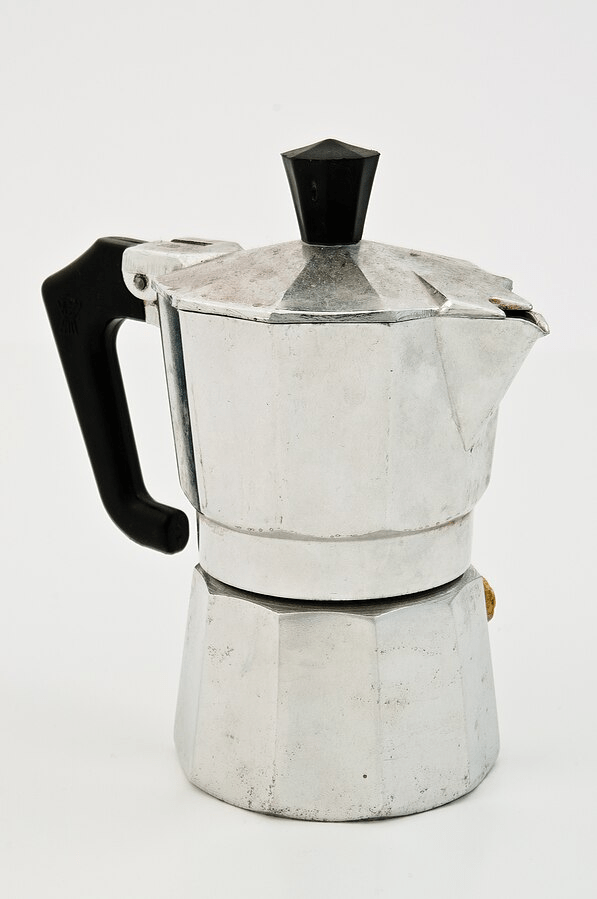
This is a Moka pot. The Moka pot was invented by the Italian engineer Luigi Di Ponti in 1933, who sold the patent to Alfonso Bialetti, who built a still-going Italian empire of Moka pots and other coffee-related things. In Rome one day I biked past a very fancy Bialetti boutique on the posh Via del Corso.
(Image info: Medvedev, CC BY-SA 3.0 https:// creativecommons. org/licenses/by-sa/3.0, via Wikimedia Commons.)
I started with two pots, the two which came with the apartment when I arrived. My inquiry to the landlady regarding “How does one make coffee here?” resulted in her bringing to my immediate attention two Moka pots on a shelf above the kitchen sink, a tiny 2-cup Moka, and an even teensier 1-cup Moka.
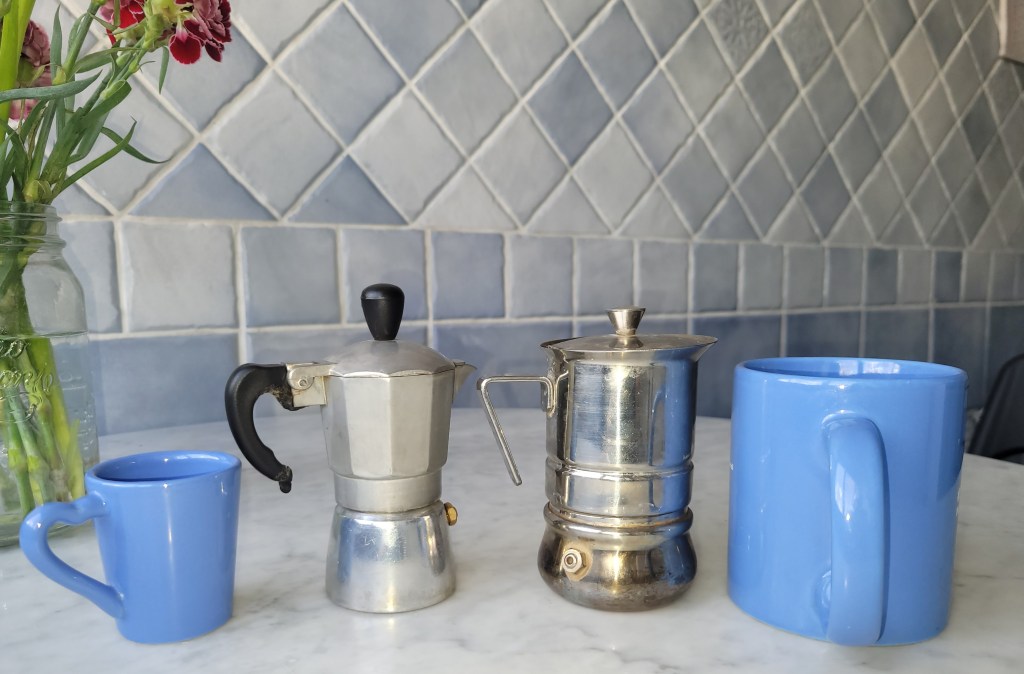
Yeah, right.
Now I cannot type fast enough here that the fine Italian tradition of a nice jolt of caffè, in the form of an espresso, is a fine Italian tradition! Which I am not knocking! At all!
But I come from the fine American tradition of something which takes a little longer to drink first thing in the morning.
A long drink, in other words. A cup of coffee.
There was, of course, the option to make an espresso, add hot water to it, and drink the resulting Americano. An Americano is a long-standing mode of drinking coffee.
I have my doubts about the Americano. Is the cup of coffee I drink in the US really the same as a watered-down espresso? I lack empirical evidence to determine if this is true. So in the face of a complete lack of empirical evidence, I will just do what I always do, which is to assert my unwavering opinion: No Way.
There is No Way that a cup of coffee in the US is the same as a watered-down espresso.
Also, what is the exact recipe for a watered-down espresso?
How much water can go into an espresso before you have produced brown water instead of coffee?
And how much before you have the equivalent of what Linus served to Charlie Brown in the Peanuts cartoon strip as “coffee,” which Charlie Brown spat out, spluttering, “What is this?” and Linus replied, “Hot water with a brown crayon stirred in.”
So the weeny piccolini Moka pots, adorable as they were, were not going to be making me any breakfast coffee. I needed a new larger Moka pot. I went to the very nearby hardware shop, which is past the organic produce shop and the gelateria on a curved side-street, and proceeded to make a major Italian communication error of my own while purchasing a Moka pot.
At first it all went fine, with the very business-like proprietor taking several Moka pots out of their boxes to show me various 2- and 3-cup versions. I said I thought I needed a 3-cup Moka pot, and I really was doing pretty well, until I pointed to one of the 3-cup Moka pots, and announced that I liked this one because the design was so modern, and the all-business proprietor gave me the oddest look, as he packed away all the other Moka pots, and I cringed inwardly and said to myself, “Gotta go easy on the whimsy.”
I was not aiming for whimsy at all. This was completely accidental whimsy. I employ words in Italian for one reason and one reason only: because I happen to know them. I only ever deploy the words I know. And I happened to know the words for “design” and “modern,” so I went and deployed them. But sometimes it is best to stick strictly to business when the business is purchasing a Moka pot at the hardware store. No flourishes. Just business.
I went home with my new moderna 3-cup Moka pot, only to discover, after heating water through it a few times to get it ready, and then loading it with coffee and carefully not tamping down the coffee too much in the part where you put the coffee, although aggressive tamping is always so tempting, that a 3-cup Moka pot makes what is still a pretty petite measure of coffee.
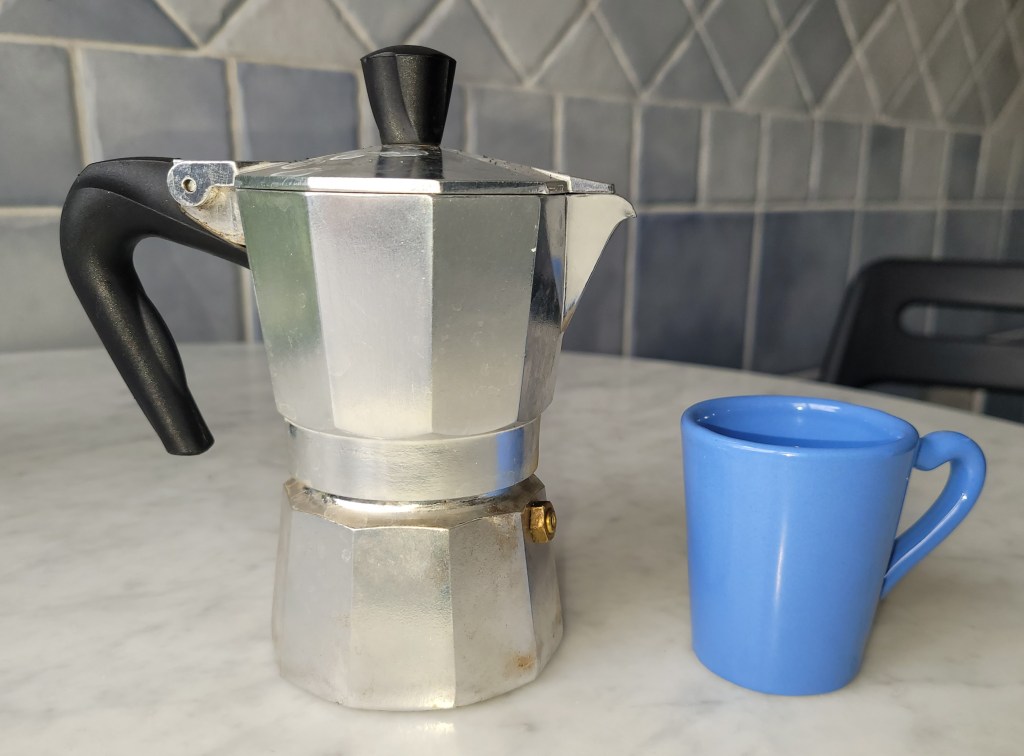
A delicious, but bijou, cup.
I needed to make coffee twice with it some mornings. And not that I have anything better to do, but it seemed to be a bit of a coffee-making production.
So you can imagine the thrill when, poking around one day shortly thereafter in the vast underground cave of treasures that is the local Garbatella neighborhood second-hand market, I came across a used 4-cup Moka pot for only 2 Euros.
A bargain. An already broken-in Moka pot.
I brought it home with great excitement, pondering the ways it was a Moka pot with history and legacy, which had no-doubt churned out countless substantial measures of delicious coffee!
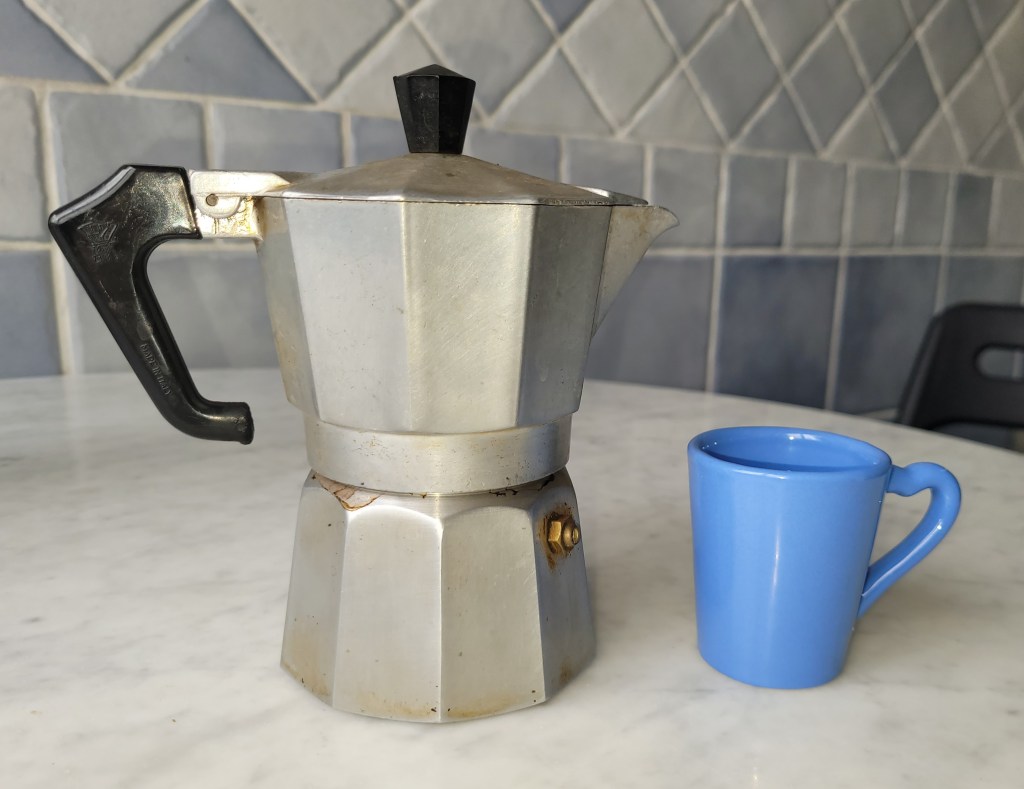
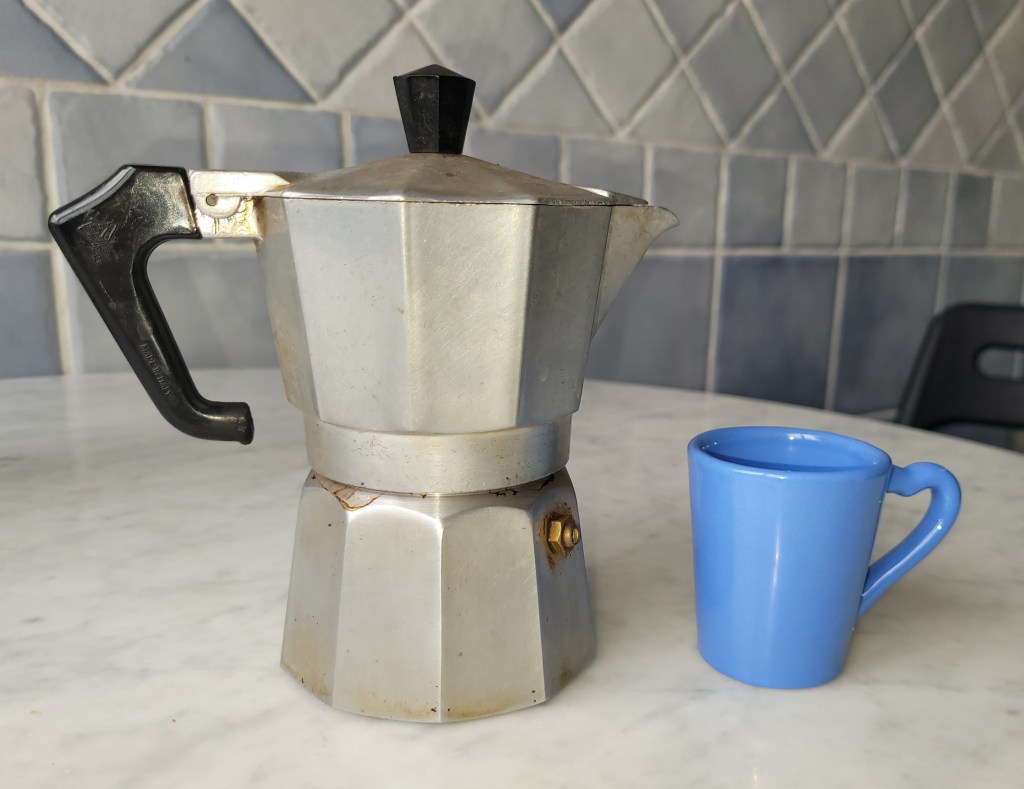
I ran a few cycles of water through it, and proceeded to load it with coffee and water and set it on the burner. And it proceeded to spit coffee all over my stove.
The next morning I tried screwing the top to the bottom much more tightly. That worked well for maybe two mornings. Then it resumed spitting.
Next I purchased a new rubber gasket for it, having decided that maybe this was a gasket problem. Local supermarkets in Italy often have a rack of replacement Moka pot parts, so I was rather proud that I was now participating even more deeply in the Italian tradition and legacy of Moka pots, prying the worn rubber ring out and adding the new rubber ring around the metal part that filters the coffee from the coffee grounds as the hot water vaporously jets upwards from the bottom of the heated pot.
That worked perfectly.
I was now a successful coffee engineer!
For two entire days.
Then the pot began respluttering coffee across the stove. Now I’d stand close watch over the pot, snatching it off the flame before it could do any spluttering, and quickly pour whatever amount of coffee had been made into my cup. I was now back to drinking an entirely insufficient measure of morning coffee.
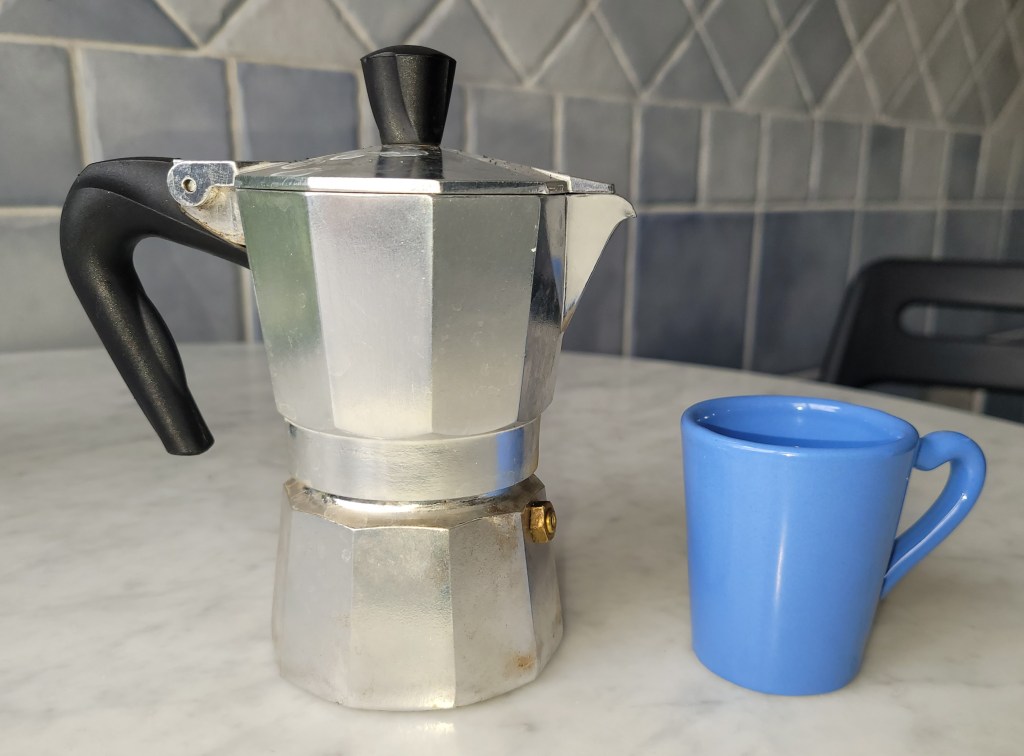
Until the day I did what I am most prone to doing, my habit, my Modus Operandi or MO, my inevitable way:
I wandered off.
I was in the living room tapping away happily on my computer when I heard BANG! from the kitchen, and raced in to find that the Moka Pot had exploded coffee everywhere. The pot did not blow apart, it just BOOM!ed and spewed.
A coffee volcano. Moka Loa had erupted in my kitchen.
I said some swear words, cleaned everything up, said a few more swear words, and headed across the street to Bar Mimmo for a nice soy cappuccino and some peace.
But me being me, I of course loaded up the same Moka pot the next morning with water in the water part, and coffee in the coffee part, I guess to see if maybe the pot wouldn’t explode.
It exploded.
Only this time I was standing nearby, and while I avoided getting sprayed with any of the lava flow of scalding coffee, the BANG! startled me out of my skin.
I cleaned up the mess, and again returned to Bar Mimmo, this time for a nice soy cappuccino and a cookie. I do not like being startled out of my skin. And the Bar Mimmo does a very nice cookie.
The next morning I started my day with a soy cappuccino over at Bar Mimmo, and then went and bought a new Moka pot — if you are counting, I am now up to five — from one of the market stalls in the local market behind Bar Mimmo. The proprietor there is a very nice man and extremely patient with my Italian. I had previously stocked up on housewares at his housewares stall: tupperwares, scissors, aluminum foil, some glasses, a spatula. I had noticed then that he carried Moka pots.
On this visit he listened to my entire dramatic saga, with patience and even what appeared to be actual interest, as I carefully tried out some of the brand new vocabulary words I’d learned so I could share these events with the wider world.
La Moka è esplosa. Un’esplosione. Ha sputato caffè.
The Moka exploded. An explosion. It spat coffee.
La guarnizione. The gasket.
Ho sostituito la guarnizione. I replaced the gasket.
And I was so thrilled to realize that I already knew another way to describe a gasket: Un anello di gomma. A rubber ring.
The man at the market stall laughed out loud when I described the coffee volcano, and said, I think you have made something good out of something bad, by learning all these new words, and making it funny.
He only had one Moka pot in stock, a much larger 6-cup model, which I had already decided to buy, even though what I had in mind initially was another 4-cup. But we agreed that even with a 6-cup Moka pot I could still opt to make a smaller amount of coffee some mornings, and that the absence of explosions and volcanoes, pretty much guaranteed with a brand new pot, would be a definite advantage in acquiring this particular model.
Like Shelley Berman with his array of soaps in A Hotel Is A Place…, I now carefully line up my impressive Moka pot inventory, making sure that each one is clean, free of dust, and not going to fall off a shelf. At the end of his chapter, Berman has presented a wry take on how sometimes we can find the comforting humor in situations seemingly beyond our control. And he has purchased a brand new bar of bath-sized Dial soap, and locked it in the hotel safe.
And I have already eyed up new potential storage spaces in my Roman kitchen, should my Moka collection expand with a BANG.
~~~~~~~~~~~~~~~~~~~~~~~~~~~~~~~~~~~
(And as ever, there is still more to read over at the regularly updated page, Extras To Read All About. Which is dedicated to absolutely everybody.)


Leave a Reply